Join Our Lunch & Learn: How Agentic AI Will Transform Industrial Operations | Register Now →
.svg)
July 6, 2026
5 Mins
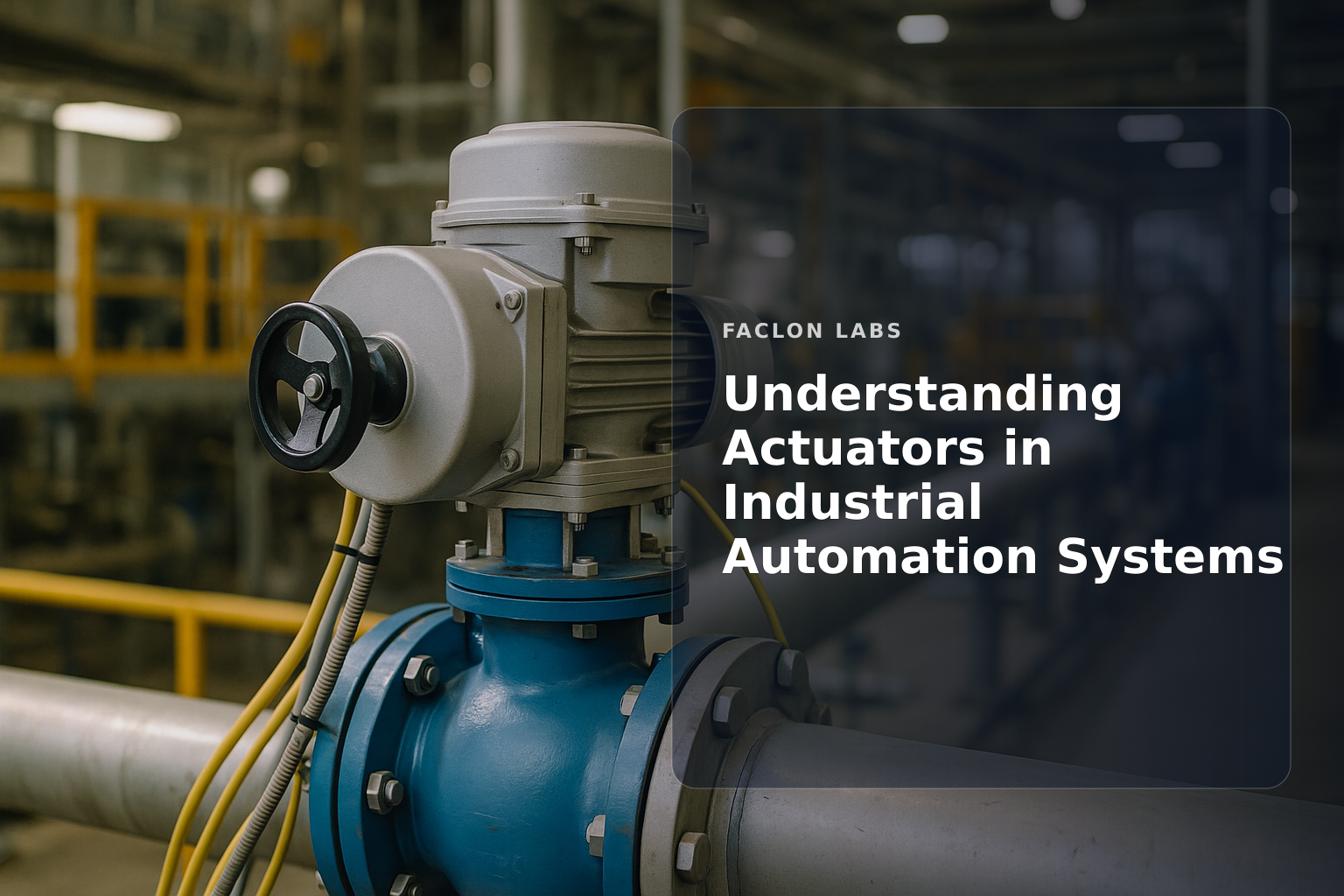
Industrial automation relies heavily on devices that can physically move or control machinery components to perform tasks without human intervention. Actuators serve this critical role by transforming various forms of energy into mechanical motion, driving valves, levers, or other mechanisms. Understanding actuators is foundational for plant operations leaders aiming to optimize manufacturing efficiency and integrate predictive maintenance strategies.
An actuator is a mechanical device that receives energy inputs—commonly electrical current, compressed air, or hydraulic fluid pressure—and converts that energy into motion. This motion can be linear (straight-line) or rotary (circular), depending on the actuator’s design and application. Actuators are essential for executing commands in automated systems, physically moving parts to desired positions.
Think of actuators as the “muscle” within industrial automation. Just as muscles contract to move limbs, actuators generate force, torque, or displacement to move machine components. This capability enables precise control over processes such as opening valves, positioning robotic arms, or adjusting conveyor belts.
Without actuators, automated control systems would remain theoretical, unable to physically interact with machinery. They bridge the gap between digital control signals and tangible mechanical movement, enabling tasks that require speed, accuracy, and repeatability beyond human capability.
Actuators operate by converting input energy into mechanical motion. Electrical actuators use motors to generate rotational or linear movement. Pneumatic actuators harness compressed air pressure to drive motion, while hydraulic actuators rely on pressurized fluid for high-force applications.
Control systems send signals to actuators to dictate their movement. These signals can be simple ON/OFF commands or complex instructions specifying position, speed, or force. The actuator responds by adjusting its output accordingly, enabling automated, precise control.
Many industrial actuators incorporate feedback sensors—such as encoders or potentiometers—that report their position or status back to the control system. This feedback loop allows for closed-loop control, ensuring actuators reach and maintain exact positions necessary for process accuracy.
Electric actuators use electric motors to create motion. They are favored for their precision, ease of integration with digital controls, and clean operation without fluids. Rotary electric actuators rotate shafts or gears, while linear electric actuators convert motor rotation into straight-line movement, ideal for tasks like valve positioning or lifting.
Pneumatic actuators utilize compressed air to generate motion. They offer fast response times and can produce significant force relative to their size. Common in environments requiring explosion-proof or clean operation, they excel in valve automation and clamping mechanisms.
Hydraulic actuators provide extremely high force output by using pressurized liquids. They are suited for heavy-duty applications such as presses, lifts, or large valve controls where electric or pneumatic actuators might lack sufficient power.
Mechanical actuators use gears, cams, or levers to produce motion directly from mechanical inputs. Smart actuators integrate sensors and communication capabilities, allowing real-time monitoring and adaptive control—key for modern IIoT systems.
Linear actuators create motion along a straight path, commonly used for pushing, pulling, or lifting. Examples include opening and closing valves, adjusting machine slides, or controlling dampers.
Rotary actuators produce circular motion around an axis, suitable for turning valves, rotating robotic joints, or driving conveyor rollers.
Choosing between linear and rotary actuators depends on the application’s motion requirements. Linear actuators fit tasks needing displacement along a line, while rotary actuators suit rotational movements. Understanding the mechanical demands is critical for optimal selection Understanding Actuators in Industrial Automation Systems.
When selecting actuators for industrial use, several factors must be evaluated to ensure reliable and efficient operation:
| Consideration | Description | Impact on Selection |
|---|---|---|
| Load Capacity | Maximum force or torque actuator can handle | Determines actuator size and power |
| Speed | How fast the actuator moves | Affects cycle times and process throughput |
| Travel Distance/Angle | Required range of motion (linear or rotary) | Dictates actuator stroke length or rotation |
| Environmental Factors | Exposure to heat, dust, moisture, chemicals | Influences material and sealing choices |
| Control Precision | Need for exact positioning and feedback | Necessitates sensors and closed-loop control |
Evaluating these factors early streamlines actuator selection and reduces costly redesigns Benefits of Automated Maintenance Services for Industrial Plants.
Modern industrial systems increasingly pair actuators with smart sensors and controllers, enabling real-time monitoring and adaptive control. This integration allows for precise adjustments and improved process reliability.
Actuators equipped with sensors can provide data on position, load, and operational cycles. Analyzing this data helps predict failures before they occur, reducing downtime and maintenance costs.
Intelligent actuators contribute to safer and more efficient plant operations by enabling automated emergency shutdowns, load balancing, and energy-efficient motion control. These capabilities support the goals of Industry 4.0 and digital transformation Generative AI Platforms: Capabilities, Applications, and Selection for Industrial AI.
Understanding actuators is fundamental for plant leaders seeking to improve automation outcomes. For detailed guidance on selecting actuators tailored to your application, explore our resources on Understanding Actuators in Industrial Automation Systems and Benefits of Automated Maintenance Services for Industrial Plants.
The main function of an actuator is to convert a source of energy (typically electrical, pneumatic, or hydraulic) into physical motion. This motion can be linear or rotary, allowing the actuator to move or control a mechanism or system within an industrial process.
The three main types of actuators commonly used in industrial settings are electric actuators, pneumatic actuators, and hydraulic actuators. Each type utilizes a different energy source and has distinct advantages for various applications, such as precision control, high force output, or operation in hazardous environments.
Actuators are fundamental to industrial automation by providing the physical means to execute commands from control systems. They enable automated processes like opening/closing valves, positioning components, clamping materials, and driving machinery, thereby transforming digital signals into tangible actions that streamline operations and improve efficiency.
A linear actuator produces motion in a straight line, pushing or pulling a load along a single axis. In contrast, a rotary actuator generates rotational motion, causing an object to turn around a fixed point. The choice between them depends on whether the application requires linear displacement or angular movement.