Join Our Lunch & Learn: How Agentic AI Will Transform Industrial Operations | Register Now →
.svg)
June 28, 2026
5 Mins
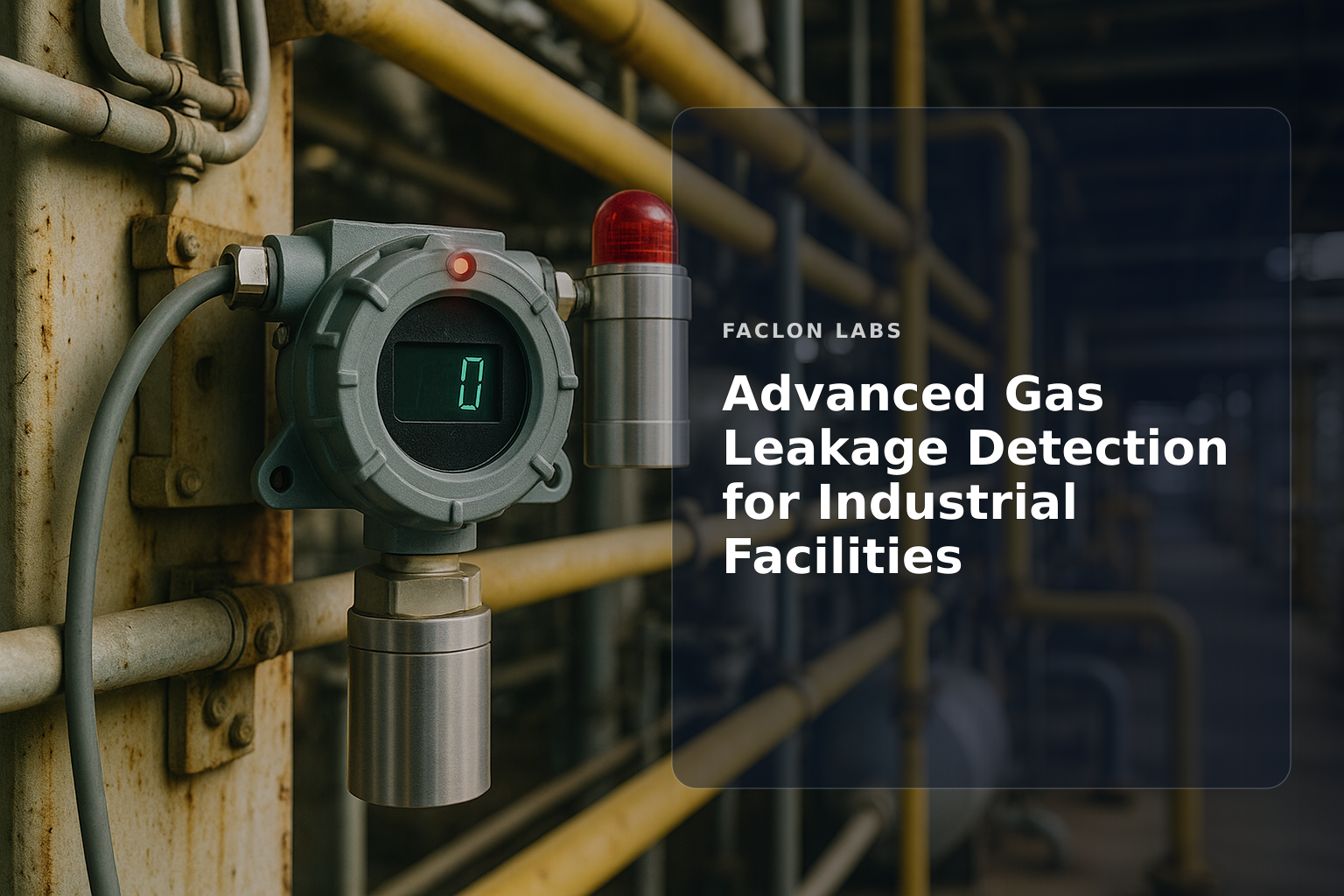
Industrial facilities face critical challenges in detecting gas leaks promptly to prevent safety hazards, environmental damage, and costly downtime. Traditional detection methods, often relying on portable or point detectors, fall short in providing continuous, comprehensive coverage. Modern solutions integrate Industrial Internet of Things (IIoT) technologies and artificial intelligence to deliver real-time, wide-area leak detection and actionable insights.
Implementing an advanced gas leakage detection system requires a structured approach that aligns sensor technology, data integration, and analytics with operational safety goals. This guide details the evolution of detection methods, a step-by-step implementation process, and key technologies driving superior performance in industrial environments.
Conventional gas detectors typically use point sensors or handheld devices that require manual operation or periodic checks. These methods suffer from limited spatial coverage, delayed detection, and dependency on personnel availability. False negatives and slow response times increase the risk of undetected leaks escalating into dangerous incidents.
Continuous monitoring systems deploy fixed sensors across critical locations, enabling persistent surveillance of gas concentrations. Wide-area systems use open-path sensors or networks of distributed detectors to monitor large zones, capturing leaks that point sensors might miss. This shift improves detection reliability and reduces blind spots.
Industrial IoT platforms connect sensors to centralized data systems, facilitating real-time data collection and remote monitoring. AI and machine learning algorithms analyze sensor data to identify leak patterns, filter noise, and reduce false alarms. These technologies enable predictive maintenance and faster emergency response, creating safer, more efficient facilities [Improving Gas Safety with Industrial IoT].
Begin with a thorough site assessment using Piping and Instrumentation Diagrams (P&IDs), HAZOP reports, and gas dispersion modeling software. Identify high-risk areas where leaks are most likely and map potential leak paths to prioritize sensor deployment.
Select sensors based on target gases and environmental conditions. Options include optical gas imaging (OGI) cameras for visual detection, ultrasonic sensors for pressurized leaks, and electrochemical sensors for specific gases. Place sensors to maximize coverage, considering:
Connect sensors via IIoT gateways to cloud or on-premise platforms, integrating with SCADA systems where applicable. Monitor metrics such as data latency and system uptime to ensure reliable data flow.
Deploy machine learning models to analyze sensor data streams, recognizing leak signatures and filtering out environmental noise. Track false positive rates and detection accuracy to refine algorithms continuously [AI-Driven Leak Detection Best Practice Trends].
Configure automated alerts via SMS, email, or sirens, and integrate with control systems for emergency shutdowns. Measure alert delivery times and response initiation to optimize safety procedures.
Implement remote diagnostics and predictive maintenance for sensors to detect drift and performance degradation. Schedule calibration based on sensor data trends to maintain accuracy and reduce downtime.
| Step | Tools & Technologies | Key Metrics |
|---|---|---|
| Site Assessment | P&IDs, HAZOP, dispersion modeling | Hazard coverage accuracy |
| Sensor Selection | OGI cameras, ultrasonic, electrochemical sensors | Coverage area, sensitivity, response time |
| Data Integration | IIoT gateways, SCADA, cloud platforms | Data latency, system uptime |
| AI Analytics | ML algorithms for pattern recognition | False positive rate, detection accuracy |
| Automated Alerts | SMS, email, sirens, control shutdown | Alert delivery time, response initiation |
| Maintenance | Remote diagnostics, predictive maintenance | Sensor drift, calibration frequency |
A chemical plant requires monitoring for volatile organic compounds (VOCs) and hydrogen sulfide (H2S), both hazardous gases with significant safety risks.
The facility installs a hybrid sensor network combining open-path infrared (IR) detectors for wide-area VOC monitoring and electrochemical sensors for localized H2S detection. Data streams feed into an AI-driven analytics platform that predicts leak events and filters false alarms.
This example demonstrates how combining sensor types and AI analytics can optimize leak detection tailored to specific industrial hazards [Reducing Risks in Petrochemical Plants].
Calculating the return on investment for advanced gas leakage detection involves considering:
| ROI Factor | Description | Impact Example |
|---|---|---|
| Incident Avoidance | Cost savings from preventing leaks and explosions | Millions in avoided damages |
| Insurance Premiums | Lower rates due to improved risk profile | 10-20% premium reduction |
| Operational Efficiency | Reduced downtime and optimized maintenance | Increased production uptime |
| Regulatory Compliance | Avoidance of fines and legal costs | Compliance with safety standards |
| Workforce Safety | Reduced injury-related costs and liabilities | Lower compensation claims |
Quantifying these factors helps justify investment in advanced detection technologies and continuous system improvements [HYCO Plant Gas Leak Detection and Response Practices].
Upgrading your facility’s gas leakage detection system is a critical investment in safety and productivity. Contact Faclon Labs to learn how our industrial AI and IIoT platform can help you implement a robust, AI-driven gas detection solution tailored to your operational needs. Benefits of Automated Maintenance Services for Industrial Plants Generative AI Platforms: Capabilities, Applications, and Selection for Industrial AI Understanding Performance Analytics for Manufacturing Operations
The primary advantage is the shift from reactive, localized detection to proactive, continuous, and wide-area monitoring. Advanced systems leverage IIoT sensors and AI to provide real-time data, predictive analytics, and faster, more accurate leak localization, significantly reducing response times and preventing incidents before they escalate.
AI algorithms analyze sensor data patterns to differentiate between actual leaks and environmental noise or false positives. Machine learning models can be trained on historical data to recognize the unique signatures of various gas leaks, improving detection accuracy, reducing false alarms, and even predicting potential failure points based on subtle changes in sensor readings.
Yes, modern advanced gas leakage detection systems are designed for seamless integration. They typically use open communication protocols (e.g., Modbus, OPC UA) and IIoT gateways to connect with existing SCADA systems, DCS, and plant safety systems, allowing for centralized monitoring, control, and automated emergency responses.
Facilities handling hazardous gases, flammable substances, or those with complex processes benefit most. This includes oil and gas refineries, chemical processing plants, petrochemical facilities, power generation plants, wastewater treatment plants, and any industrial environment where gas leaks pose significant safety, environmental, or operational risks.