Join Our Lunch & Learn: How Agentic AI Will Transform Industrial Operations | Register Now →
.svg)
June 27, 2026
5 Mins
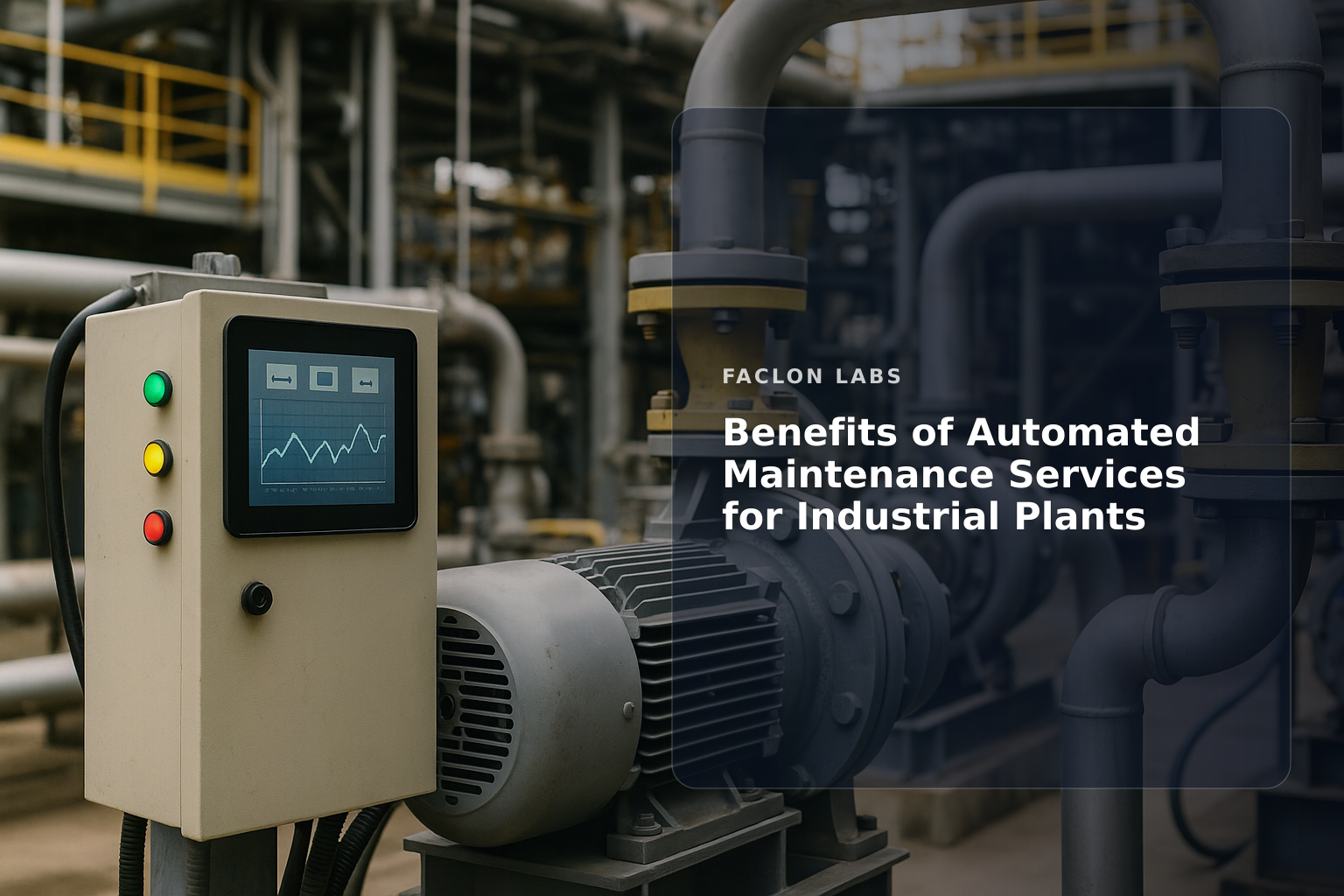
Industrial plants traditionally rely on reactive or scheduled maintenance, which often leads to unexpected downtime, high repair costs, and inefficient use of resources. Automated maintenance services transform this approach by leveraging industrial AI and IIoT (Industrial Internet of Things) to predict equipment failures before they occur. This shift not only improves operational efficiency but also delivers measurable business value through cost savings and enhanced safety.
As plant operations leaders seek smarter, data-driven ways to maintain critical assets, understanding the benefits and implementation of automated maintenance services becomes essential. This guide explores the core advantages, components, and practical steps for adopting automated maintenance in industrial settings.
Conventional maintenance often follows a break-fix or scheduled downtime model. Break-fix means repairs happen only after equipment failure, leading to costly unplanned outages. Scheduled maintenance, while preventive, can result in unnecessary downtime and replacement of parts still in good condition. Both approaches limit operational efficiency and inflate maintenance budgets.
Automated maintenance services use continuous monitoring and data analytics to anticipate equipment issues. Instead of reacting to failures, these services enable proactive interventions based on real-time equipment health data. This approach reduces unplanned downtime and optimizes maintenance schedules.
Industrial IoT sensors collect data such as vibration, temperature, and pressure from machines. AI and machine learning algorithms analyze this data to detect anomalies and forecast failures with high accuracy. Prescriptive maintenance goes a step further by recommending specific actions to prevent breakdowns, ensuring maintenance is timely and targeted Effective Production Line Monitoring with Industrial IoT.
Automated maintenance services enable early detection of equipment degradation, allowing maintenance teams to address issues before they cause downtime. Plants have reported up to 30% reductions in unplanned downtime, significantly improving production continuity and throughput.
By targeting maintenance activities only when needed, automated services reduce labor hours, spare parts usage, and emergency repair expenses. This precision maintenance lowers overall costs while maintaining asset reliability.
Continuous monitoring and timely interventions prevent severe damage, extending the useful life of expensive industrial equipment. Optimized maintenance schedules also ensure machines operate at peak efficiency, reducing energy consumption and wear.
Automated alerts and real-time dashboards help plant managers identify safety risks early, reducing workplace hazards. Additionally, compliance with industry regulations is improved through accurate maintenance records and consistent monitoring Generative AI Platforms: Capabilities, Applications, and Selection for Industrial AI.
| Component | Description |
|---|---|
| Sensor Technology | Vibration, temperature, pressure sensors collect real-time data |
| AI/ML Algorithms | Analyze sensor data to detect anomalies and predict failures |
| CMMS/EAM Integration | Connects predictive insights with maintenance management systems |
| Dashboards & Alerts | Visualize equipment health and notify teams of critical issues |
Sensors embedded on critical assets continuously capture operational parameters such as vibration frequencies, thermal readings, and pressure levels. This data forms the foundation for predictive analytics.
Machine learning models trained on historical and real-time data identify abnormal patterns indicating impending failures. These algorithms improve over time, increasing prediction accuracy.
Automated maintenance solutions integrate with existing Computerized Maintenance Management Systems (CMMS) or Enterprise Asset Management (EAM) platforms to streamline work orders and inventory management.
Interactive dashboards provide maintenance teams with actionable insights and status updates, while automated alerts ensure timely response to critical conditions Generative AI Platforms: Capabilities, Applications, and Selection for Industrial AI.
Begin by reviewing existing maintenance workflows, downtime causes, and cost drivers. Identify equipment with high failure rates or critical impact on operations.
Choose a platform that supports flexible sensor integration, robust data analytics, and easy CMMS connectivity. Deploy sensors strategically on assets with the highest risk or value.
Gather initial sensor data to train AI models tailored to your plant’s equipment. Calibrate thresholds and alerts to minimize false positives and maximize actionable insights.
Ensure maintenance teams are trained on using dashboards and responding to alerts. Incorporate automated maintenance outputs into daily planning and decision-making processes to realize full benefits.
Industrial plants adopting automated maintenance have documented:
| Metric | Typical Improvement | Impact on ROI |
|---|---|---|
| Downtime Reduction | 25-30% | Increased production and revenue |
| Maintenance Cost Reduction | 25-40% | Lower labor and parts expenses |
| Asset Life Extension | 15-20% | Deferred capital expenditures |
| Safety Incidents Decrease | 10-15% | Reduced fines and insurance costs |
Automated maintenance systems are scalable across multiple plants and adaptable to new equipment types. Their data-driven nature supports continuous improvement and integration with future digital initiatives Understanding Performance Analytics for Manufacturing Operations.
Select a partner with proven IIoT and AI expertise tailored to industrial environments. Evaluate platform flexibility, ease of integration, and quality of ongoing technical support.
Robust cybersecurity measures and reliable uptime are critical for protecting sensitive operational data and maintaining trust in automated systems.
Faclon Labs combines advanced AI algorithms with deep industrial domain knowledge to deliver automated maintenance solutions that drive measurable ROI and operational excellence. Our platform emphasizes seamless integration, actionable insights, and scalable deployment to meet evolving plant needs.
For plant operations leaders looking to improve reliability and reduce costs, adopting automated maintenance services is a proven strategy. Contact Faclon Labs to explore how our industrial AI platform can help your plant transition to predictive maintenance and realize tangible operational gains.
Automated maintenance services utilize advanced technologies like AI, machine learning, and the Industrial Internet of Things (IIoT) to monitor equipment health in real-time. They predict potential failures, optimize maintenance schedules, and automate tasks, shifting from reactive to proactive maintenance strategies in industrial settings.
These services reduce costs by preventing unexpected breakdowns, minimizing costly emergency repairs, optimizing spare parts inventory, and extending the operational life of assets. By predicting failures, maintenance can be scheduled during planned downtime, avoiding production losses and overtime labor costs.
Industrial plants with complex machinery, high production volumes, and critical uptime requirements, such as those in manufacturing, oil & gas, energy, chemicals, and mining, benefit most. Any plant where equipment failure leads to significant financial loss or safety risks can see substantial gains.
Predictive maintenance is a core component of automated maintenance services. While predictive maintenance focuses on forecasting equipment failures, automated maintenance encompasses a broader scope, including automated data collection, analysis, decision-making, and often, automated task initiation or scheduling, leveraging AI and IIoT for a comprehensive approach.