Join Our Lunch & Learn: How Agentic AI Will Transform Industrial Operations | Register Now →
.svg)
August 27, 2026
5 Mins
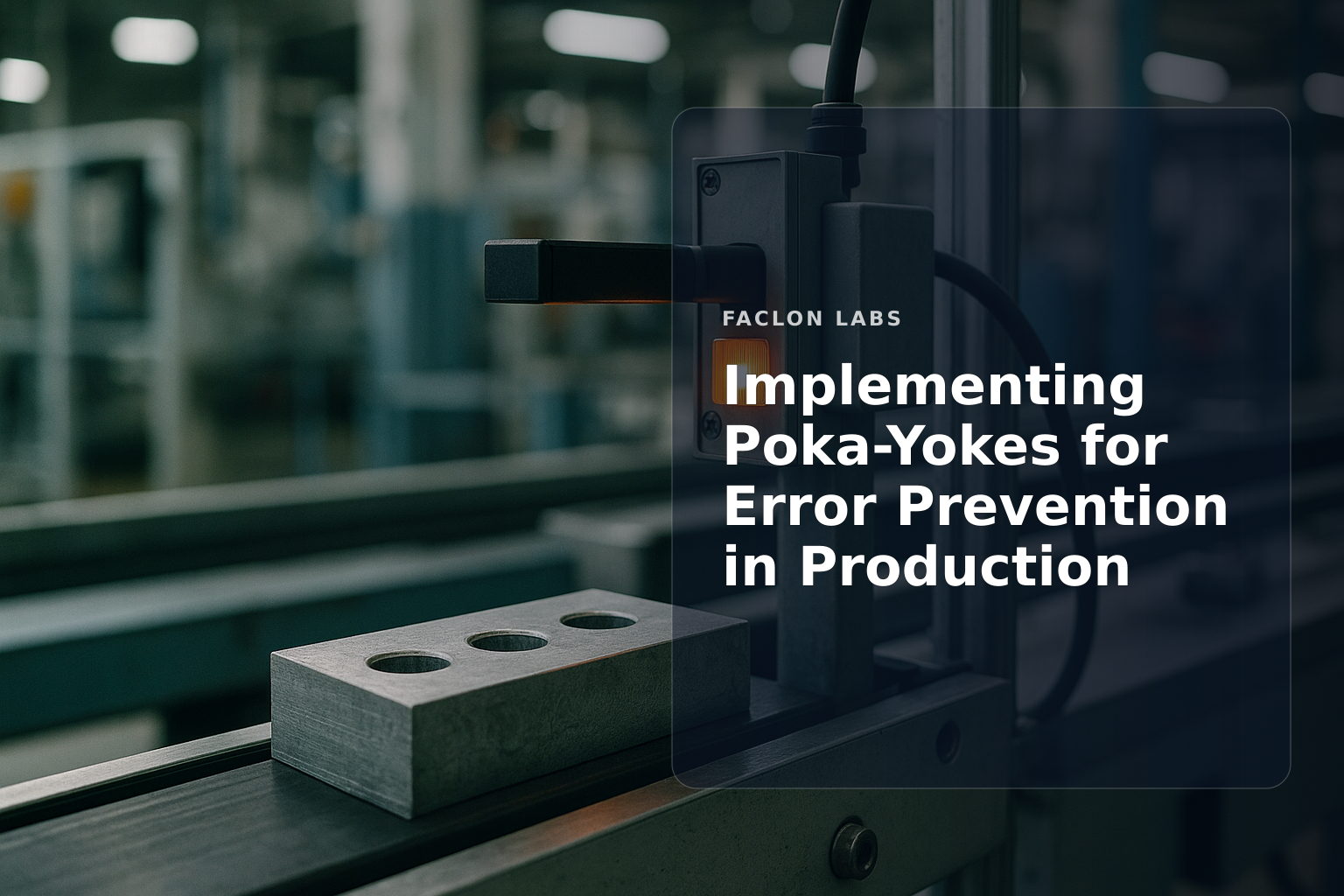
Error prevention is critical in manufacturing to maintain product quality, reduce waste, and optimize operational costs. Poka yokes, a concept developed within the Toyota Production System, provide practical solutions that directly address human error—the most common cause of defects and safety incidents on production lines. Understanding how poka yokes work and how to implement them can help plant operations leaders enhance process reliability without relying solely on inspection or rework.
The term poka yoke (pronounced poh-kah yoh-keh) comes from Japanese, meaning "mistake-proofing" or "error prevention." It was introduced as part of the Toyota Production System to systematically reduce human errors by designing processes and devices that either prevent mistakes from happening or make errors immediately visible.
Poka yokes are mechanisms, devices, or procedural steps integrated into production processes to either:
Unlike general quality control methods that detect defects after production, poka yokes focus on preventing errors at the source or catching them immediately.
While quality control often involves inspection and testing after a product is made, poka yokes embed safeguards within the process itself. This proactive approach reduces reliance on human vigilance and inspection, lowering defect rates and improving consistency [Quality Glossary Definition: Mistake proofing].
Human error accounts for a significant portion of defects, safety incidents, and inefficiencies in manufacturing. Implementing poka yokes directly addresses these issues by:
Poka yokes help create robust processes that sustain quality and operational excellence while reducing the burden on operators [Mastering Mistake-Proofing: Insights from Toyota's Poka Yoke Approach].
Poka yokes typically fall into three categories based on how they prevent or detect errors:
| Type | Description | Example |
|---|---|---|
| Contact | Detects errors by sensing physical contact or position | A fixture that only fits a part in the correct orientation |
| Fixed-Value | Ensures a specific number of actions or parts are used | Counting devices that verify a set number of components assembled |
| Motion-Step | Verifies the sequence of steps performed | Sensors that detect if a step in a process was skipped |
These poka yokes are often simple, inexpensive, and easy to integrate into existing workflows [Poka Yoke - A Resource Guide].
Simple poka yokes include:
Such low-cost solutions can have outsized impacts on quality and safety.
Start by mapping workflows and pinpointing where errors most frequently occur or could cause significant defects or safety issues.
Develop error-proofing devices or steps specific to the identified risks. Solutions should be:
This iterative approach ensures poka yokes remain effective and aligned with operational realities [Poka Yoke: error-proof processes | KAIZEN™ Article].
Operators may initially resist poka yokes if they perceive them as cumbersome or mistrust their purpose. Clear communication, involvement in design, and training help build buy-in.
Overly complex poka yokes can introduce new failure points. Focus on simplicity and reliability.
Regular audits and maintenance are necessary to keep poka yokes functioning as intended.
Integrating poka yokes with digital sensors and IIoT platforms enables real-time monitoring and data collection, further enhancing error detection and process transparency Generative AI Platforms: Capabilities, Applications, and Selection for Industrial AI.
Poka yokes are foundational tools in Lean manufacturing and Six Sigma for mistake-proofing processes and driving continuous improvement. They help eliminate waste caused by defects and rework.
By reducing downtime and defects, poka yokes contribute directly to higher Overall Equipment Effectiveness (OEE), a key metric for manufacturing productivity How to Calculate and Improve OEE in Manufacturing.
Poka yokes support the PDCA (Plan-Do-Check-Act) cycle by embedding error prevention into daily operations and providing feedback for ongoing process refinement Understanding Takt Time for Lean Manufacturing Efficiency.
They are essentially the same concept. "Poka yoke" is the Japanese term for mistake-proofing—designing processes or devices to prevent or detect errors immediately to avoid defects [Quality Glossary Definition: Mistake proofing].
Yes. Poka yokes are applicable in any process where human error can cause defects or safety issues, including healthcare, software development, and service industries.
By preventing incorrect operations or alerting operators to unsafe conditions instantly, poka yokes reduce accidents and ensure compliance with safety protocols.
Implementing poka yokes is a practical step toward error-free production and improved operational performance. Start by identifying your most error-prone processes and explore simple poka yoke solutions that fit your plant’s needs. For deeper insights on integrating poka yokes with IIoT and Lean practices, explore our related resources Generative AI Platforms: Capabilities, Applications, and Selection for Industrial AI, Understanding Takt Time for Lean Manufacturing Efficiency, and How to Calculate and Improve OEE in Manufacturing.
A poka yoke is a simple device or process designed to prevent human errors in manufacturing. It either makes it impossible to make a mistake or immediately alerts the operator when an error occurs, ensuring defects are avoided.
Poka yokes reduce defects by preventing mistakes before they happen or by making errors obvious right away. This leads to fewer reworks, less waste, and more consistent product quality.
Common poka yoke types include contact methods (detecting physical presence), fixed-value methods (counting steps or parts), and motion-step methods (ensuring steps occur in the correct order).
Yes, poka yokes can be combined with industrial IoT and AI systems to monitor processes in real time, provide alerts, and enable data-driven continuous improvement.
While most common in manufacturing, poka yokes can be applied in any process where human error can cause defects or safety issues, including assembly, packaging, and maintenance.