Join Our Lunch & Learn: How Agentic AI Will Transform Industrial Operations | Register Now →
.svg)
July 4, 2026
6 Mins
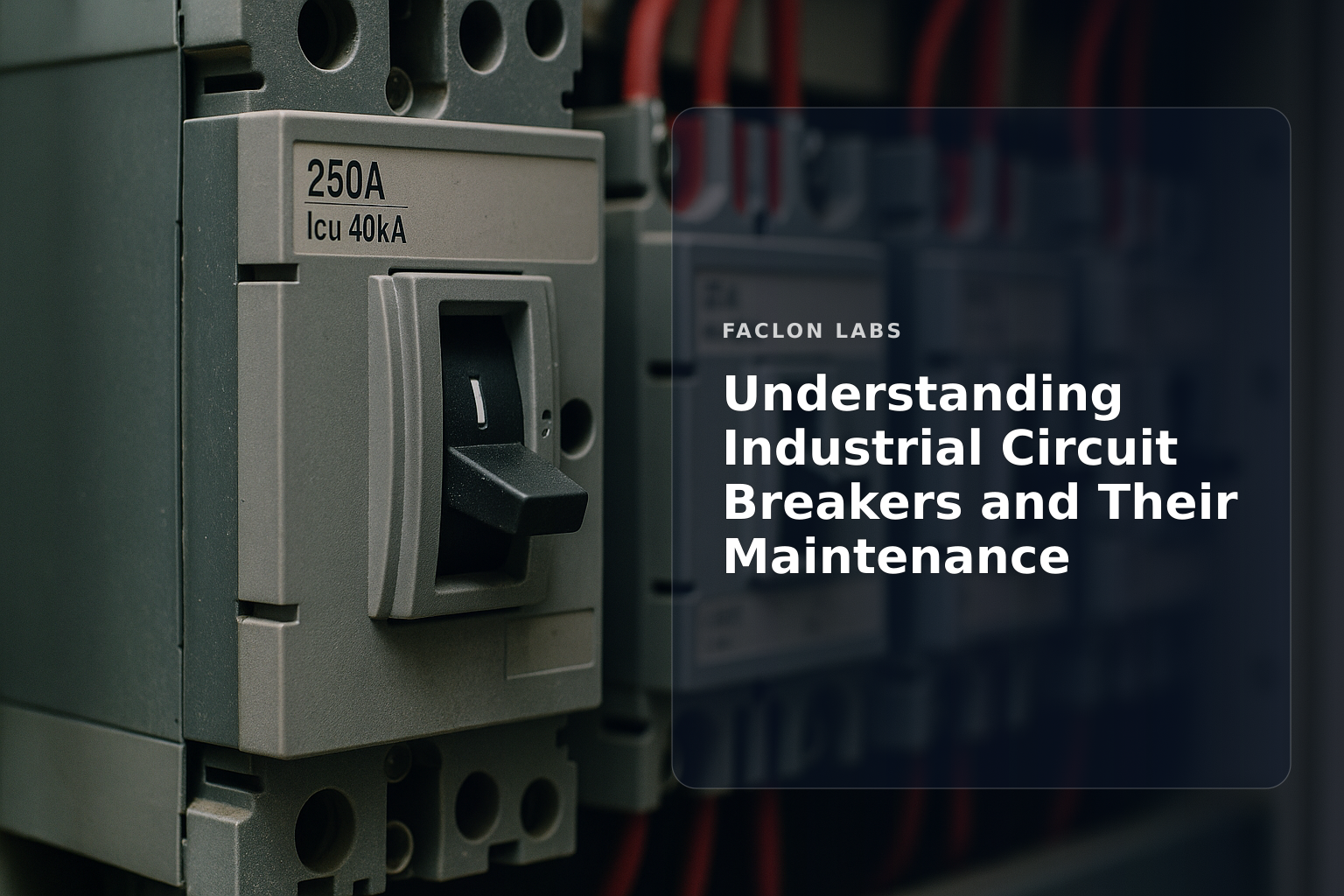
Industrial circuit breakers are critical components in manufacturing plants, power distribution, and other heavy-duty electrical systems. They serve as the first line of defense against electrical faults that can damage equipment, disrupt operations, or create safety hazards. Understanding how breakers function and how to maintain them is essential for plant operations leaders aiming to maximize uptime and safety.
This guide explains the fundamentals of industrial circuit breakers, their importance, types, operating principles, selection criteria, and maintenance best practices. It is designed to provide clear, practical insights for those new to the topic and help build a foundation for effective electrical system management.
An industrial circuit breaker is an automatically operated electrical switch designed to protect circuits by interrupting current flow when an electrical fault such as an overload or short circuit occurs. Its primary purpose is to prevent damage to electrical equipment and reduce fire risks in industrial environments.
Unlike a fuse, which melts and must be replaced after a fault, a breaker can be reset manually or automatically once the fault is cleared. This reset capability reduces downtime and maintenance costs, making breakers more suitable for industrial applications where reliability and fast recovery are critical.
Breakers prevent excessive current from damaging motors, transformers, and other costly equipment by interrupting power during faults.
By quickly disconnecting faulty circuits, breakers reduce the risk of electric shock and fire hazards in industrial facilities.
Fast fault isolation helps avoid widespread outages, allowing operations to resume quickly after incidents.
Industrial breakers are mandated by codes like the National Electrical Code (NEC) to ensure safe electrical system design and operation NEC Requirements for Overcurrent Protection — EC&M.
| Type | Voltage Range | Typical Application | Key Features |
|---|---|---|---|
| Molded Case Circuit Breakers (MCCBs) | Low to medium voltage | General industrial and commercial use | Adjustable trip settings, compact |
| Air Circuit Breakers (ACBs) | Low voltage | High current industrial power systems | High interrupting capacity |
| Vacuum Circuit Breakers (VCBs) | Medium voltage | Switchgear and distribution systems | Long life, minimal maintenance |
| SF6 Circuit Breakers | High voltage | Utility and large industrial systems | Excellent insulation properties |
| Residual Current Devices (RCDs) / Ground Fault Circuit Interrupters (GFCIs) | Low voltage | Personnel protection | Detect earth leakage currents |
MCCBs are versatile breakers widely used for low to medium voltage applications. They provide adjustable trip settings to protect circuits from overloads and short circuits.
ACBs are designed for high current applications and are often found in industrial power distribution panels. They use air to extinguish the arc when interrupting current.
VCBs operate in medium voltage ranges using vacuum interrupters to quench arcs. They are common in switchgear due to their durability and low maintenance needs.
These breakers use sulfur hexafluoride gas for arc extinction in high voltage systems. Their insulation properties make them suitable for utility-scale power distribution.
RCDs and GFCIs detect leakage currents to ground and trip quickly, protecting personnel from electric shock.
The trip unit continuously monitors current. When current exceeds preset limits, it activates the mechanism to open the contacts.
Opening contacts creates an electrical arc; the arc chute or vacuum interrupts this arc quickly to stop current flow safely.
Once the fault is cleared, the breaker can be manually or automatically reset to restore power without replacing components.
| Selection Factor | Importance | Notes |
|---|---|---|
| Rated Voltage | Must match system voltage | Avoid under- or over-rating |
| Rated Current | Should exceed maximum load current | Prevent nuisance tripping |
| Interrupting Capacity | Must handle potential short-circuit current | Critical for safety |
| Trip Curve | Defines time-current characteristic | Ensures coordination |
| Environmental Rating | Protects against physical and chemical hazards | Extends breaker life |
| Communication Features | Enables IIoT integration and diagnostics | Supports predictive maintenance |
Visual checks for signs of wear, overheating, corrosion, or physical damage help detect issues early.
Removing dust and applying appropriate lubricants maintain smooth mechanical operation.
Infrared cameras identify overheating components before failure occurs.
Advanced sensors and analytics enable real-time monitoring of breaker health, reducing unplanned downtime Benefits of Automated Maintenance Services for Industrial Plants.
Common causes include overloads, short circuits, and ground faults. Systematic diagnosis helps isolate the problem.
If a breaker does not trip when it should, it poses serious safety risks. Testing trip units and contacts is essential.
Signs include discoloration, melting, or increased resistance. Regular maintenance and thermal scans help prevent damage.
Analyzing breaker operation data can reveal patterns indicating impending failures, allowing timely intervention Essential Tools for Data Analytics in Smart Manufacturing.
Understanding your industrial circuit breakers and maintaining them properly is essential to safeguarding your facility’s electrical system and ensuring continuous operation. For plant operations leaders, adopting best practices in breaker selection and maintenance can deliver measurable ROI through reduced downtime and enhanced safety. Explore how IIoT solutions can help elevate your maintenance strategy and electrical reliability Benefits of Automated Maintenance Services for Industrial Plants.
The main function of a circuit breaker is to protect an electrical circuit from damage caused by overcurrent or short circuit. It automatically interrupts the flow of electricity when a fault is detected, preventing equipment damage, fires, and electrical hazards.
Industrial circuit breakers should be maintained periodically, with frequency depending on operational conditions, criticality, and manufacturer recommendations. This can range from annual visual inspections to comprehensive testing every 3-5 years. Predictive maintenance strategies, leveraging IIoT sensors, can optimize this schedule.
A thermal trip responds to sustained overcurrents, using a bimetallic strip that heats up and bends to trip the breaker. A magnetic trip responds instantly to sudden, high-magnitude currents (short circuits) using an electromagnet to trip the breaker. Most industrial circuit breakers combine both for comprehensive protection.
While circuit breakers are crucial safety devices, they cannot prevent all electrical hazards. They primarily protect against overcurrents and short circuits. Other devices like Ground Fault Circuit Interrupters (GFCIs) are needed to protect against ground faults, and proper wiring, insulation, and safe work practices are always essential.