Join Our Lunch & Learn: How Agentic AI Will Transform Industrial Operations | Register Now →
.svg)
August 19, 2026
5 Mins
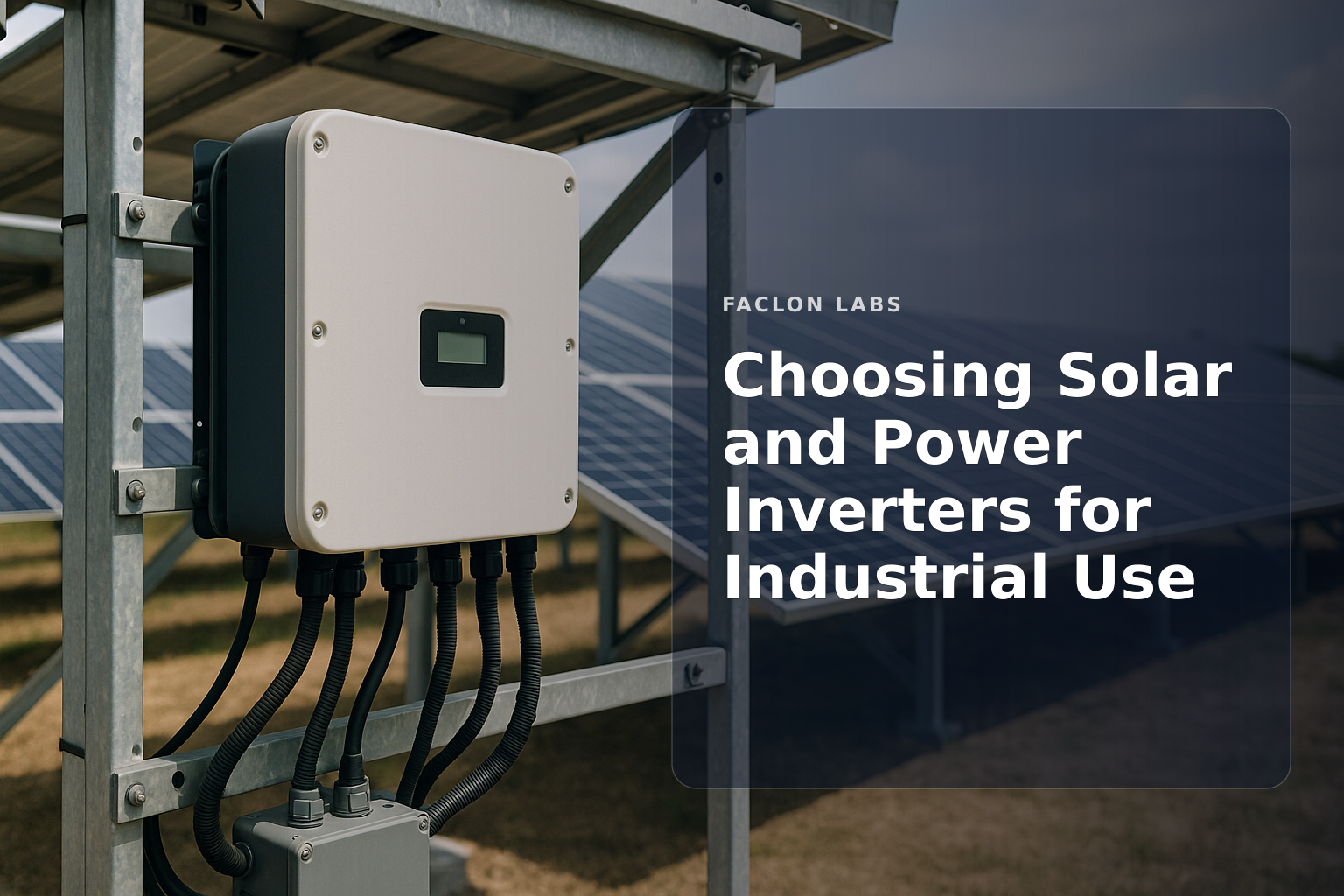
Industrial operations demand robust and efficient solar and power inverter solutions tailored to complex load profiles and stringent power quality requirements. Unlike residential systems, industrial inverters must handle higher capacities, three-phase power, and critical load prioritization. This guide breaks down the process of selecting and implementing inverters that optimize energy conversion, reliability, and ROI for industrial plants.
A solar and power inverter converts the direct current (DC) electricity generated by solar panels into alternating current (AC) electricity used by industrial equipment. This conversion is essential because most industrial machinery and grid systems operate on AC power.
Industrial inverters typically support three-phase power, higher capacities, and more complex load types than residential inverters. They also offer enhanced durability, advanced control interfaces, and compliance with industrial safety and power quality standards.
Inverters not only convert power but also regulate voltage, manage power quality, and provide critical data for energy management systems. They support integration with IIoT platforms to enable predictive maintenance and optimize energy flows.
Begin by measuring your plant’s average and peak power consumption. Total kW indicates continuous load, while kVA reflects apparent power including reactive components. Accurate assessment prevents undersizing or oversizing inverters.
Industrial loads vary:
Identify which loads require uninterrupted power and prioritize inverter capacity accordingly. Critical loads might need dedicated backup or hybrid inverter configurations.
Leverage digital power meters and load profiling software to collect detailed consumption data. Conduct energy audits to validate measurements and identify optimization opportunities.
Choose based on facility needs:
Select an inverter rated to handle continuous loads plus surge demands, especially for inductive equipment. A typical rule is sizing inverters 20–30% above peak load to accommodate startup currents.
Industrial plants commonly use three-phase power for efficiency. Ensure the inverter supports balanced three-phase output and complies with local grid interconnection standards.
| Parameter | Value |
|---|---|
| Average load | 500 kW |
| Peak load (surge) | 650 kVA |
| Load type | Mixed (motors, HVAC) |
| Critical load portion | 60% |
| Recommended inverter | 700 kVA three-phase, hybrid grid-tie with battery integration |
This sizing ensures sufficient capacity for peak surges and critical load support, with flexibility for energy storage integration Understanding Energy Consumption in Industrial Plants.
High inverter efficiency (often above 97%) reduces energy losses and improves ROI. Look for certifications like CEC (California Energy Commission) or European efficiency standards to benchmark performance.
Lower Total Harmonic Distortion (THD) is crucial in industrial environments to prevent equipment malfunction. Aim for inverters with THD below 5% for sensitive loads.
Modern inverters offer remote monitoring and integration with SCADA or IIoT platforms, enabling real-time performance tracking and predictive maintenance.
Prioritize inverters with built-in safety mechanisms to protect personnel and equipment, comply with regulations, and reduce downtime.
Select inverters with appropriate IP (Ingress Protection) ratings for the installation environment and a wide operating temperature range to ensure reliability.
Ensure proper ventilation, secure mounting, and compliance with electrical codes. Coordinate with plant engineers to integrate with existing infrastructure.
Regular inspection of cooling systems, wiring, and firmware updates prolong inverter life. Common issues include overheating and component wear.
Choose vendors offering comprehensive warranties and responsive technical support to minimize operational risks.
Seamless integration with energy management and automation systems maximizes inverter utility and operational insight Understanding Energy Consumption in Industrial Plants.
Smart inverters can provide ancillary services that stabilize the grid and generate additional revenue streams.
AI algorithms analyze inverter data to predict failures and optimize energy flows, reducing downtime and maintenance costs.
Hybrid inverters enable smooth integration of battery storage, improving energy resilience and load shifting capabilities.
Emerging trends include higher power density devices, enhanced cybersecurity features, and AI-driven autonomous operation Understanding Energy Consumption in Industrial Plants.
Selecting the right solar and power inverter for your industrial facility is a strategic decision that balances capacity, efficiency, and integration capabilities. Partner with experts who understand industrial energy ecosystems to ensure your inverter investment delivers reliable performance and measurable ROI. For tailored guidance on inverter selection and integration, contact Faclon Labs.
The primary function of a solar inverter in an industrial setting is to convert the direct current (DC) electricity generated by solar panels into alternating current (AC) electricity, which is the usable form of power for most industrial machinery and the electrical grid. This conversion is essential for integrating solar energy into plant operations.
To determine the correct size, you must first calculate your facility's total power consumption (kW) and peak demand (kVA), considering all critical and non-critical loads. The inverter's capacity should meet or exceed your peak demand, with additional buffer for future expansion or surge loads. Consulting with an energy expert for a detailed load profile analysis is highly recommended.
Hybrid inverters offer significant advantages for industrial applications by combining grid-tie and off-grid functionalities. They can manage power from solar panels, batteries, and the utility grid simultaneously, providing energy independence, backup power during outages, and opportunities for demand-side management and peak shaving, ultimately enhancing operational resilience and reducing energy costs.
An off-grid inverter operates independently of the utility grid, typically used in remote locations or for facilities seeking complete energy independence, often paired with battery storage. A grid-tie inverter, conversely, is designed to work in parallel with the utility grid, feeding excess solar power back into it and drawing power when solar generation is insufficient. Hybrid inverters combine aspects of both.