Join Our Lunch & Learn: How Agentic AI Will Transform Industrial Operations | Register Now →
.svg)
June 29, 2026
4 Mins
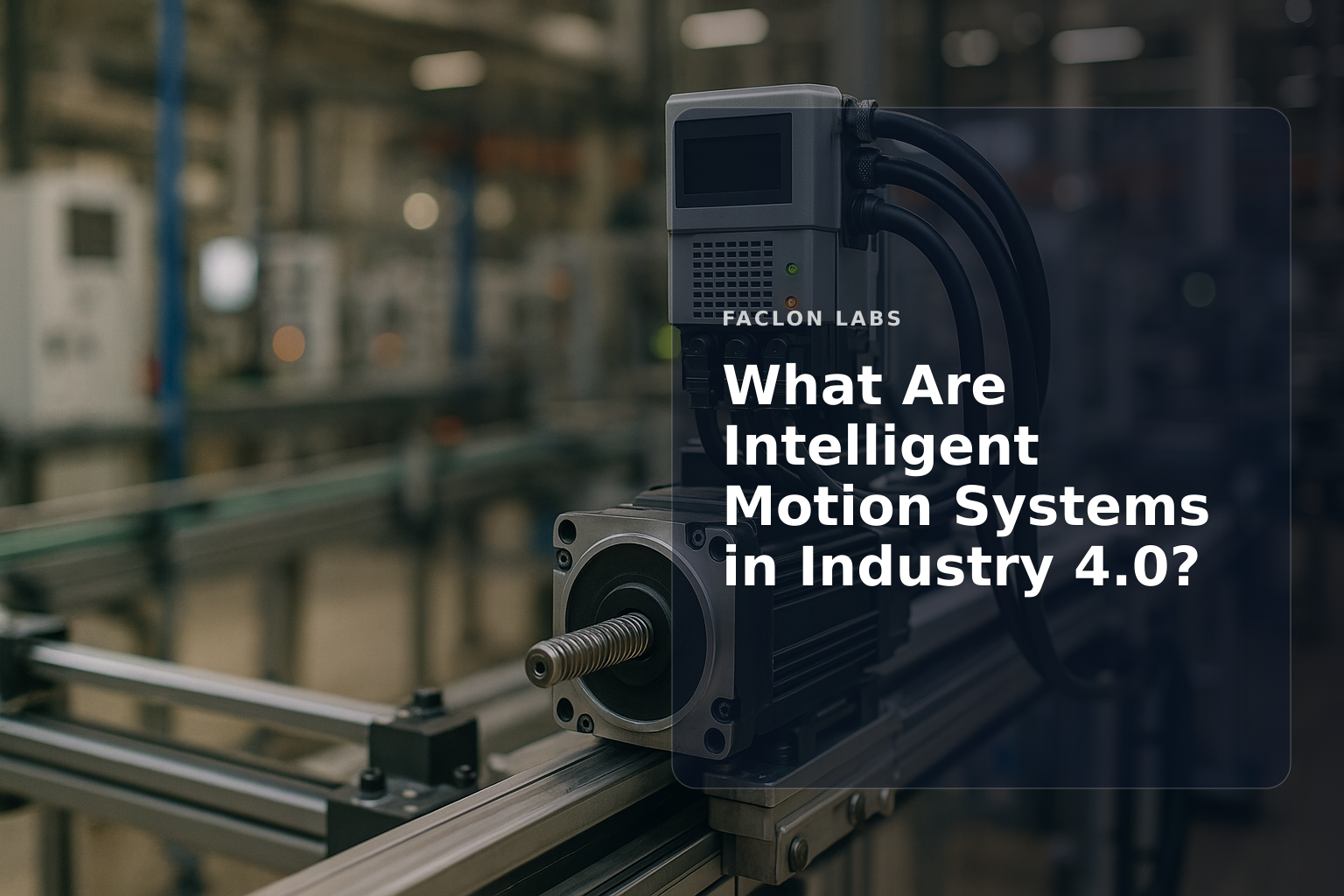
Intelligent motion systems represent a significant evolution from traditional motion control by embedding smart technologies that enable machines to operate with higher precision, flexibility, and autonomy. As Industry 4.0 reshapes manufacturing and industrial processes, these systems become key enablers of smarter, more connected, and data-driven operations.
Understanding what defines an intelligent motion system and how it functions can help plant operations leaders appreciate its impact on productivity, quality, and operational resilience. This overview breaks down the core concepts, components, industrial applications, and emerging trends shaping the future of motion control.
Traditional motion control focuses on driving motors and actuators to move parts along predefined paths with set speeds and positions. Intelligent motion systems extend this by incorporating real-time data processing, adaptive algorithms, and connectivity to respond dynamically to changing conditions.
Intelligent motion systems combine mechanical elements (motors, gears), electronic hardware (sensors, controllers), and sophisticated software to create closed-loop systems that monitor and adjust motion continuously.
Artificial intelligence and machine learning analyze sensor data to optimize motion trajectories, predict failures, and enable autonomous adjustments. IoT connectivity allows these systems to communicate with other machines and cloud platforms for coordinated operations and remote monitoring.
Sensors measure position, velocity, torque, temperature, and vibration. Feedback loops use this data to continuously correct motion, ensuring accuracy and stability.
Electric motors (servo and stepper) convert electrical energy into mechanical motion. Actuators execute precise movements based on controller commands.
Controllers execute algorithms that process sensor inputs and command actuators. Embedded processors may run AI models for predictive adjustments.
High-speed industrial networks enable data exchange between system components and external platforms, supporting real-time control and integration within Industry 4.0 architectures.
Software tools analyze operational data to identify inefficiencies, optimize performance, and schedule maintenance proactively.
| Component | Function | Examples |
|---|---|---|
| Sensors | Capture real-time motion and environmental data | Encoders, accelerometers |
| Actuators/Motors | Generate controlled movement | Servo motors, stepper motors |
| Controllers | Process data and control actuators | PLCs with AI integration |
| Communication | Enable data exchange and synchronization | Industrial Ethernet, PROFINET |
| Software Platforms | Analyze data and optimize system behavior | Motion control suites, AI analytics |
Closed-loop feedback and AI-driven corrections enable sub-millimeter accuracy and consistent repeatability, critical for high-quality manufacturing.
Adaptive motion control reduces cycle times and energy consumption, boosting overall equipment effectiveness (OEE).
Continuous monitoring detects early signs of wear or faults, allowing maintenance before failures occur, minimizing unplanned downtime.
Systems can quickly reconfigure motion parameters for different products or processes without extensive manual intervention.
Intelligent motion systems integrate sensors and controls that monitor human presence and adjust machine behavior to prevent accidents.
Robotic arms and CNC machines use intelligent motion to execute complex tasks with precision and speed.
Automated guided vehicles (AGVs) and autonomous mobile robots (AMRs) rely on intelligent motion for navigation and load handling.
Motion systems coordinate high-speed packaging lines and position inspection cameras or sensors accurately.
Cobots use intelligent motion to safely work alongside humans, adapting their movements to dynamic environments.
Digital twins replicate physical motion systems virtually, allowing simulation and testing of motion strategies before deployment.
Processing data locally at the device level reduces latency, enabling real-time adaptive control.
Intuitive HMIs improve operator interaction with motion systems, providing actionable insights and control customization.
AI algorithms continuously learn and refine motion trajectories to maximize performance and reduce wear.
| Trend | Description | Industrial Benefit |
|---|---|---|
| Digital Twins | Virtual replicas for testing and optimization | Reduced downtime, improved design |
| Edge Computing | Local data processing for real-time control | Faster response, increased autonomy |
| Advanced HMIs | Enhanced operator interfaces | Better usability, faster troubleshooting |
| AI-Driven Optimization | Self-learning motion path adjustments | Higher efficiency, longer equipment life |
Intelligent motion systems are foundational to Industry 4.0’s promise of smarter, more efficient industrial operations. For plant leaders aiming to enhance precision, flexibility, and uptime, understanding these systems is the first step to informed technology adoption and continuous improvement. Explore how intelligent motion can fit into your operational strategy and unlock measurable industrial outcomes. Benefits of Automated Maintenance Services for Industrial Plants Generative AI Platforms: Capabilities, Applications, and Selection for Industrial AI Generative AI Platforms: Capabilities, Applications, and Selection for Industrial AI
Intelligent motion control refers to a sophisticated system that governs the movement of machinery and equipment by integrating advanced sensors, actuators, controllers, and software with AI and IoT capabilities. It allows for real-time data analysis, adaptive adjustments, and predictive functions, moving beyond basic programmed movements to achieve greater precision, efficiency, and autonomy.
Traditional motion control primarily executes pre-programmed movements. Intelligent motion systems, however, incorporate real-time feedback, sensor data, and AI/ML algorithms to adapt to changing conditions, optimize performance, predict maintenance needs, and even learn new tasks, offering significantly higher levels of flexibility, efficiency, and autonomy.
Implementing intelligent motion systems can lead to numerous benefits, including enhanced operational precision, increased production throughput, reduced energy consumption, minimized downtime through predictive maintenance, greater flexibility for product changes, improved worker safety, and overall higher ROI for industrial operations.