Join Our Lunch & Learn: How Agentic AI Will Transform Industrial Operations | Register Now →
.svg)
July 1, 2026
5 Mins
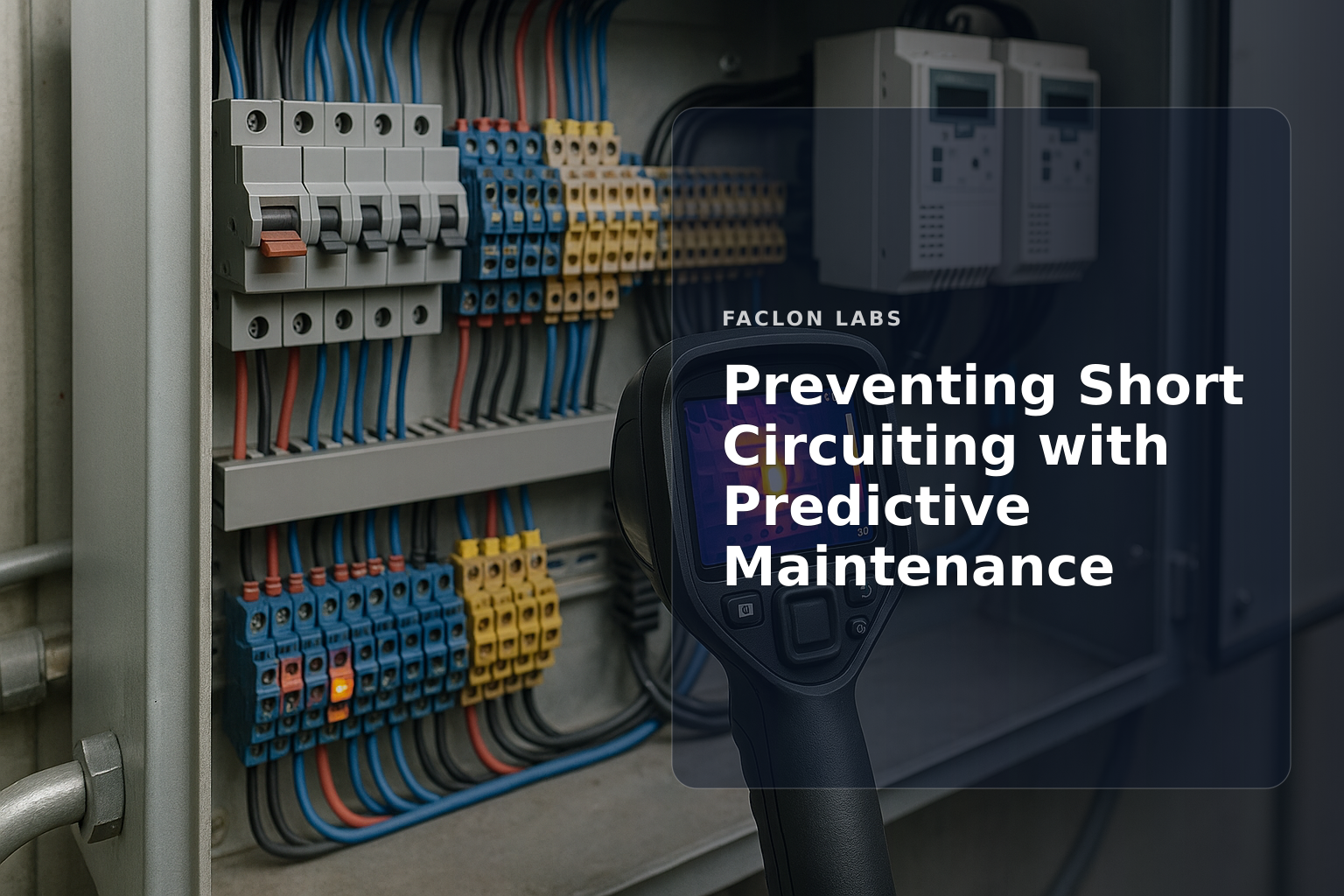
Short circuits are a critical risk in industrial electrical systems, often leading to costly downtime, equipment damage, and safety hazards such as fires or arc flashes. Traditional maintenance approaches struggle to prevent these incidents effectively due to their reactive or schedule-based nature. Implementing predictive maintenance tailored to electrical systems offers a data-driven, proactive method to identify early warning signs of short circuits and address root causes before failures occur.
A short circuit is an unintended electrical path with very low resistance that allows current to bypass the designed circuit route, often returning directly to the power source. This causes a surge of excessive current that can quickly damage components or trigger protective devices. In industrial environments, short circuits frequently occur due to:
Short circuiting can have severe impacts on plant operations, including:
Understanding these risks underscores the importance of preventing short circuits through advanced maintenance strategies Advanced Gas Leak Detection Sensors for Industrial Safety.
Reactive maintenance waits until equipment fails before acting. This approach results in:
Preventive maintenance schedules inspections or replacements based on time or usage intervals. While better than reactive, it often:
Electrical faults like short circuits can develop rapidly and irregularly, making time-based or failure-driven maintenance insufficient. Complex interactions of environmental, mechanical, and electrical factors require continuous monitoring and data analysis to detect subtle precursors to failure Benefits of Automated Maintenance Services for Industrial Plants.
Monitor key parameters that indicate electrical health:
Deploy sensors strategically on motors, switchgear, transformers, and control panels to gather continuous real-time data.
Centralize data using an IIoT platform that can:
This aggregation enables holistic analysis rather than isolated readings.
Leverage AI and machine learning algorithms to:
This early warning system reduces reliance on manual inspections.
Use advanced analytics to:
This insight supports efficient resource allocation.
Schedule targeted maintenance such as tightening connections, replacing insulation, or repairing wiring before faults escalate. After repairs, validate the system’s health through follow-up sensor readings to confirm issue resolution.
| Step | Activity | Tools / Metrics | Outcome |
|---|---|---|---|
| 1 | Sensor deployment | Thermal cameras, current transformers, vibration sensors | Continuous data capture |
| 2 | Data aggregation | IIoT platform, dashboards | Centralized view of electrical health |
| 3 | Anomaly detection | AI/ML algorithms, alerting system | Early fault warnings |
| 4 | Diagnostics | Root cause analysis, prognostics | Maintenance prioritization |
| 5 | Intervention & verification | Scheduled repairs, post-maintenance testing | Fault prevention confirmed |
These technologies combined provide a comprehensive view of electrical system health Effective Production Line Monitoring with Industrial IoT.
Predictive maintenance for short circuit prevention delivers measurable benefits:
For example, a manufacturing plant implementing predictive electrical maintenance reduced electrical faults by 40%, significantly improving operational reliability.
Integrating new sensors and IIoT platforms with existing equipment requires careful planning and often customized interfaces.
Protecting sensitive operational data and control systems from cyber threats is critical when deploying connected devices.
Operators and maintenance teams need training to interpret predictive analytics and adapt workflows accordingly.
Advances in AI will further enhance anomaly detection accuracy and prognostics, enabling even more precise short circuit prevention Benefits of Automated Maintenance Services for Industrial Plants.
Preventing short circuiting through predictive maintenance is a strategic investment that enhances both operational reliability and safety. Start by assessing your electrical assets for critical monitoring points and explore IIoT solutions that fit your environment. For more guidance on deploying predictive maintenance effectively, reach out to experts who specialize in industrial electrical systems and AI-driven analytics.
The primary causes of short circuits in industrial machinery often include insulation degradation due to age, heat, or chemical exposure; loose electrical connections leading to arcing; and physical damage to wiring from vibration or external forces. Environmental factors like moisture and dust can also significantly contribute.
Predictive maintenance prevents short circuiting by continuously monitoring key electrical parameters such as temperature, current, voltage, and insulation resistance. AI-powered analytics detect subtle anomalies or trends, like rising temperatures at a connection point or changes in current draw, which are precursors to a short circuit, allowing for intervention before failure.
Essential tools for monitoring electrical systems include thermal imaging cameras to detect hotspots, current transformers and voltage sensors for real-time electrical load analysis, partial discharge detectors for insulation health, and vibration sensors for mechanical issues that can impact electrical integrity. IIoT platforms integrate data from these tools for comprehensive analysis.
An open circuit occurs when there is a break in the electrical path, preventing current from flowing. This results in infinite resistance and zero current. Conversely, a short circuit occurs when current finds an unintended, low-resistance path, leading to excessively high current flow and potential damage. While an open circuit stops operation, a short circuit can cause severe damage or hazards.