Join Our Lunch & Learn: How Agentic AI Will Transform Industrial Operations | Register Now →
.svg)
July 9, 2026
5 Mins
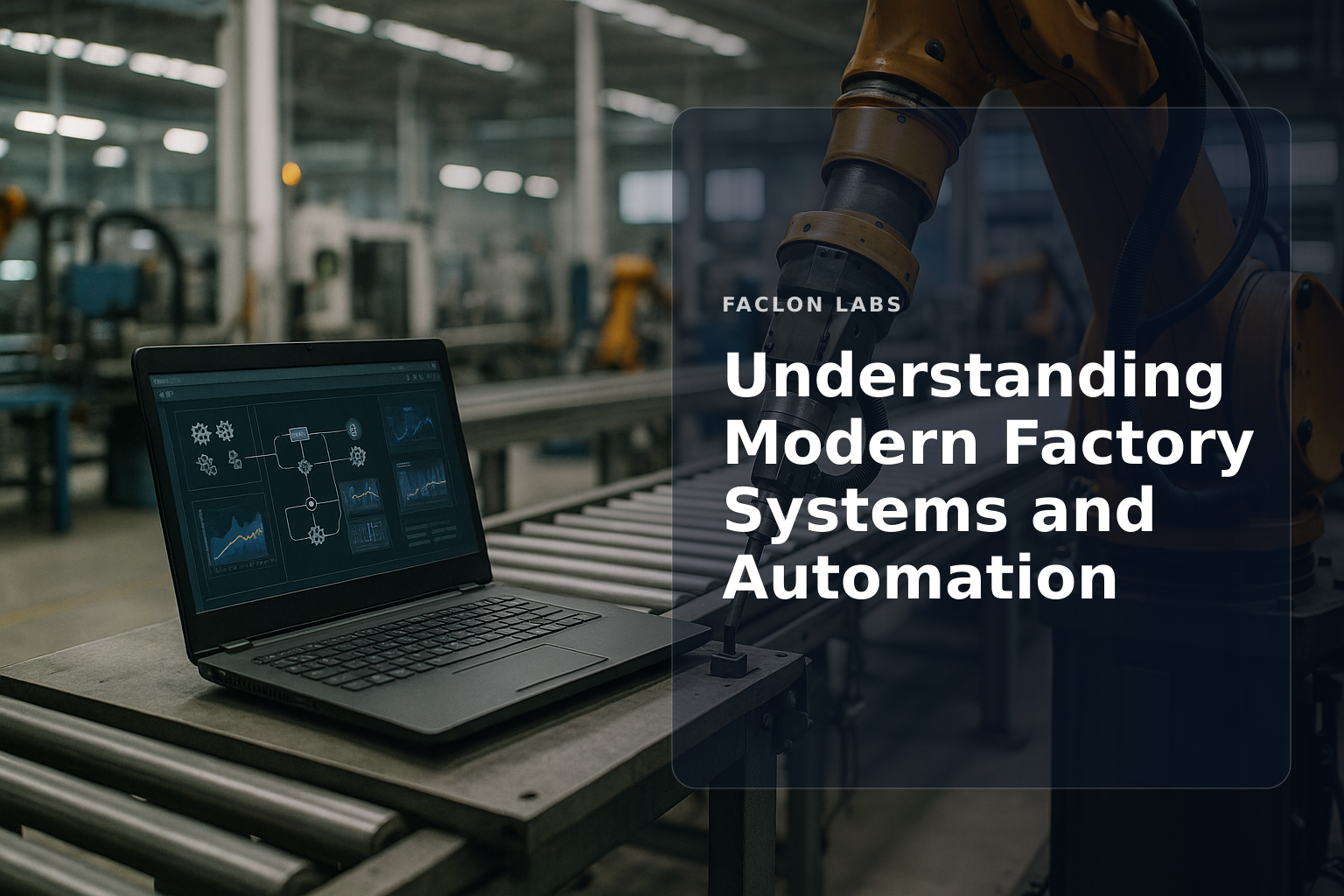
Factory systems have evolved far beyond their original concept as centralized manufacturing hubs. Today's factories combine physical machinery with digital intelligence to respond dynamically to production demands and operational challenges. For plant operations leaders new to this landscape, understanding how modern factory systems function is essential to navigating the ongoing industrial transformation.
Historically, factory systems referred to centralized manufacturing facilities where labor and machines were organized for mass production. In contrast, modern factory systems encompass integrated networks of machines, sensors, software, and human operators working cohesively. They are characterized by the fusion of physical assets with digital technologies, enabling real-time control and optimization.
Modern factory systems stand out due to their:
These features allow manufacturers to improve throughput, reduce downtime, and customize products more efficiently.
Unlike traditional factories that rely heavily on manual processes and fixed workflows, modern systems automate repetitive tasks and provide visibility across the production line. This shift enables predictive maintenance, quality control, and supply chain synchronization, which were previously difficult to achieve at scale Understanding Actuators in Industrial Automation Systems.
The factory system began in the 18th century with the Industrial Revolution, introducing centralized production facilities. The power loom and steam engine were pivotal inventions that increased output and standardized manufacturing processes.
These technologies mechanized textile production and other industries, replacing artisanal methods with machine-based manufacturing. This shift laid the groundwork for mass production and economies of scale.
The 20th century saw assembly lines and automation improve efficiency further. Today, digital transformation introduces connectivity and intelligence, marking a new phase in factory systems.
Industry 4.0 represents the current wave of industrial innovation, characterized by:
These pillars enable factories to operate as smart, self-optimizing systems What is Terminal 4.0 and Its Impact on Industry?.
Sensors collect real-time data on temperature, pressure, vibration, and other variables, while actuators execute commands to adjust machinery. Together, they form the feedback loop crucial for automated control.
Robots perform repetitive or hazardous tasks with precision and speed. Cobots work alongside human operators, enhancing flexibility and safety on the factory floor.
PLCs automate specific machine functions, while DCS coordinate complex processes across multiple systems, ensuring synchronized operation.
MES track production progress and quality in real-time, linking shop floor activities with ERP systems that manage resources, inventory, and business processes.
| Component | Function | Benefit |
|---|---|---|
| Sensors & Actuators | Data collection and machine control | Real-time monitoring and adjustment |
| Robotics & Cobots | Automated task execution | Increased efficiency and safety |
| PLCs & DCS | Process automation and coordination | Reliable and consistent operations |
| MES & ERP | Production tracking and resource planning | Enhanced visibility and decision-making |
IIoT devices link machines and systems to cloud platforms, enabling remote monitoring and control. This connectivity breaks down information silos and supports data-driven workflows.
AI algorithms analyze sensor data to predict equipment failures before they occur and detect quality deviations early, reducing downtime and scrap rates.
Advanced analytics provide plant managers with actionable insights to optimize production schedules, energy consumption, and supply chain coordination.
Digital twins are virtual replicas of physical assets or processes, allowing simulation and testing without disrupting actual operations. Cyber-physical systems integrate these twins with real-time data for adaptive control Advanced Gas Leakage Detection for Industrial Facilities.
These benefits contribute to measurable ROI and competitive advantage in manufacturing.
| Challenge | Description | Mitigation Strategy |
|---|---|---|
| Investment & ROI | High upfront costs with uncertain returns | Detailed cost-benefit analysis |
| Cybersecurity | Risk of data breaches and operational disruption | Implement multi-layered security |
| Workforce Training | Skill gaps in new technologies | Continuous education and upskilling |
| Legacy System Integration | Compatibility and data flow issues | Phased integration and middleware |
Modern factory systems are reshaping manufacturing by combining automation with intelligent data management. If you're exploring how to modernize your plant, start by assessing your current operations and identifying where digital integration can deliver the most value. For deeper insights on implementing these technologies, explore our guides on Understanding Actuators in Industrial Automation Systems and Essential Tools for Data Analytics in Smart Manufacturing.
The primary purpose of modern factory systems is to optimize manufacturing processes through automation, data integration, and advanced technologies like AI and IoT. This leads to increased efficiency, reduced costs, improved product quality, and greater operational agility.
Modern factory systems differ from traditional ones by integrating digital technologies for real-time data collection, analysis, and autonomous decision-making. Traditional systems relied more on manual labor, fixed machinery, and less interconnected processes, lacking the adaptability and predictive capabilities of today's smart factories.
AI plays a crucial role in modern factory systems by enabling predictive maintenance, optimizing production schedules, enhancing quality control through vision systems, and improving supply chain management. It transforms raw data into actionable insights, leading to more intelligent and efficient operations.