Join Our Lunch & Learn: How Agentic AI Will Transform Industrial Operations | Register Now →
.svg)
June 29, 2026
6 Mins
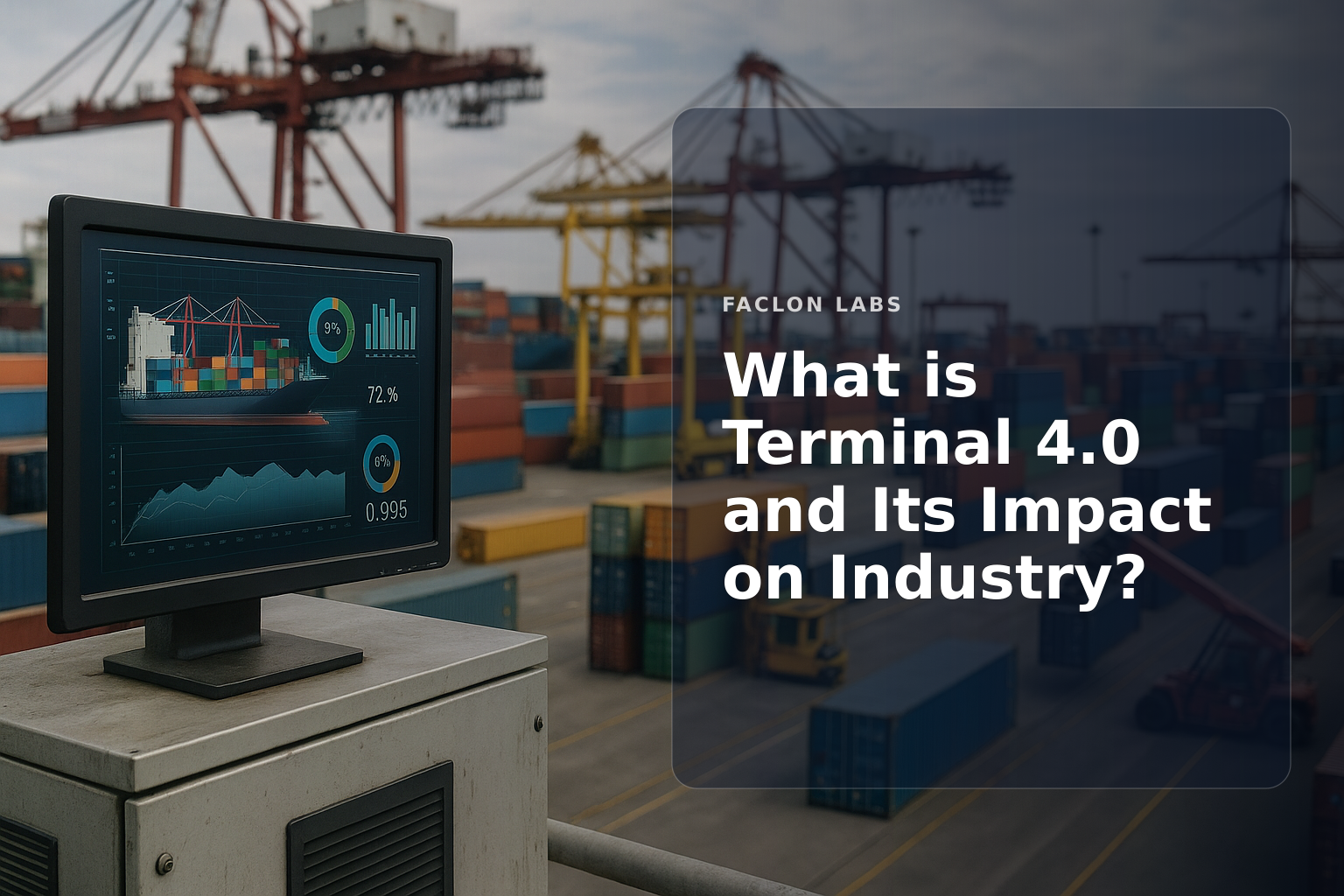
Terminal 4.0 is an emerging concept within the broader Industry 4.0 framework, specifically targeting the modernization of cargo and logistics terminals. As global trade volumes grow and supply chains become more complex, terminals face mounting pressure to enhance operational efficiency, safety, and sustainability. Terminal 4.0 addresses these challenges by integrating advanced digital technologies into terminal operations, transforming traditional manual processes into smart, connected workflows.
Understanding Terminal 4.0 is essential for plant operations leaders and logistics managers seeking to future-proof their facilities. This post breaks down the key technologies, operational impacts, economic benefits, and challenges associated with Terminal 4.0, providing a clear foundation for those new to the concept.
Terminal 4.0 applies the principles of Industry 4.0—digitalization, connectivity, and automation—to cargo handling terminals. It involves the integration of cyber-physical systems that enable terminals to collect, analyze, and act on data in real time. Unlike general software versions or remote desktop clients also named “Terminal 4.0,” this concept specifically focuses on transforming physical terminal operations.
While some tools or software products may share the name "Terminal 4.0," the industrial concept refers to a comprehensive operational paradigm shift rather than a single application. It encompasses hardware, software, and process redesign for container, port, and cargo terminals.
Terminal 4.0 rests on five foundational technologies:
Terminals face challenges such as congestion, unpredictable cargo flows, equipment downtime, and safety risks. Terminal 4.0 aims to resolve these by enhancing visibility, automating routine tasks, and enabling data-driven decision-making.
IoT devices continuously monitor container locations, equipment status, and environmental conditions. This data provides operators with a live overview of terminal activities, reducing delays and errors.
AI models analyze historical and real-time data to predict equipment failures, optimize cargo routing, and improve scheduling. Machine learning adapts over time, enhancing accuracy and operational efficiency.
Terminals generate massive datasets from sensors, cameras, and control systems. Big Data platforms aggregate and analyze this information to uncover patterns and support strategic planning.
Automated cranes, guided vehicles, and robotic systems handle repetitive, hazardous, or precision tasks. This reduces human error and improves throughput while enhancing worker safety.
Digital twins create virtual models of terminal operations, allowing simulation of scenarios and testing of process changes without disrupting real-world activities.
As terminals become more connected, protecting data integrity and operational continuity is critical. Robust cybersecurity frameworks and standards such as TIC 4.0 help mitigate risks.
| Technology | Role in Terminal 4.0 | Benefits |
|---|---|---|
| IoT | Real-time monitoring and asset tracking | Enhanced visibility, reduced errors |
| AI & Machine Learning | Predictive analytics and optimization | Reduced downtime, better scheduling |
| Big Data | Data aggregation and analysis | Informed decision-making |
| Automation & Robotics | Automated cargo handling and operations | Increased throughput, safety |
| Digital Twins | Virtual simulation and testing | Risk reduction, process improvement |
| Cybersecurity | Protection of data and systems | Operational resilience |
Terminal 4.0 enables continuous monitoring and coordination of cargo movements, minimizing bottlenecks and speeding up loading and unloading processes.
Data-driven insights allow terminals to deploy cranes, trucks, and staff where they are most needed, reducing idle times and maximizing asset utilization.
Predictive maintenance powered by AI helps schedule repairs before failures occur, keeping equipment operational longer and avoiding costly downtime.
Advanced analytics support dynamic scheduling that adapts to changing conditions, improving reliability and throughput.
Operators gain a comprehensive, up-to-the-minute view of terminal status, enabling faster responses to disruptions and better coordination with supply chain partners.
Automation lowers labor costs and reduces errors, while optimized workflows cut fuel consumption and equipment wear.
By anticipating failures, terminals avoid unplanned stoppages that can cost thousands per hour in lost productivity.
Data-driven optimization allows terminals to handle more cargo using existing assets, deferring costly capital investments.
Smart energy management and optimized equipment use reduce environmental impact and operational expenses.
Terminals adopting Terminal 4.0 technologies can offer faster, more reliable services, attracting more business and strengthening their market position.
Deploying Terminal 4.0 technologies requires significant upfront capital and careful integration with legacy systems.
Achieving seamless communication between diverse hardware and software components is essential but complex. Standardization efforts like TIC 4.0 facilitate this process TIC4.0 new publication.
Adopting Terminal 4.0 demands upskilling staff to operate and maintain advanced systems, requiring ongoing training programs.
The increased attack surface from interconnected devices necessitates comprehensive cybersecurity strategies to protect operations and data.
Compliance with emerging standards ensures interoperability and safety but requires active engagement with industry initiatives White Paper Terminal Automation.
High-speed, low-latency networks like 5G will enable real-time data exchange and support autonomous operations at scale.
Terminals will increasingly connect with shipping lines, customs, and logistics providers to create end-to-end visibility and coordination.
Driverless trucks and automated cranes will further reduce labor costs and improve safety.
Combining AI, IoT, and digital twins will create terminals capable of self-monitoring, self-adjusting, and continuous improvement.
Terminal 4.0 represents a critical step in modernizing industrial terminals to meet the demands of today’s complex logistics environment. For plant operations leaders, understanding its technologies and impacts is key to making informed decisions about digital transformation initiatives. To explore how industrial AI and IIoT platforms can support your Terminal 4.0 journey, reach out to Faclon Labs for expert guidance tailored to your operational needs.
The primary goal of Terminal 4.0 is to leverage advanced digital technologies from Industry 4.0 to enhance the efficiency, safety, and sustainability of port and logistics terminal operations. This includes optimizing cargo flow, reducing operational costs, and improving overall throughput through automation, data analytics, and real-time connectivity.
Terminal 4.0 differs significantly from traditional operations by moving beyond manual processes and isolated systems. It integrates IoT sensors, AI-driven analytics, robotic automation, and cloud computing to create a highly interconnected, data-driven, and predictive operational environment, offering real-time visibility and proactive decision-making capabilities that traditional models lack.
IoT plays a crucial role in Terminal 4.0 by providing the foundational data layer. Sensors on equipment, cargo, and infrastructure collect real-time data on location, condition, performance, and environmental factors. This data feeds into analytics platforms, enabling predictive maintenance, optimized asset utilization, and enhanced situational awareness across the terminal.
TIC 4.0 (Terminal Industry Committee 4.0) is an initiative aimed at standardizing data exchange and operational processes within the terminal industry. Its relevance lies in fostering interoperability between different systems and equipment, which is critical for the successful implementation and scalability of Terminal 4.0 solutions across various stakeholders in the port ecosystem.