.svg)
May 21, 2026
9 Mins
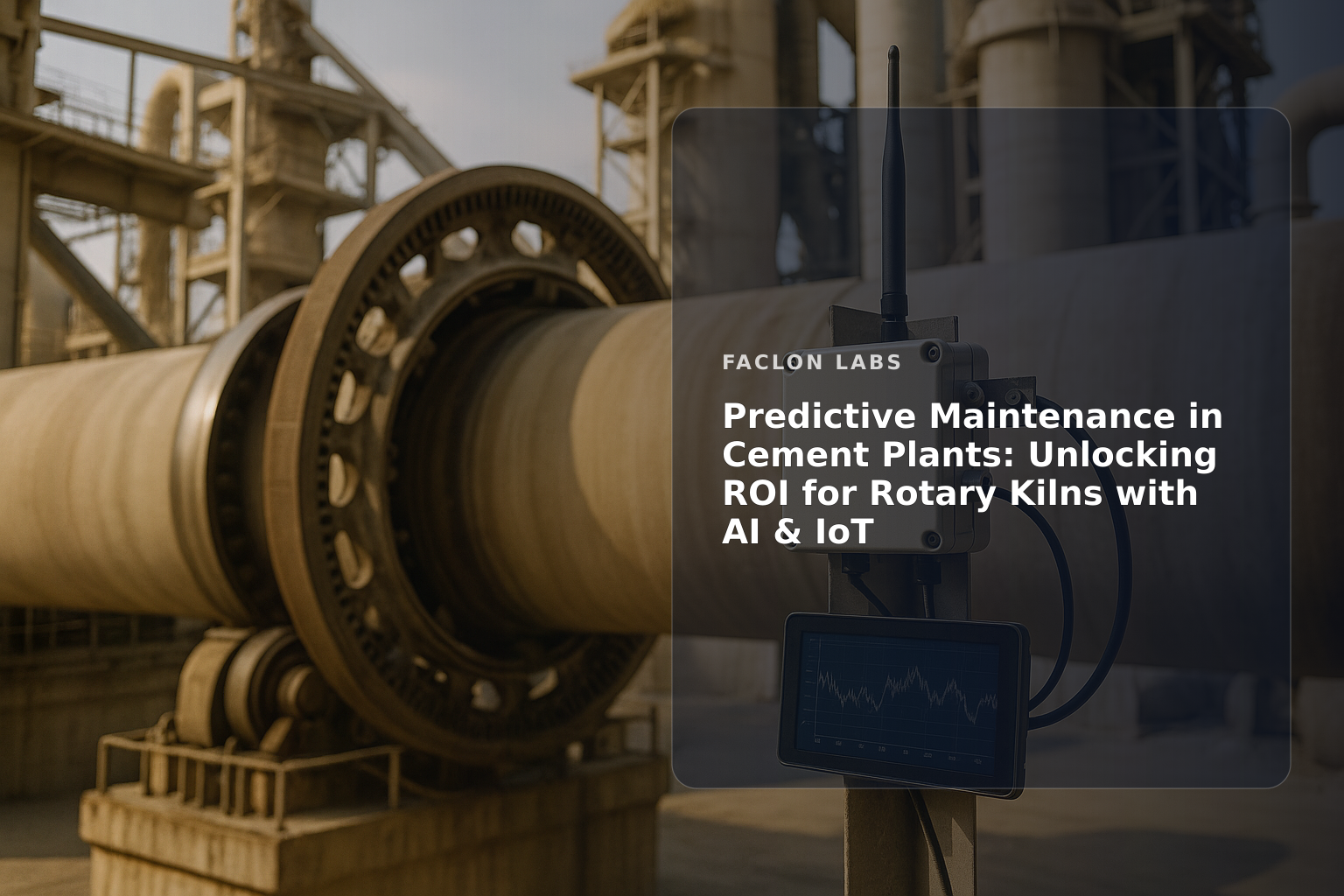
The continuous operation of a rotary kiln is the heartbeat of any cement plant. These colossal machines are central to clinker production, and their uninterrupted performance is directly tied to a plant's profitability and output targets. Yet, despite their critical role, rotary kilns are often subjected to traditional maintenance strategies that fall short, leading to costly and disruptive unplanned downtime.
This post explores how advanced predictive maintenance, powered by industrial AI and IoT, is transforming cement plant operations. We'll delve into the tangible benefits, from significant reductions in unplanned downtime to improved safety and substantial ROI, demonstrating why this shift is no longer optional but essential for modern cement production.
Unplanned downtime in a cement plant, especially involving a rotary kiln, isn't just an inconvenience; it's a cascade of financial and operational setbacks. The sheer scale and complexity of these assets mean that a sudden failure can halt an entire production line, with repercussions felt across the supply chain.
When a rotary kiln goes down unexpectedly, the immediate impact is a direct loss of production. For a plant operating on tight margins and demanding schedules, even a few hours of downtime can mean missing critical clinker output targets. This translates directly into lost revenue, delayed shipments, and potential penalties for unmet customer commitments. The ripple effect can extend to inventory management, creating bottlenecks or shortages further down the line.
The costs associated with emergency repairs far exceed those of planned maintenance. Emergency situations often require expedited shipping for parts, overtime pay for maintenance crews, and a scramble for specialized technicians who may charge premium rates. These reactive costs can be several times higher than the expenses incurred for a scheduled repair or replacement, where resources can be allocated efficiently and parts sourced economically.
Beyond the financial strain, sudden breakdowns pose significant safety risks to personnel. Working on a failed, hot kiln under pressure can be hazardous. There's also the potential for environmental impact, such as uncontrolled emissions or material spills, particularly if a breakdown occurs during a critical process phase. Predictive maintenance mitigates these risks by allowing for controlled shutdowns and safer working conditions.
To understand the value of predictive maintenance, it's crucial to differentiate it from its predecessors. Traditional maintenance strategies, while having their place, often fall short in preventing critical asset failures.
Historically, maintenance has largely fallen into two categories:
Predictive maintenance transcends these by focusing on the actual condition of the asset.
The core of predictive maintenance is continuous monitoring of asset health using real-time data. Instead of guessing when a component might fail or waiting for it to break, we analyze operational parameters to understand its current state and predict its future performance. This condition-based approach ensures maintenance is performed only when truly needed, optimizing resource allocation.
The ability to gather and interpret this real-time data comes from the convergence of IoT and advanced analytics. IoT sensors collect a wealth of information from critical machinery, while AI-powered analytics sift through this data to identify subtle patterns and anomalies that indicate impending failure. This allows for proactive intervention, transforming maintenance from a reactive cost center into a strategic advantage.
For rotary kilns, the application of AI and IoT is particularly impactful due to their complex mechanics and extreme operating conditions. These technologies provide an unprecedented level of insight into the kiln's health.
A comprehensive predictive maintenance system for a rotary kiln deploys a variety of IoT sensors to capture a holistic view of its operational status. Common sensor types include:
The sheer volume and velocity of data generated by these sensors would overwhelm human analysis. This is where AI algorithms come in. They are trained on historical operational data, including instances of both normal operation and known failure modes. These algorithms can:
With AI and IoT, Faclon Labs' platform can predict a range of critical issues specific to rotary kilns:
The shift to predictive maintenance isn't just about avoiding problems; it's about generating measurable returns on investment. For cement plants, these benefits translate directly to the bottom line.
While specific numbers vary by plant and initial condition, industrial AI and IoT platforms consistently deliver significant reductions in unplanned downtime. Many facilities report reductions of 20-50% in unplanned downtime for critical assets like rotary kilns. For a cement plant, this can mean hundreds of additional operating hours per year, directly boosting clinker production and revenue.
Consider a typical scenario:
| Metric | Traditional Maintenance | Predictive Maintenance (Faclon Labs) | Improvement |
|---|---|---|---|
| Unplanned Downtime (hours/year) | 200 | 80 | 60% |
| Emergency Repair Costs | High | Low | Significant |
| Production Output | Inconsistent | Consistent | Increased |
| Asset Lifespan | Standard | Extended | ~15-20% |
Predictive maintenance allows for a "just-in-time" approach to spare parts. Instead of maintaining large, expensive inventories for every possible emergency, plants can order parts precisely when they are predicted to be needed. This reduces carrying costs, obsolescence risk, and capital tied up in inventory. Furthermore, maintenance activities can be scheduled during planned outages or low-demand periods, minimizing disruption and optimizing labor allocation.
By addressing issues before they escalate into major failures, predictive maintenance extends the operational lifespan of expensive assets like rotary kilns. Components are replaced based on their actual condition, not arbitrary schedules, leading to more efficient use of capital. This proactive approach also significantly boosts OEE Basics for Plant Managers, a key metric for manufacturing productivity, by reducing downtime, improving performance, and ensuring quality output.
Adopting predictive maintenance for a critical asset like a rotary kiln requires a structured approach to ensure success and maximize ROI.
The first step involves a thorough assessment of your existing operational technology (OT) infrastructure and identifying the most critical assets where predictive maintenance will yield the greatest impact. For a cement plant, the rotary kiln is almost always at the top of this list, followed by raw mills, cement mills, and crushers. Understanding current data collection capabilities and network infrastructure is also vital.
Starting with a pilot project on a single critical asset, like one rotary kiln, allows your team to gain experience, refine processes, and demonstrate tangible value without overhauling your entire operation. Once the pilot proves successful, the insights and infrastructure can be scaled to other kilns or critical assets across the plant or even to other facilities.
For seamless operation, the predictive maintenance platform should integrate with your existing Computerized Maintenance Management System (CMMS) or Enterprise Asset Management (EAM) system. This ensures that predicted maintenance tasks automatically generate work orders, spare parts requests, and update asset histories, streamlining workflows and preventing manual data entry errors.
The success of your predictive maintenance initiative hinges on selecting the right technology partner. It's not just about buying sensors; it's about a comprehensive solution that delivers actionable intelligence.
Look for a partner with deep expertise in industrial data science, capable of handling the unique challenges of cement plant environments. They should possess specific industry knowledge of rotary kilns and cement production processes, ensuring their AI models are relevant and accurate. The platform itself must be scalable, able to grow with your needs, and robust enough to handle continuous, high-volume data streams.
In an increasingly connected industrial landscape, data security is paramount. Your chosen partner must demonstrate strong cybersecurity protocols to protect your operational data from unauthorized access. System reliability and uptime are also critical; the predictive maintenance platform itself must be a dependable tool, not another source of downtime.
Ultimately, the goal isn't to collect more data, but to gain actionable insights. A good industrial AI/IoT partner will focus on delivering clear, prioritized recommendations that maintenance teams can act upon immediately. The platform should translate complex data into intuitive dashboards and alerts, empowering your team to make informed decisions that directly impact uptime and ROI.
Embrace the future of cement production by leveraging industrial AI and IoT for predictive maintenance. Contact Faclon Labs today to learn how our platform can transform your operations, reduce costs, and secure a competitive edge.
Predictive maintenance can monitor critical rotary kiln components such as refractory lining integrity, roller station bearings, girth gear and pinion wear, drive system motors and gearboxes, and shell ovality, detecting subtle changes that indicate impending failure.
While specific timelines vary, many cement plants begin to see significant ROI within 6-12 months through reduced emergency repairs, optimized maintenance schedules, and a decrease in unplanned downtime events, leading to improved production consistency and lower operational costs.
Modern predictive maintenance platforms are designed for flexible integration. They can often connect with existing SCADA, DCS, CMMS, and ERP systems through standard protocols, allowing for a unified view of plant operations and streamlined maintenance workflows.
Data collected includes vibration analysis from bearings and drives, temperature readings from refractory and shell, acoustic emissions for crack detection, motor current signatures, and operational parameters like kiln speed and feed rates. AI algorithms then analyze this multi-modal data for patterns indicative of failure.

May 19, 2026
8 min read
.svg)

May 19, 2026
10 min read

May 16, 2026
6 Mins