Join Our Lunch & Learn: How Agentic AI Will Transform Industrial Operations | Register Now →
.svg)
June 23, 2026
6 Mins
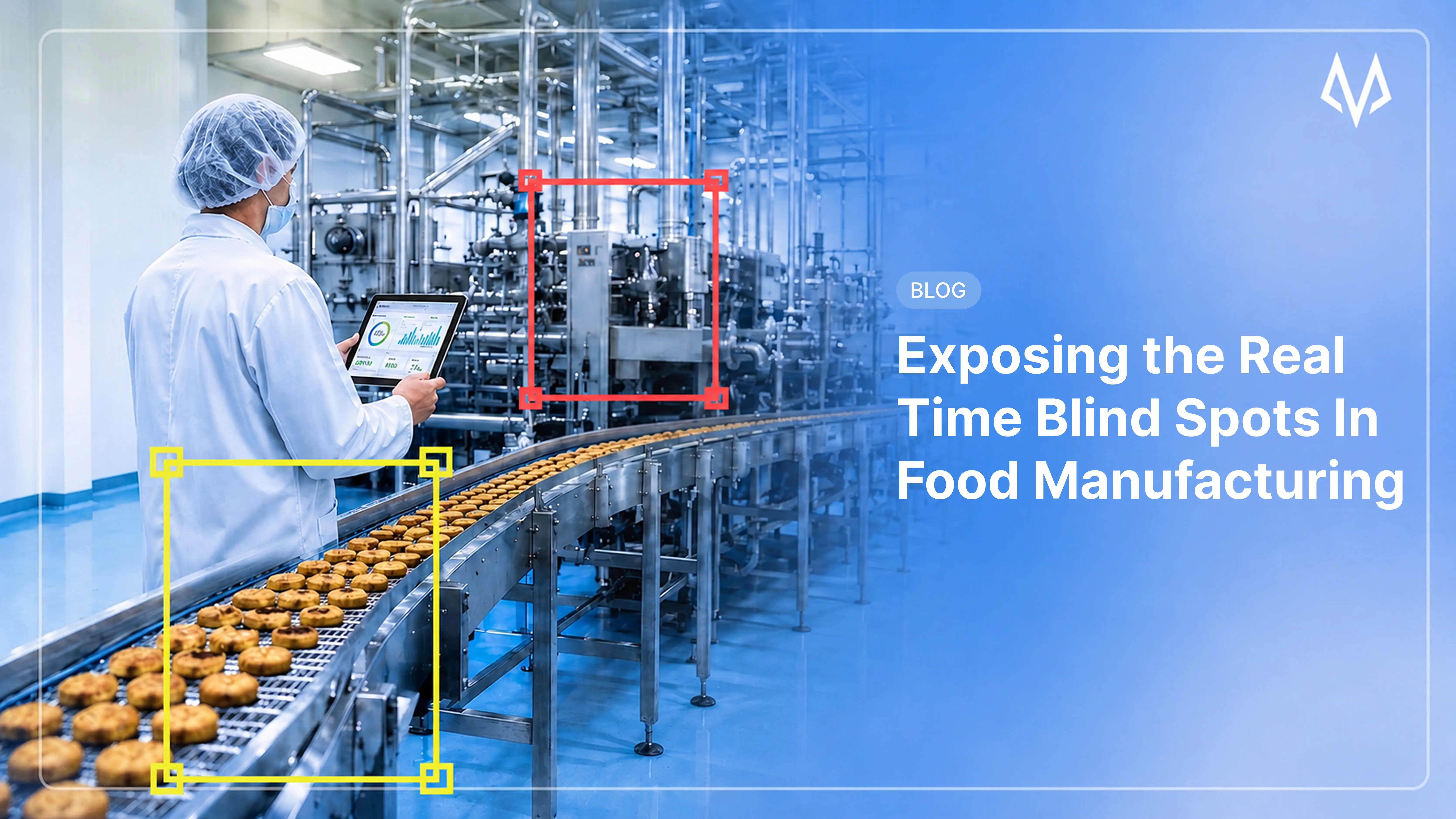
Food & beverage manufacturing plants are under constant pressure to improve throughput, reduce waste, control utility costs, maintain product quality, and meet strict traceability and compliance requirements, often across high-volume, continuously running operations.
But while manufacturing environments have become more connected over the years, operational decision-making in many plants is still reactive.
Production, utilities, quality, maintenance, and cold storage systems may all generate data independently, yet plant teams often lack a real-time operational view across the facility. As a result, issues like microstoppages, utility inefficiencies, quality deviations, and temperature fluctuations are frequently identified only after they have already impacted throughput, cost, or product quality.
This growing gap between data availability and operational visibility is becoming one of the biggest operational challenges in modern food manufacturing.
Food & beverage manufacturers generate massive amounts of operational data every day. Production systems, utilities, quality platforms, maintenance logs, SCADA systems, ERP software, and cold storage monitoring systems continuously collect information across the plant floor.
Yet many food manufacturing plants still struggle with one critical challenge: real-time operational visibility.
The issue is rarely the lack of data. Most manufacturers already monitor production, utilities, quality, and maintenance separately. The challenge is that these systems often operate in silos, making it difficult for plant teams to understand what is happening across operations in real time.
As a result, production losses, utility inefficiencies, quality deviations, and maintenance issues are often identified only after the operational impact has already compounded.
One of the biggest operational blind spots in food manufacturing is microstoppages.
Unlike major equipment failures, microstoppages are short interruptions that occur repeatedly throughout production. These can include small jams, unstable product flow, sensor resets, minor operator delays, or packaging line interruptions.
Individually, these events may appear insignificant. But across a full production shift, they can quietly reduce throughput, lower OEE (Overall Equipment Effectiveness), increase downtime, and create downstream quality inconsistencies.
Many food manufacturing plants still rely on manual downtime logging or end-of-shift reporting to identify these losses. This means smaller disruptions often go unnoticed until production efficiency has already been affected.
Without real-time production monitoring and connected operational visibility, identifying these hidden inefficiencies becomes difficult.
Cold storage monitoring is another major operational challenge across food & beverage manufacturing.
In many plants, cold storage systems are primarily managed from a compliance perspective. However, even small temperature deviations can quickly create broader operational issues, including:
The challenge is that cold storage systems often operate independently from production and utility systems. This limits visibility into how temperature fluctuations affect the broader manufacturing environment.
For food manufacturers, real-time operational visibility is becoming increasingly important not only for compliance, but also for improving production continuity, energy efficiency, and operational performance.
Many food manufacturers still make operational decisions using delayed reports, fragmented dashboards, or disconnected systems.
Production, utilities, quality, and maintenance data may all exist but without a connected operational view, plant teams are often forced into reactive decision-making.
This is why operational intelligence platforms and industrial AI solutions are becoming more important across the food manufacturing industry.
Plant managers today are not looking for more dashboards alone. They increasingly need:
The shift happening across food manufacturing is no longer just about digitization. It is about moving from disconnected monitoring systems to connected operational intelligence.
Manufacturers that improve real-time visibility across production, utilities, quality, and maintenance operations will be better positioned to reduce downtime, improve throughput, optimize energy consumption, and strengthen overall manufacturing performance.
July 30, 2026
10 minutes
.svg)
%20(1).webp)
July 9, 2026
7 min
July 9, 2026
9 min read