Join Our Lunch & Learn: How Agentic AI Will Transform Industrial Operations | Register Now →
.svg)
September 11, 2026
6 Mins
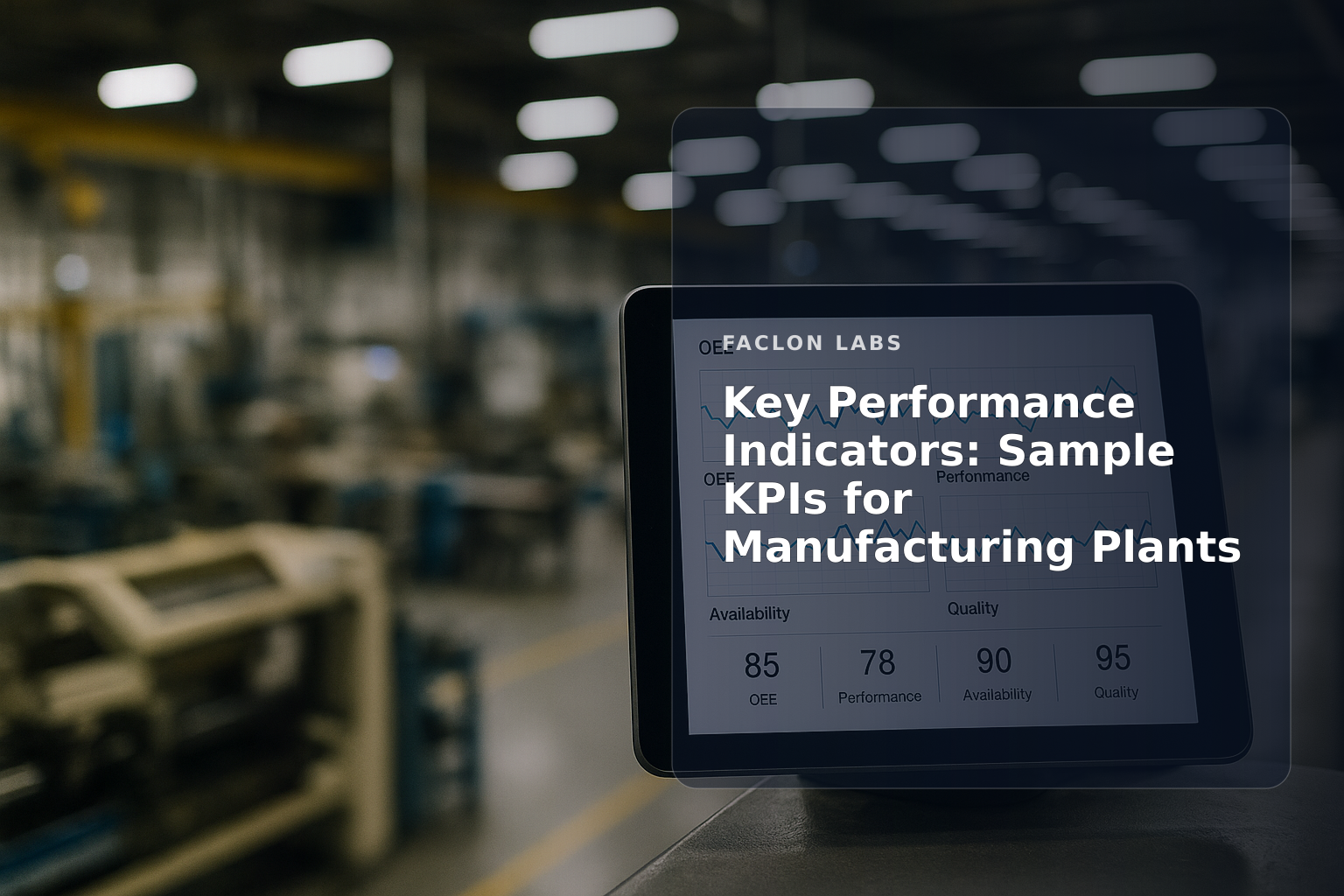
Manufacturing plants operate in complex environments where performance measurement is critical for operational success. Key Performance Indicators (KPIs) serve as quantifiable measures that help plant operations leaders monitor progress, identify bottlenecks, and drive continuous improvement. Understanding what KPIs are and how to select the right ones is essential for optimizing plant productivity and aligning operations with business objectives.
KPIs differ from general metrics by focusing on the most impactful indicators that directly influence strategic outcomes. This article explains the fundamentals of KPIs, why they matter in manufacturing, and provides sample KPIs commonly used in plant operations.
Key Performance Indicators (KPIs) are specific, measurable values that demonstrate how effectively a manufacturing plant is achieving key business objectives. Unlike general data or metrics, KPIs are carefully selected to reflect critical success factors and operational priorities. In manufacturing, KPIs help translate complex processes into actionable insights.
For plant managers and operations leaders, KPIs provide a clear lens to evaluate performance, allocate resources efficiently, and maintain accountability. They enable data-driven decisions that improve throughput, reduce waste, and enhance equipment utilization, all of which contribute directly to profitability and competitiveness.
While all KPIs are metrics, not all metrics qualify as KPIs. Metrics are any quantifiable measure, but KPIs are those metrics most closely tied to strategic goals and business outcomes. For example, total units produced is a metric, but Overall Equipment Effectiveness (OEE), which combines availability, performance, and quality, is a KPI because it reflects operational efficiency.
KPIs must be aligned with the plant’s strategic objectives to ensure they drive meaningful improvements. For instance, if reducing downtime is a priority, KPIs related to equipment availability and mean time to repair become critical. This alignment ensures that performance measurement supports broader business goals.
KPIs create a framework for continuous improvement by highlighting areas needing attention and encouraging accountability at all levels. They help teams focus on what matters most and track progress over time, fostering a culture of operational excellence.
Effective KPIs directly influence return on investment (ROI) by identifying inefficiencies and enabling targeted interventions. For example, improving OEE by just 5% can significantly increase production output without additional capital expenditure, thereby boosting margins.
Below are common KPIs widely used in manufacturing to monitor plant performance:
OEE is a comprehensive KPI that measures equipment productivity by combining:
| KPI Name | Description | Formula Example |
|---|---|---|
| Overall Equipment Effectiveness (OEE) | Measures overall equipment productivity | OEE = Availability × Performance × Quality |
| Production Yield | Ratio of good units produced to total units | Yield = (Good Units / Total Units) × 100% |
| Downtime | Total non-operational time of equipment | Downtime = Scheduled Time − Operating Time |
| Cycle Time | Time to produce one unit | Cycle Time = Total Production Time / Units Produced |
| Scrap Rate | Percentage of defective products | Scrap Rate = (Scrap Units / Total Units) × 100% |
Choose KPIs that are directly relevant to your plant’s goals, clearly defined, and actionable. Avoid overly complex or ambiguous metrics that do not lead to clear decisions or improvements.
Leading indicators predict future performance (e.g., machine temperature trends), while lagging indicators report past results (e.g., monthly scrap rate). A balanced KPI set includes both to enable proactive management and accurate performance tracking.
KPIs should reflect the specific context of the plant, including its size, product type, and strategic priorities. For example, a high-volume automotive plant may prioritize cycle time and OEE, while a specialty chemical plant might focus more on quality rate and safety metrics.
OEE is calculated by multiplying three factors:
Example: If availability is 90%, performance is 85%, and quality is 95%, then OEE = 0.90 × 0.85 × 0.95 = 72.7%.
Downtime can be tracked by summing all periods when equipment is not operational due to failures, maintenance, or changeovers. Tracking mean time to repair (MTTR) and mean time between failures (MTBF) are common approaches.
Too many KPIs can dilute focus and overwhelm teams. Prioritize a concise set of KPIs that truly impact plant performance to maintain clarity and drive results.
Reliable KPIs depend on accurate data collection and consistent measurement standards. Automation and standardized data protocols help reduce errors and improve trust in KPI reporting.
Sharing KPIs transparently and involving teams in review processes increases buy-in and encourages ownership of performance improvements.
Key performance indicators sample refers to typical KPIs used in manufacturing such as OEE, production yield, downtime, cycle time, and scrap rate. These indicators measure operational performance and help track progress toward production goals.
KPIs are a focused subset of metrics directly tied to strategic objectives and operational outcomes, whereas general business metrics may cover broader or less critical data points.
Start with a few relevant KPIs aligned to your plant’s goals, ensure data quality, and regularly review KPI performance with your team to foster continuous improvement.
Understanding and applying the right key performance indicators sample can transform your manufacturing plant’s operations. Start by selecting KPIs that align with your goals, ensure data accuracy, and engage your teams in continuous improvement. For more insights on manufacturing metrics and operational excellence, explore our resources on How to Calculate and Improve OEE in Manufacturing and Essential Tools for Data Analytics in Smart Manufacturing.
Key performance indicators sample in manufacturing are measurable values such as Overall Equipment Effectiveness (OEE), production yield, downtime, and scrap rate that help plant leaders monitor and improve operational performance.
OEE is important because it combines availability, performance, and quality into a single metric that reflects how effectively manufacturing equipment is utilized, helping identify losses and improvement opportunities.
Choose KPIs that align with your plant’s strategic goals, are clearly defined, actionable, and balanced between leading indicators (predictive) and lagging indicators (historical), while considering your plant’s size and industry specifics.
A KPI is a critical metric tied directly to business objectives and decision-making, while a metric is any quantifiable measure. Not all metrics qualify as KPIs.
Plants can avoid pitfalls by focusing on a manageable number of relevant KPIs, ensuring data accuracy, regularly reviewing KPI relevance, and engaging teams through transparent communication and feedback.