Join Our Lunch & Learn: How Agentic AI Will Transform Industrial Operations | Register Now →
.svg)
August 7, 2026
5 Mins
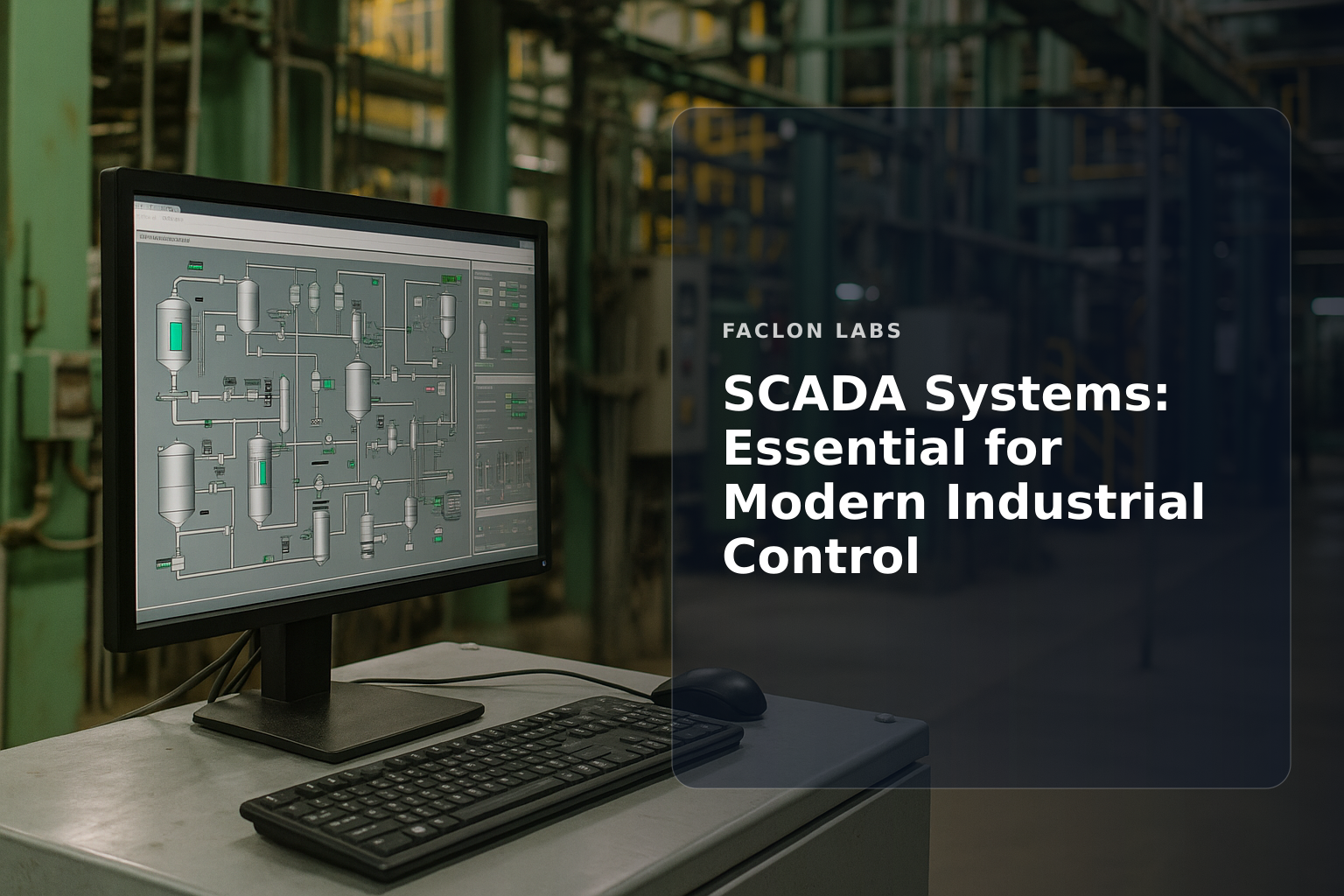
SCADA systems form the backbone of modern industrial control environments, providing plant operations leaders with visibility and control over critical processes. As industrial operations grow increasingly complex, understanding SCADA’s role helps clarify how these systems support operational excellence, from manufacturing floors to energy grids.
This article explains what SCADA systems are, their core components, how they work, and why they remain indispensable in today’s industrial landscape.
SCADA stands for Supervisory Control and Data Acquisition. It refers to a control system architecture that combines software and hardware to monitor and control industrial processes remotely or locally. SCADA systems collect data from sensors and devices, process it, and provide operators with actionable insights to manage operations efficiently.
While SCADA systems focus on supervisory control and data collection across wide geographic areas or multiple sites, Distributed Control Systems (DCS) are typically used for centralized control within a single plant. Programmable Logic Controllers (PLCs) are field-level devices executing control logic but do not provide the supervisory or data acquisition functions inherent to SCADA.
| System Type | Primary Function | Typical Use Case |
|---|---|---|
| SCADA | Supervisory control & data acquisition | Multi-site monitoring (e.g., pipelines, utilities) |
| DCS | Distributed process control | Centralized plant automation (e.g., chemical plants) |
| PLC | Local control automation | Machine-level control (e.g., assembly lines) |
SCADA technology evolved from early telemetry systems used in the 1960s for utilities and infrastructure monitoring. Over decades, it integrated digital computing, networking, and graphical user interfaces, transforming into sophisticated platforms capable of handling complex industrial ecosystems with real-time data and remote control capabilities.
The MTU is the central server or computer that gathers data from field devices, processes it, and serves as the control center. It manages communications, data logging, and issues control commands.
RTUs and PLCs act as intermediaries between sensors/actuators and the MTU. They collect data from sensors, execute control commands, and communicate status back to the MTU.
The HMI is the graphical interface operators use to monitor system status, visualize data trends, and issue commands. It translates complex data into intuitive visuals for effective decision-making.
SCADA relies on robust communication networks—wired or wireless—to transmit data between MTU, RTUs, and HMIs. Common protocols include Modbus, DNP3, and IEC 60870, ensuring interoperability and data integrity.
Sensors measure physical parameters like temperature, pressure, and flow, while actuators perform actions such as opening valves or starting motors based on control signals.
SCADA systems continuously gather data from sensors and devices distributed across the plant or infrastructure. This data reflects the current state of processes and equipment.
Collected data is processed by the MTU and displayed on HMIs as charts, alarms, or dashboards. This visualization enables operators to understand system conditions quickly.
Operators can send commands through the HMI to control equipment remotely, adjusting process parameters or responding to abnormal conditions without physical presence.
SCADA systems generate alarms for abnormal conditions, helping operators prioritize responses. Event logs create an audit trail for troubleshooting and compliance.
Historical data is stored for trend analysis, performance evaluation, and regulatory reporting, supporting continuous improvement and accountability.
SCADA systems are versatile and widely applied across sectors:
Modern SCADA systems increasingly leverage cloud platforms, enabling secure remote access, scalability, and data sharing across global operations.
Integrating AI allows SCADA to predict equipment failures, optimize maintenance schedules, and improve process efficiency through advanced data analysis.
As SCADA systems connect to broader networks, cybersecurity is critical to protect against threats that could disrupt operations or compromise data integrity.
The blending of Information Technology (IT) and Operational Technology (OT) environments enhances data integration, analytics, and operational agility, driving smarter industrial control solutions Understanding Energy Consumption in Industrial Plants Generative AI Platforms: Capabilities, Applications, and Selection for Industrial AI.
For plant operations leaders seeking to enhance control and visibility, understanding SCADA systems is foundational. Explore how integrating SCADA with advanced analytics and IIoT can unlock new operational insights and resilience in your industrial operations.
The primary function of a SCADA system is to provide supervisory control and data acquisition for industrial processes. It collects real-time data from field devices, processes it, and presents it to operators via an HMI, allowing them to monitor and control operations, optimize performance, and respond to events from a central location.
While both are crucial in industrial automation, a PLC (Programmable Logic Controller) is a hardware device that directly controls specific, localized processes based on programmed logic. A SCADA system, on the other hand, is a broader software and hardware architecture that supervises and collects data from multiple PLCs and other field devices across a wider geographical area, providing a holistic view and central control.
Yes, modern SCADA systems are designed for remote accessibility. Through secure network connections, operators and authorized personnel can monitor and control industrial processes from off-site locations, often via web-based interfaces or mobile applications. This capability is enhanced by cloud-based SCADA solutions and robust cybersecurity measures.
The main components of a SCADA system include the Master Terminal Unit (MTU) for central processing, Remote Terminal Units (RTUs) or Programmable Logic Controllers (PLCs) for data acquisition at remote sites, a Human-Machine Interface (HMI) for operator interaction, communication infrastructure (networks), and various sensors and actuators that interact with the physical process.