Back to Blog Home

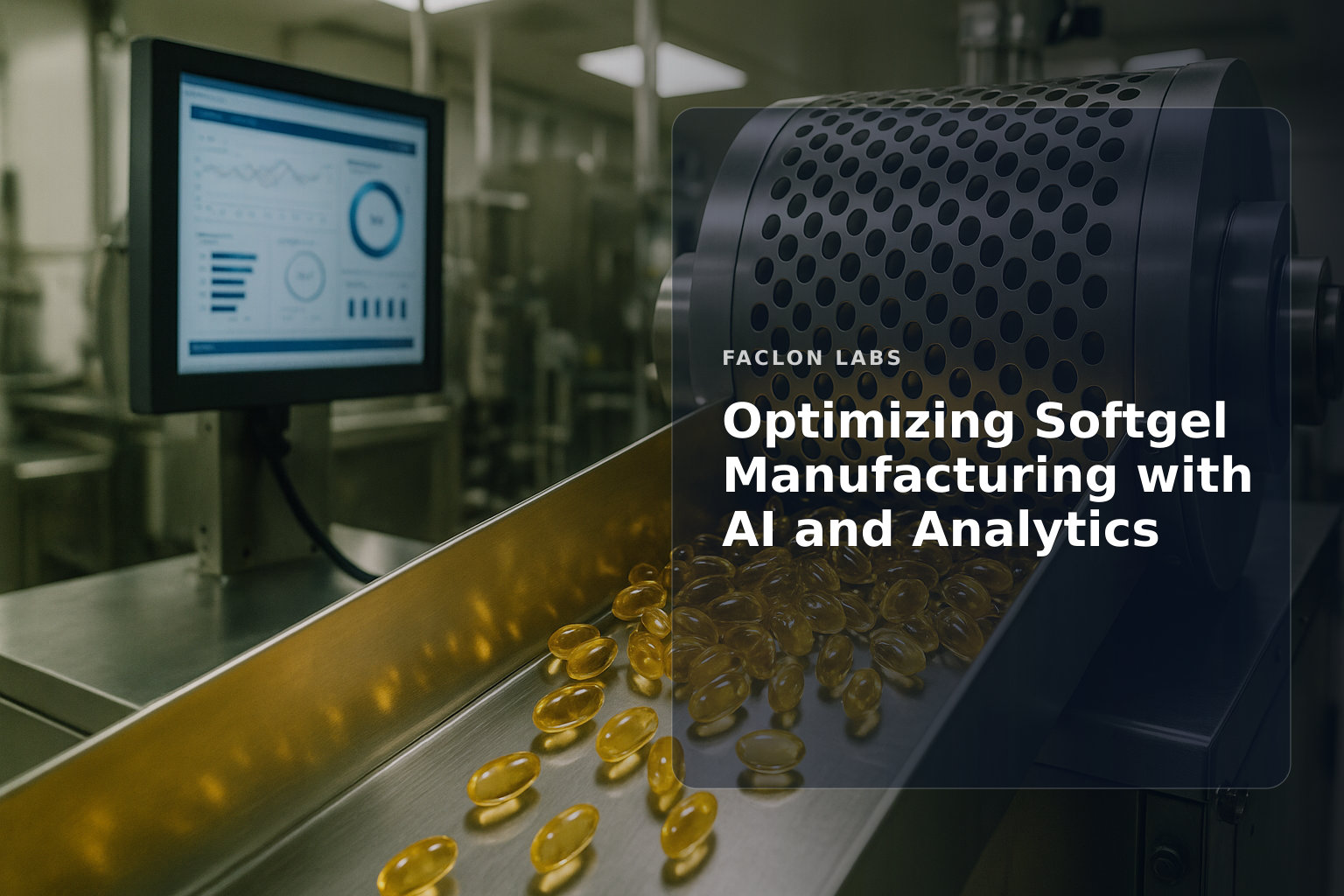
Optimizing Softgel Manufacturing with AI and Analytics

August 20, 2026

5 Mins

Faclon Labs — Optimizing Softgel Manufacturing with AI and Analytics

Content

Share This Blog
Quick answer: Softgel manufacturing is optimized by integrating AI and analytics to monitor and control critical variables such as gelatin viscosity, fill accuracy, and drying parameters. Real-time data from sensors combined with machine learning models enables predictive maintenance, reduces defects, and improves throughput, enhancing product quality and operational efficiency.

Softgel manufacturing is a complex pharmaceutical process involving multiple tightly controlled steps to produce high-quality gelatin capsules. Given the sensitivity of raw materials and environmental conditions, manufacturers face challenges in maintaining consistent product quality and minimizing waste. Industrial AI and IIoT technologies offer practical solutions to enhance visibility, control, and predictive capabilities throughout the softgel production line.

This guide outlines how plant operations leaders can implement AI-powered analytics in softgel manufacturing to achieve measurable improvements in yield, quality, and equipment uptime.

The Intricacies of Softgel Manufacturing

Overview of the traditional softgel production process

Softgel manufacturing typically involves these core steps:

  • Gelatin preparation: Melting and mixing gelatin with plasticizers and water to form a viscous gel mass.
  • Encapsulation: Two gelatin ribbons form a shell around the fill material injected between them.
  • Drying: Softgels are dried to remove excess moisture while maintaining shell integrity.
  • Polishing: Capsules are cleaned and polished for appearance and handling.
  • Inspection: Visual and mechanical inspection identifies defects such as leaks or shell imperfections.

Each stage requires precise control of variables like temperature, humidity, and fill volume to ensure capsule uniformity and stability.

Common challenges in softgel production

Softgel manufacturing is challenging due to:

  • Variability in raw materials: Gelatin viscosity and fill material properties can fluctuate batch to batch.
  • Environmental factors: Humidity and temperature changes affect drying and shell formation.
  • Process control complexity: Multiple interdependent parameters must be maintained within narrow limits.
  • Quality assurance demands: Regulatory compliance requires thorough defect detection and traceability.

These factors make softgel production one of the most sophisticated pharmaceutical manufacturing segments, demanding advanced process monitoring and control [The Definitive Guide to Softgel Manufacturing: Facilities, Operations, and Costing - Pharma Excipients].

Leveraging AI and IIoT for Enhanced Softgel Production

Introduction to Industrial AI and IIoT in pharmaceutical manufacturing

Industrial AI combines machine learning with IIoT devices—such as sensors and edge computing—to collect and analyze real-time data from manufacturing equipment and processes. In pharma environments, this integration enhances process visibility, enabling data-driven decision-making and automation.

How real-time data collection transforms process visibility

Sensors embedded in softgel production lines continuously measure:

  • Gelatin temperature and viscosity
  • Fill material flow and volume
  • Environmental humidity and temperature
  • Drying chamber moisture levels
  • Equipment performance metrics

Streaming this data to centralized platforms allows operators to monitor production live, detect deviations immediately, and adjust parameters dynamically to maintain optimal conditions.

The role of machine learning in identifying patterns and predicting outcomes

Machine learning models trained on historical and real-time data can:

  • Predict gelatin viscosity changes based on temperature and humidity trends
  • Forecast equipment failures before downtime occurs
  • Detect anomalies in fill volume or seal integrity
  • Optimize drying times to reduce cycle duration without compromising quality

This predictive capability reduces waste, improves consistency, and increases throughput [Soft Gelatin Capsule Manufacturing: GMP Controls for Fill, Shell and Leakage – Pharma GMP].

Step-by-Step Optimization: A Practical Guide

Step 1: Data Acquisition and Integration

Establish a robust data infrastructure by integrating:

  • Sensors: For temperature, humidity, viscosity, fill volume, and moisture content.
  • SCADA systems: Supervisory control and data acquisition for real-time process control.
  • MES (Manufacturing Execution Systems): To link production data with batch records and quality control.

This unified data stream forms the foundation for AI analytics.

Step 2: Predictive Modeling for Gelatin Preparation

Use machine learning to predict gelatin viscosity and optimize preparation parameters:

Parameter Sensor/Data Source AI Model Use
Gelatin temperature Temperature sensors Predict viscosity fluctuations
Humidity Environmental sensors Adjust water/plasticizer ratio
Gel mass viscosity Rheometers Forecast gel readiness for encapsulation

This reduces batch variability and ensures consistent shell quality.

Step 3: Real-time Monitoring of Encapsulation

Monitor fill material accuracy and seal integrity with:

  • Flow meters and pressure sensors to verify fill volume.
  • Vision systems for seal inspection.
  • AI algorithms to detect deviations and trigger alarms or automatic adjustments.

Step 4: AI-driven Drying Process Control

Optimize drying by analyzing moisture content and drying time:

  • Moisture sensors provide continuous feedback.
  • AI models adjust drying temperature and duration dynamically.
  • This prevents over- or under-drying, preserving capsule stability.

Step 5: Automated Quality Inspection and Anomaly Detection

Deploy computer vision and machine learning to automate defect detection:

  • Identify shell cracks, leaks, and surface imperfections.
  • Classify defects for root cause analysis.
  • Integrate inspection data with MES for traceability.

Achieving Concrete Outcomes: ROI and Operational Benefits

AI and analytics deliver measurable benefits in softgel manufacturing:

  • Reduced waste and rework: Precise control cuts defective capsule rates.
  • Improved product consistency: Stable gelatin viscosity and fill accuracy enhance quality.
  • Minimized downtime: Predictive maintenance reduces unexpected equipment failures.
  • Higher throughput: Optimized drying and encapsulation speeds increase output.
  • Enhanced OEE: Overall equipment effectiveness improves through data-driven scheduling and interventions.
Benefit Impact Metric Typical Improvement
Waste reduction % defective capsules 20-30% decrease
Product consistency Batch-to-batch variability 15-25% reduction
Downtime reduction Equipment availability 10-15% increase
Throughput increase Capsules produced per hour 10-20% increase

Implementing AI in Your Softgel Plant with Faclon Labs

Faclon Labs' approach to industrial AI solutions for pharma

Faclon Labs specializes in delivering tailored AI and IIoT solutions that integrate seamlessly with existing pharma manufacturing systems. Our platform supports data ingestion from diverse sources and applies advanced analytics to optimize processes like softgel manufacturing.

Case study examples of successful implementations

Clients have realized:

  • Early detection of gelatin viscosity shifts preventing batch failures.
  • Automated anomaly detection in encapsulation reducing manual inspection labor.
  • Predictive maintenance schedules that cut downtime by up to 15%.

Getting started: assessment, pilot, and full-scale deployment

To adopt AI in your softgel facility:

  1. Conduct a comprehensive process data assessment.
  2. Deploy a pilot project focusing on a critical process step (e.g., gelatin preparation).
  3. Scale to full production with continuous monitoring and iterative model refinement.

Faclon Labs offers expert guidance throughout this journey [The Ultimate Guide to Soft Gelatin Capsule Manufacturing - Pharma Excipients].

Key takeaways

  • Softgel manufacturing requires precise control of gelatin viscosity, fill accuracy, and drying parameters to ensure quality.
  • Industrial AI and IIoT enable real-time monitoring and predictive analytics that reduce defects and downtime.
  • A stepwise implementation approach—data acquisition, modeling, monitoring, and automated inspection—drives measurable process improvements.
  • AI-driven optimization increases throughput, enhances product consistency, and improves overall equipment effectiveness.
  • Faclon Labs provides tailored AI solutions and expert support for pharmaceutical softgel manufacturing facilities.

Optimizing your softgel manufacturing process with AI and analytics is a strategic investment that delivers clear ROI through improved quality and operational efficiency. Contact Faclon Labs today to explore how our industrial AI platform can help your plant achieve these benefits.

Frequently asked questions

What are the primary steps in the softgel manufacturing process?

The primary steps in softgel manufacturing include gelatin preparation, fill material preparation, encapsulation (forming the softgel shell and filling it simultaneously), drying, polishing, and final inspection and packaging. Each step requires precise control to ensure product quality and stability.

How can AI improve softgel capsule manufacturing?

AI can significantly improve softgel capsule manufacturing by enabling real-time process monitoring, predictive quality control, and optimized resource utilization. It helps in predicting potential defects, fine-tuning machine parameters, and reducing material waste, leading to higher yields and consistent product quality.

What are the benefits of softgel capsules compared to other dosage forms?

Softgel capsules offer several benefits, including improved bioavailability for certain compounds, enhanced patient compliance due to ease of swallowing, taste masking, and protection of sensitive ingredients from oxidation or degradation. They also allow for precise dosing and can accommodate a wide range of fill materials.

What challenges does softgel production face that AI can address?

Softgel production faces challenges like variability in raw material properties, complex drying processes, and the need for stringent quality control. AI can address these by providing data-driven insights to standardize gelatin formulation, optimize drying cycles based on real-time moisture data, and automate defect detection, thereby reducing human error and improving efficiency.

Sources

Share This Blog

Join 13,376+ Subscribers

We share Stories Around AI Agents Every 2 Weeks. No Spam.
Thank you! Your submission has been received!
Ooops! Form submission failed.
No items found.