Join Our Lunch & Learn: How Agentic AI Will Transform Industrial Operations | Register Now →
.svg)
August 13, 2026
6 Mins
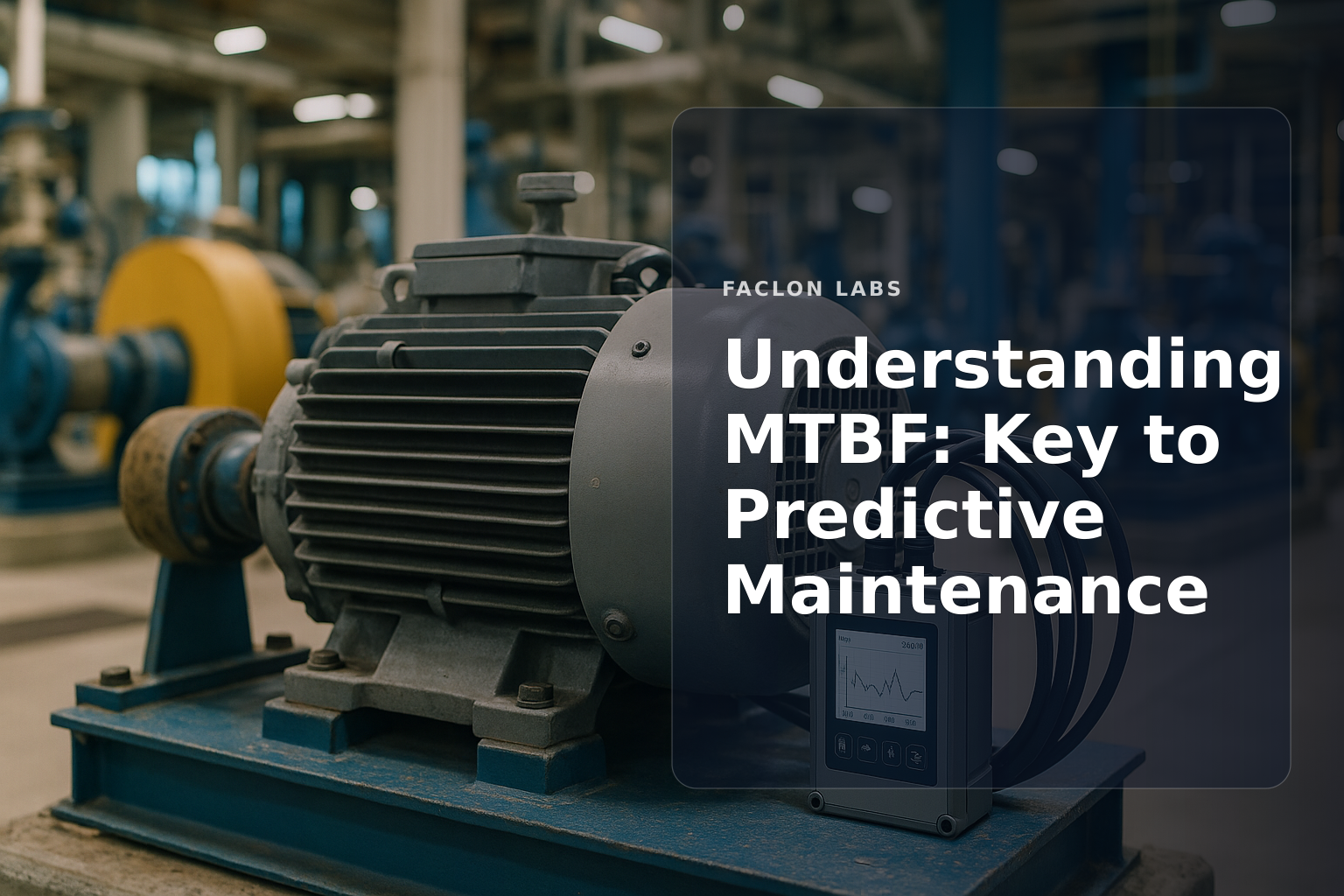
MTBF is a foundational concept in industrial maintenance that helps organizations understand how often equipment is likely to fail during normal operation. For plant operations leaders new to predictive maintenance, grasping MTBF is essential to making data-driven decisions that improve asset reliability and operational efficiency. This metric forms the basis for planning maintenance activities that prevent unexpected breakdowns and costly downtime.
By quantifying the average time between failures, MTBF offers a measurable way to track equipment health trends and prioritize maintenance efforts. In this article, we break down what MTBF means, why it matters, and how to use it effectively in your maintenance strategy.
MTBF stands for Mean Time Between Failures. It is a reliability metric that measures the average time a repairable asset operates before experiencing a failure that requires repair. Calculated by dividing the total operational time by the number of failures in that period, MTBF provides a statistical expectation of how long equipment can run under normal conditions without breaking down.
Understanding these distinctions clarifies how MTBF fits into overall reliability and maintenance metrics.
MTBF is specifically designed for assets that can be repaired and returned to service. It assumes failures are not terminal but temporary interruptions that can be fixed to resume normal operation. This focus makes MTBF highly relevant for industrial machinery and equipment where maintenance teams perform repairs to extend asset life.
MTBF is a direct indicator of equipment reliability. A higher MTBF means longer intervals between failures, signaling more dependable machinery. Tracking MTBF helps maintenance teams identify which assets are more prone to failures and prioritize them for inspection or upgrades.
By estimating how often failures occur, MTBF guides when maintenance should be scheduled to prevent unexpected breakdowns. It helps optimize resource allocation by focusing efforts on assets with lower MTBF values, reducing emergency repairs and costly downtime.
Increasing MTBF results in fewer failures, less downtime, and smoother operations. This leads to higher productivity and lower maintenance costs, directly improving return on investment (ROI) for plant operations. Predictive maintenance strategies leverage MTBF data to extend asset life and maximize uptime Benefits of Automated Maintenance Services for Industrial Plants.
The formula for MTBF is:
[ \text{MTBF} = \frac{\text{Total operational time}}{\text{Number of failures}} ]
This calculation requires accurate tracking of operational hours and failure events over a defined period.
Suppose a machine operates for 10,000 hours during a year and experiences 5 failures requiring repair. The MTBF would be:
[ \frac{10,000 \text{ hours}}{5 \text{ failures}} = 2,000 \text{ hours} ]
This means on average, the machine runs 2,000 hours between failures.
| Metric | Definition | Applies To | Purpose |
|---|---|---|---|
| MTBF | Average time between failures | Repairable systems | Measures reliability and helps schedule maintenance |
| MTTF | Average time to failure | Non-repairable items | Estimates useful life expectancy |
| MTTR | Average time to repair | Repairable systems | Measures maintenance efficiency |
Together, MTBF, MTTF, and MTTR provide a comprehensive view of equipment performance and maintenance needs. MTBF and MTTF help predict failure frequency, while MTTR measures downtime impact and repair speed.
Monitoring MTBF over time reveals whether asset reliability is improving or degrading. Increasing MTBF indicates effective maintenance and longer asset life, while declining MTBF signals emerging issues needing attention.
MTBF alone does not capture failure severity, repair quality, or root causes. It should be combined with other data, such as failure modes and condition monitoring, for a fuller reliability picture.
Combining MTBF with real-time condition data from IoT sensors enables predictive maintenance models that anticipate failures before they occur. This integration enhances decision-making accuracy and maintenance efficiency Generative AI Platforms: Capabilities, Applications, and Selection for Industrial AI.
Advanced analytics and AI can analyze MTBF trends alongside sensor data to predict failures and recommend optimal maintenance windows, reducing unplanned downtime and extending MTBF.
Organizations using predictive maintenance platforms have reported MTBF increases of 20-30%, translating into significant cost savings and uptime improvements Understanding Energy Consumption in Industrial Plants.
MTBF measures average time between failures for repairable systems, while MTTF applies to non-repairable components and indicates average time to failure without repair.
No, MTBF provides an average failure interval, not precise failure timing. It helps estimate reliability trends but cannot forecast exact breakdowns.
MTBF should be recalculated regularly as new operational and failure data accumulate, ideally after every significant maintenance cycle or quarterly for most plants.
Generally, yes—a higher MTBF indicates longer operating times between failures. However, it must be interpreted alongside other factors like failure severity and maintenance quality.
Understanding and applying MTBF effectively empowers plant operations leaders to reduce downtime, extend asset life, and increase maintenance ROI. Start tracking your MTBF data accurately today and explore how integrating it with condition monitoring and AI can elevate your predictive maintenance strategy.
MTBF stands for Mean Time Between Failures. It is important because it measures the average time a repairable system operates before a failure occurs, helping maintenance teams predict and prevent unexpected downtime.
MTBF measures average time between repairable failures, MTTF (Mean Time To Failure) applies to non-repairable systems, and MTTR (Mean Time To Repair) measures the average time taken to fix a failure. Together, these metrics provide a comprehensive view of asset reliability and maintenance efficiency.
MTBF provides an average expected time between failures, but it does not predict exact failure times. It is a statistical measure used to guide maintenance scheduling rather than precise failure forecasting.
Leaders use MTBF data to identify assets with frequent failures, optimize maintenance intervals, allocate resources efficiently, and implement predictive maintenance strategies that reduce downtime and extend asset life.
Accuracy can be affected by inconsistent failure reporting, varying operating conditions, small sample sizes, and failure modes that are not random or constant over time. It's important to use MTBF alongside other reliability data and condition monitoring.