Join Our Lunch & Learn: How Agentic AI Will Transform Industrial Operations | Register Now →
.svg)
August 21, 2026
5 Mins
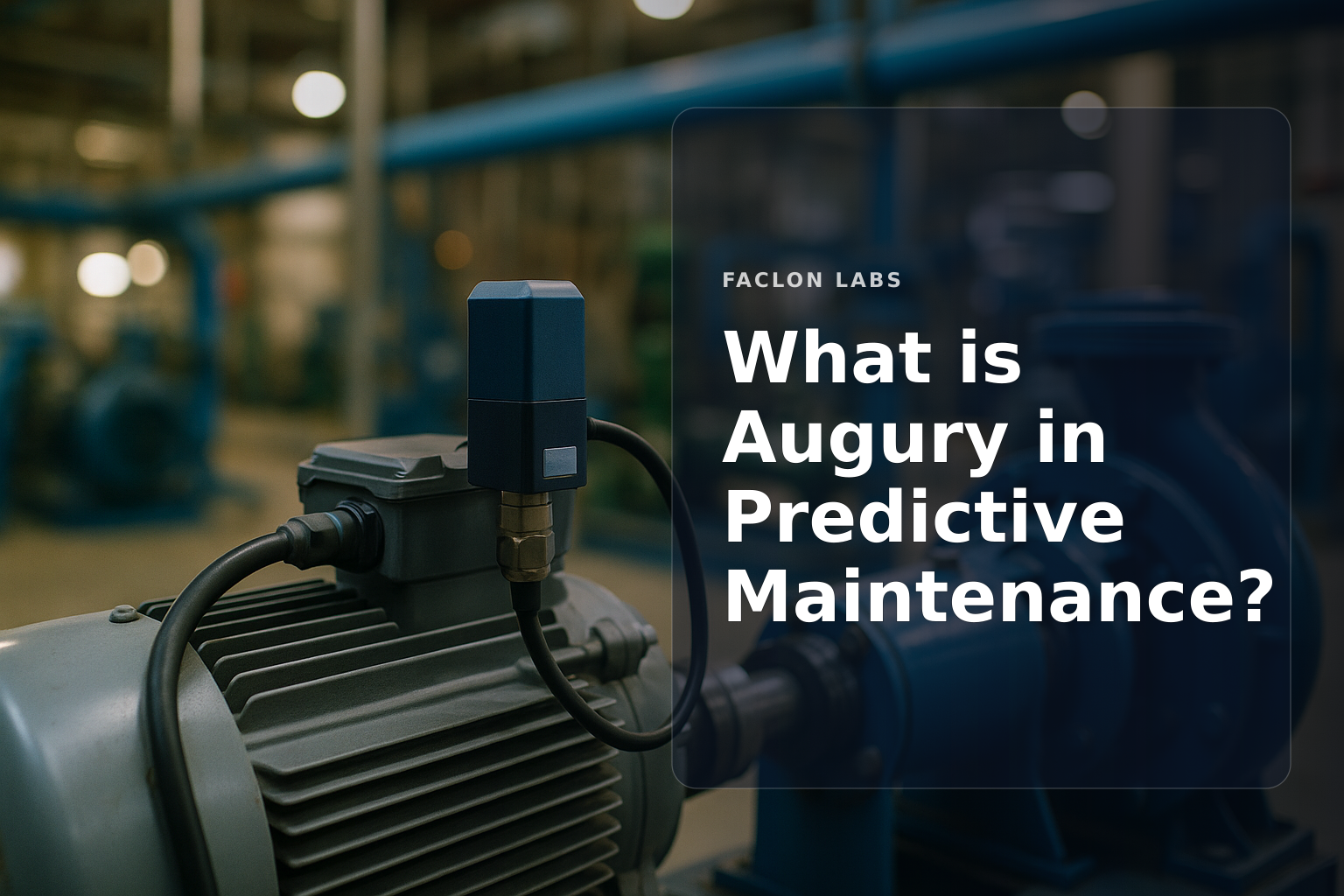
Predictive maintenance has become a cornerstone of modern industrial operations, shifting maintenance strategies from reactive to proactive. The term “augury,” originally rooted in ancient practices of divining the future by observing natural signs, now finds a new meaning in industrial technology. It symbolizes the ability to predict and prevent machine failures using data-driven insights rather than superstition.
Understanding what augury means in the context of predictive maintenance helps plant operations leaders appreciate how AI-powered tools transform maintenance workflows. This article breaks down the concept, the technology behind it, and the measurable benefits it delivers.
Historically, augury was the practice of interpreting omens, especially through the behavior of birds, to foresee future events. In industrial contexts, the term has been repurposed to describe the predictive capabilities enabled by data and AI. Instead of birds, machines “signal” their health status through sensor data, which is analyzed to anticipate failures.
Where ancient augury relied on observation and interpretation of natural phenomena, modern predictive maintenance uses precise measurements and algorithms. This shift reflects the evolution from subjective forecasts to objective, data-backed predictions that improve reliability and decision-making.
The name “Augury” captures the essence of foresight—knowing what lies ahead to take timely action. It embodies the transition from guessing to scientifically predicting machine health, aligning perfectly with the goals of predictive maintenance in industrial operations.
Augury, as a company, develops industrial AI platforms that monitor the health of machines continuously. Their technology integrates smart sensors with AI algorithms to detect anomalies and diagnose faults early, enabling maintenance teams to act before breakdowns occur.
Traditional maintenance often relies on scheduled inspections or reactive repairs after failures. Augury’s approach uses continuous monitoring and predictive analytics to:
This leads to more efficient resource use and less unplanned downtime Benefits of Automated Maintenance Services for Industrial Plants.
By forecasting failures before they happen, Augury helps plants avoid costly unplanned stoppages. Early detection means repairs can be scheduled during planned downtime, preserving production continuity.
Predictive insights allow maintenance teams to focus on machines that need attention, improving workforce efficiency and spare parts management. This targeted approach reduces labor and inventory costs.
Augury’s technology contributes to higher OEE by minimizing downtime, reducing defects, and maximizing throughput. The result is a tangible uplift in operational performance and cost savings.
| Benefit | Impact on Operations |
|---|---|
| Reduced unplanned downtime | Increased production availability |
| Targeted maintenance actions | Lower maintenance costs and labor efficiency |
| Improved machine reliability | Higher product quality and throughput |
These outcomes directly tie to improved ROI for industrial operators How to Calculate and Improve OEE in Manufacturing.
Industrial AI algorithms continuously learn from machine data, recognizing normal operating patterns and flagging anomalies that may indicate faults. This automated fault detection accelerates troubleshooting and reduces human error.
Raw data streams are complex and voluminous. AI processes this data to generate clear, prioritized alerts and diagnostic information, enabling maintenance teams to make informed decisions quickly.
AI agents work around the clock, providing real-time health scores and prognostics. This persistent monitoring ensures no early warning signs are missed, supporting a proactive maintenance culture Top Manufacturing Execution Software for Industrial Plants.
Augury’s platform is designed to integrate seamlessly with existing IIoT systems, leveraging current sensors and data networks. This compatibility facilitates scalable deployment without extensive retrofitting.
Security is critical when connecting operational technology to networks. Augury employs robust encryption and access controls to protect sensitive machine data while supporting scalable growth across multiple assets and sites.
As industrial AI and IIoT technologies evolve, platforms like Augury’s will enable even more precise predictions, autonomous maintenance actions, and integration with broader digital transformation initiatives, driving continuous operational improvement The Future of Automated Manufacturing: Trends for 2025.
Predictive maintenance powered by augury-style industrial AI is no longer a futuristic concept but a practical tool for plant operations leaders. Exploring how these technologies fit into your existing workflows can help you reduce downtime and improve productivity. For deeper insights on implementing predictive maintenance, check out our resources on Implementing Total Productive Maintenance for Industrial Assets and Understanding Energy Consumption in Industrial Plants.
Augury's primary function in manufacturing is to provide AI-driven machine health monitoring and predictive maintenance solutions. This helps manufacturers prevent equipment failures, optimize uptime, and improve overall operational productivity by offering real-time insights into machine performance.
Augury uses AI by deploying advanced sensors to collect data (like vibration, temperature, and acoustics) from industrial machines. Machine learning algorithms then analyze this data to detect anomalies, predict potential failures before they occur, and diagnose root causes, providing actionable intelligence to maintenance teams.
Augury is both a technology platform and a service. It provides proprietary hardware (sensors) and software (AI analytics platform) for machine health monitoring, often bundled with expert services for implementation, data analysis, and ongoing support, delivering a comprehensive predictive maintenance solution.
Benefits include significant reductions in unplanned downtime, extended asset lifespan, lower maintenance costs, improved safety, and increased production efficiency. By predicting failures, plants can switch from reactive to proactive maintenance, leading to more stable and profitable operations.