Join Our Lunch & Learn: How Agentic AI Will Transform Industrial Operations | Register Now →
.svg)
June 8, 2026
7 Minutes
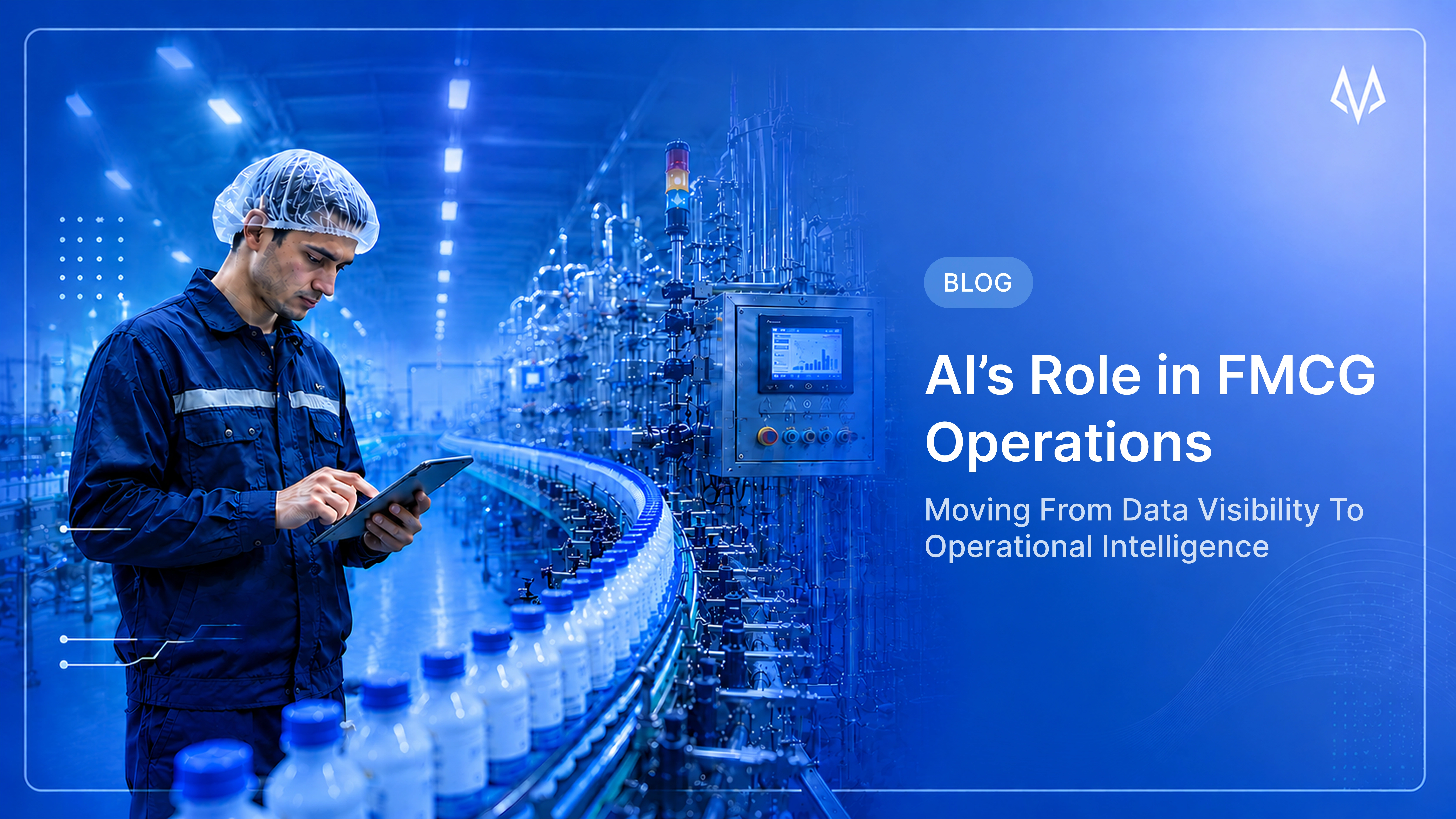
Fast-moving consumer goods (FMCG) have always been an industry characterized by speed, scale, and change. Consumer demands shift constantly, factory schedules need to adapt daily, and disruptions are part of the normal flow. Operational efficiency has been under constant focus.
In the past decade, there has been a lot of investment in digital transformation projects within FMCG manufacturing companies. Sensors, automated systems, MES systems, ERP solutions, and Industrial IoT have been implemented at the factory level to create operational transparency. Therefore, the fact that many companies have significantly more operational data than ever before is not uncommon.
However, although the amount of data available has increased dramatically, there is still one major issue that persists: the difficulty for the operational team to derive actionable decisions from all the data collected. It seems that this is where digital transformation will be taking place in the coming years. It is no longer about collecting even more data or creating even more dashboards. The goal is to create operational intelligence and provide actionable decision-making recommendations.
Modern FMCG manufacturing environments are significantly more complex than they were just a few years ago.
Several factors are contributing to this increasing operational pressure:
Consumer preferences are changing faster than ever. Seasonal fluctuations, promotional campaigns, shifting retail patterns, and evolving market dynamics create constant uncertainty in production planning.
Manufacturers must balance inventory levels, production capacity, and service levels while maintaining operational efficiency.
Even minor disruptions can have significant consequences in high-volume FMCG environments. Equipment failures, process deviations, and quality issues can quickly impact production targets and profitability.
Reducing downtime remains a critical priority for plant leaders.
Rising energy prices and increasing sustainability goals mean that manufacturers must reduce their energy use without reducing throughput or compromising product quality.
To do so, one needs to have a better understanding of operations than can be achieved by conventional monitoring tools.
With increased complexity, operational staff need more than just visibility; they require intelligence that allows them to gain insight into what is going on, what it means, and what they should do next.
For decades, dashboards have been the main tool used for tracking the performance of plants. Dashboards offer a gateway to production KPIs, machine-related information, product quality metrics, and energy consumption trends. Dashboards do have a key role to play in terms of tracking processes, but they are ineffective when it comes to making decisions based on that information. This is not due to the lack of information available. It is about the context surrounding the information.
A common problem at FMCG plants is having too much data and lacking context for that data. Frequently, operations teams are faced with the need to analyze a single issue using many different sources of information.
When an operational disruption occurs, teams often spend valuable time answering basic questions:
Traditional dashboards rarely provide these answers directly. Instead, engineers and operators must manually gather information from multiple sources, interpret trends, and rely heavily on personal experience or tribal knowledge.
This reactive approach creates several challenges:
As manufacturing environments become more complex, organizations need systems capable of transforming raw data into operational understanding. This is where Industrial AI is beginning to create a meaningful impact.
Most of the discussions about AI with regard to the manufacturing industry focus on the concept of predictive analysis and machine learning. While predictive analysis remains highly relevant, it makes up only one small component.
The most relevant area in which AI can help is represented by an operational intelligence layer, allowing employees to understand their operational position.
One of the most time-intensive tasks in manufacturing is determining the root cause of production issues. Teams end up wasting many man-hours analyzing trends, logs, maintenance schedules, and process variables when production losses happen.
However, artificial intelligence will enable them to analyze several sources of information and identify the most probable causes, thus saving the team valuable time as they need not waste effort looking for answers.
An industrial environment produces hundreds of alerts and exceptions each day. However, not all of them require any action, nor do they all signify a problem.
AI technology can assist in discerning which of these is simply a variation and which poses an actual risk, taking into account what's happening throughout the system at large.
Plant leaders often need a clear understanding of operational performance without reviewing dozens of dashboards and reports.
AI can automatically generate operational summaries that explain key events, production trends, equipment issues, and performance deviations in simple business language.
This reduces reporting effort while improving situational awareness.
The emergence of industrial copilots is changing how users interact with operational information.
Rather than navigating multiple systems, operators and engineers can simply ask questions such as:
AI can interpret these questions and provide contextual responses based on real operational data.
This conversational approach democratizes access to information and reduces reliance on specialized analytics expertise.
The following level of AI evolution involves not just prediction but recommendation. It is not just the identification of a probable problem, but also recommending a course of action based on previous patterns, operational requirements, and existing conditions at the plant.
This takes AI from an analysis function to a decision-making function.
Whether AI can succeed in the manufacturing sector depends not on the complexity of algorithms but on how effectively it is integrated into daily operational workflows. Too often, AI is viewed merely as an analytical tool rather than a means of driving operational value. However, insights become truly valuable only when they reach the right person at the right time within their workflow, enabling faster and more informed decision-making.
Production teams need immediate access to operational intelligence while managing throughput, quality, and efficiency.
AI should provide recommendations directly within production environments, helping operators identify emerging issues before they escalate.
Conventional monitoring mainly concentrates on the visualization of the operational state. AI-based monitoring centers around the interpretation of operational states.
In contrast to having users analyze trends by themselves, AI can take care of providing the most valuable insights and explanations thereof.
This change will make operations more responsive to any changes. What we aim at here is not replacing professional knowledge. We aim to support the work of professionals with relevant intelligence.
One of the most promising developments in Industrial AI is the emergence of industrial copilots.
Industrial copilots combine advanced AI capabilities with operational knowledge to assist plant teams in real time.
Unlike generic AI tools, industrial copilots are designed specifically for manufacturing environments.
They understand:
With the development of such technologies, they will become a key point of contact for operational intelligence. The staff within an organization will be able to engage in dialogue with operational information using natural language rather than dashboards.
The benefit associated with this would be the improvement of the speed of decision-making and the effectiveness of the workforce. In FMCG companies experiencing workforce changes and increasing complexity, industrial copilots could become a necessary asset.
The Future of FMCG Operations Is Intelligence-Driven
The future of FMCG manufacturing will not be defined by who collects the most data. It will be defined by who can transform data into action the fastest.
Organizations that successfully deploy operational intelligence capabilities will be better positioned to:
The future of manufacturing will be intelligent, connected, predictive, and adaptive. AI will go further than just reports and analysis; it will start taking part in the decision process itself.
For FMCG executives, it’s not a matter of if AI will affect operations, but rather, how soon organizations will be able to evolve from visibility to intelligence.
The manufacturing industry is moving towards an era of greater digital transformation. Although improvements such as dashboards and analytics have enhanced visibility within businesses, it is time for something even more complex to happen. Through linking disparate data, providing context, quickening the process of root cause analysis, and integrating intelligence into workflows, Industrial AI is making way for a new era of operational excellence.
At Faclon Labs, we firmly believe that contextual operational intelligence will be what FMCG operations will need in the future. By leveraging AI, companies will gain valuable insights that can help make daily decisions better. Those who choose to embrace this paradigm change will not merely optimize their business processes but create the necessary manufacturing ecosystems for future success.
AI in FMCG operations goes beyond data visualization by providing contextual operational intelligence. Instead of simply displaying metrics, AI helps manufacturers identify root causes, interpret anomalies, generate operational summaries, and recommend actions that improve decision-making and plant performance.
Operational intelligence is the ability to combine data from multiple systems and convert it into actionable insights in real time. By using Industrial AI, FMCG manufacturers can move from reactive troubleshooting to proactive decision-making, improving productivity, efficiency, and operational responsiveness.
Industrial AI enhances predictive maintenance in FMCG by analyzing equipment performance, maintenance records, and operational conditions to identify potential failures before they occur. This helps reduce unplanned downtime, optimize maintenance schedules, and improve asset reliability across manufacturing facilities.
Industrial copilots act as AI-powered assistants that help plant teams access operational insights through natural language interactions. In smart manufacturing FMCG environments, they enable operators, engineers, and plant managers to quickly understand performance issues, identify opportunities for improvement, and make faster operational decisions.
FMCG manufacturers are investing in AI in manufacturing because increasing operational complexity requires more than visibility alone. AI-driven operational intelligence helps organizations connect siloed data, accelerate root cause analysis, improve energy efficiency, support real-time decision-making, and create more adaptive and resilient operations.
July 30, 2026
10 minutes
.svg)
%20(1).webp)
July 9, 2026
7 min
July 9, 2026
9 min read