Join Our Lunch & Learn: How Agentic AI Will Transform Industrial Operations | Register Now →
.svg)
July 9, 2026
9 min read
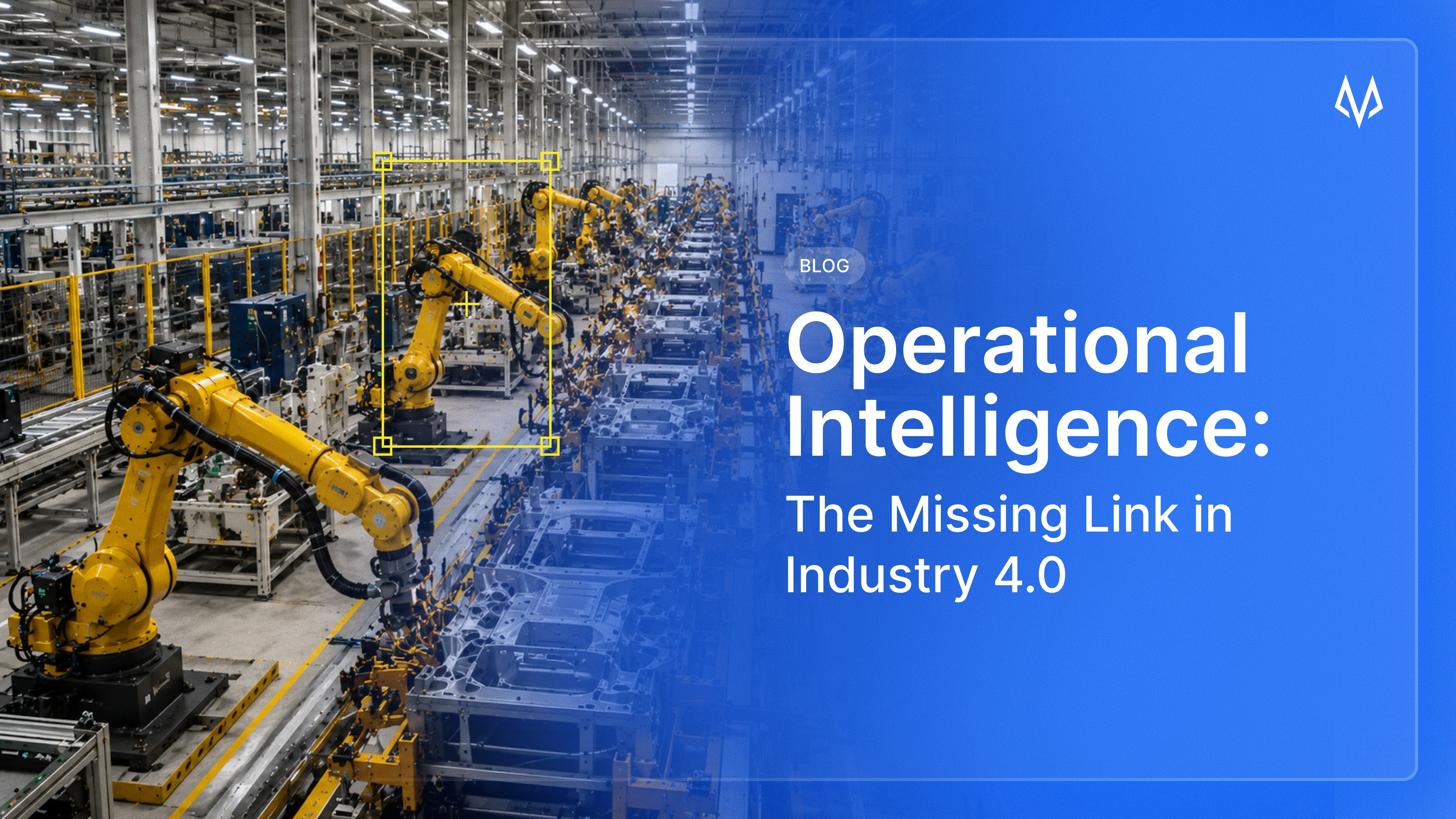
For more than a decade, Industry 4.0 has helped manufacturers build connected factories and use data to improve operations. Companies have invested in Industrial IoT (IIoT), cloud platforms, sensors, MES, ERP, SCADA systems, AI, and other digital technologies. However, many factories still struggle with common challenges such as unplanned downtime, high energy costs, quality issues, disconnected data, and slow, reactive decision-making.
The problem isn’t the lack of data. It’s the lack of Operational Intelligence.
Every day, industrial organizations generate huge amounts of data from production lines, machines, energy systems, and maintenance operations. However, this data is often scattered across different systems, making it difficult to turn into useful insights.
According to industry estimates, manufacturers generate millions of operational data points every day, yet much of this information remains underutilized because it is spread across multiple systems. As factories adopt AI, Industrial IoT (IIoT), and automation, the real challenge is no longer collecting data; it’s turning that data into faster, smarter business decisions.
Operational Intelligence solves this by connecting data, adding context, and using AI to support faster, smarter decisions. As Industry 4.0 moves toward autonomous manufacturing and Agentic AI, Operational Intelligence is becoming the foundation for turning insights into action.
✔ Manufacturers generate millions of operational data points every day.
✔ Unplanned downtime remains one of the biggest causes of production losses.
✔ Energy costs account for a significant share of manufacturing operating expenses.
✔ AI adoption in manufacturing continues to grow as companies focus on predictive maintenance, energy optimization, and production efficiency.
Since the first wave of Industry 4.0, manufacturers have successfully digitized operations by connecting machines, deploying sensors, and collecting vast amounts of production data. While these investments have improved visibility through dashboards and reports, visibility alone doesn’t drive better outcomes.
Today’s industrial leaders are shifting their focus from simply gathering data to using Operational Intelligence to transform real-time insights into faster decisions, improved efficiency, and measurable business results. The key question is no longer “How much data do we have?” but “How can we turn our operational data into meaningful business value?”
Across manufacturing conferences, industrial technology forums, analyst reports, and vendor announcements, several themes consistently dominate conversations.
Manufacturers are moving beyond AI experiments and focusing on solutions that deliver measurable business outcomes. Rather than using AI solely for predictive analytics, organizations are adopting intelligent systems that optimize production, reduce costs, improve asset reliability, and accelerate decision-making.
The next evolution of Industrial AI lies in prescriptive and autonomous capabilities that not only predict potential issues but also recommend or even execute the best course of action to enhance operational performance.
Manufacturers today face several challenges, including rising energy prices, higher maintenance costs, supply chain disruptions, workforce shortages, and increasing production demands. As a result, improving operational efficiency has become a top priority. Companies are looking for smart technologies that reduce waste, improve productivity, and lower costs without requiring major capital investments.
Connecting machines is no longer enough.
Organizations now want every operational system, including ERP, MES, SCADA, historians, maintenance software, quality systems, laboratory information systems, and utility data, to work together as one connected ecosystem.
The objective is to eliminate data silos and provide a single operational view across the enterprise.
Environmental sustainability is no longer treated solely as a compliance initiative.
Reducing emissions, optimizing energy consumption, minimizing water usage, and lowering waste now directly influence operating margins.
Manufacturers increasingly recognize that sustainability and profitability are closely aligned.
Industrial AI is entering a new phase.
Instead of merely answering questions, AI systems are beginning to analyze situations, recommend actions, coordinate workflows, and automate operational decisions.
These intelligent agents represent the next evolution of digital manufacturing.
However, their effectiveness depends entirely on access to clean, contextualized industrial data.
Without Operational Intelligence, even the most advanced AI agents cannot deliver reliable outcomes.
Manufacturers are increasingly focusing on protecting operational technology (OT) environments from cyber threats. As more factory systems become connected, securing industrial networks has become just as important as improving productivity.
Many manufacturers already have the essential digital infrastructure, including sensors, SCADA systems, historians, ERP, CMMS, and dashboards. However, valuable operational data often remains siloed, forcing engineers to piece together information from multiple systems before making decisions.
Operational Intelligence bridges this gap by adding context to real-time data, connecting equipment health, production schedules, maintenance history, energy usage, quality metrics, and process conditions. Instead of simply explaining what happened, it helps organizations understand why it happened, what is likely to happen next, and what actions will deliver the greatest business value.
Operational Intelligence brings together industrial connectivity, contextualized data, real-time analytics, AI, and automated workflows into a unified decision-making platform. Rather than replacing existing systems, it integrates them to provide a complete operational view.
For example, if a production slowdown occurs, Operational Intelligence can identify the affected asset, detect abnormal equipment behavior, correlate it with maintenance history and energy usage, and recommend corrective actions before quality or productivity is impacted. By automatically triggering workflows and delivering real-time business insights, it enables organizations to move beyond simple monitoring to proactive, intelligent operations.
Unexpected equipment failures remain one of manufacturing’s highest hidden costs.
By continuously monitoring asset behavior, identifying anomalies, and recommending proactive maintenance, Operational Intelligence enables organizations to:
Energy often represents one of the largest controllable operating expenses. Operational Intelligence continuously analyzes:
This enables organizations to reduce energy waste while maintaining production performance.
Production losses rarely originate from a single cause.
Instead, they emerge from multiple operational factors happening simultaneously.
Operational Intelligence correlates production, maintenance, quality, utilities, and process conditions to identify the true drivers behind reduced throughput and lower OEE.
Quality issues frequently appear only after production is complete.
Operational Intelligence continuously monitors process parameters, identifies deviations early, and alerts operators before defects escalate into large-scale quality losses.
Engineers often spend significant time gathering data before solving problems.
Operational Intelligence dramatically shortens this cycle by providing contextual recommendations instead of disconnected reports.
This enables faster response times and more consistent operational decisions.
Operational Intelligence delivers value across a wide range of industries. In manufacturing, it helps improve OEE, reduce downtime, and optimize production planning. Cement plants can enhance kiln performance and lower energy consumption, while metals and mining companies can improve asset reliability and operational efficiency. In food and beverage, it supports quality consistency and waste reduction, and in pharmaceuticals, it improves compliance, batch quality, and production visibility. Utilities can use Operational Intelligence to monitor assets, optimize energy performance, and strengthen operational resilience.
Industry 4.0 has successfully connected machines and digitized factory operations, but the next stage of transformation is about connecting decisions. While dashboards provide visibility, they rarely deliver the actionable intelligence needed to optimize operations. Operational Intelligence enables manufacturers to continuously learn, adapt, and make smarter decisions by combining real-time data with AI-driven insights.
As industrial AI becomes more autonomous, organizations that build a strong Operational Intelligence foundation will improve efficiency, resilience, and competitiveness. Ultimately, the future of manufacturing will be determined not by how much data is collected, but by how effectively that data is transformed into intelligent action.
Operational Intelligence requires more than another dashboard. It requires a connected industrial ecosystem.
Faclon’s Industrial Intelligence platform brings together operational data from across the enterprise into a single, contextualized environment that transforms data into decisions.
By integrating assets, utilities, production systems, maintenance platforms, enterprise applications, and industrial protocols, organizations gain a unified operational view that enables AI-driven optimization across the plant.
Key capabilities include:
Faclon helps manufacturers move beyond dashboards by creating a unified Industrial Intelligence platform that connects OT and IT systems. With AI-powered insights, predictive maintenance, energy optimization, KPI monitoring, and intelligent workflows, manufacturers can make faster decisions while improving productivity, reliability, and sustainability.
Operational Intelligence (OI) helps manufacturers collect, connect, and analyze real-time data from machines, equipment, and production systems. Unlike traditional dashboards that only show past performance, OI uses Industrial IoT, AI, and analytics to provide actionable insights. This helps businesses reduce downtime, improve productivity, optimize energy use, and make faster, smarter decisions.
Industry 4.0 is about creating connected and digital factories using technologies like Industrial IoT, AI, cloud computing, and automation. Operational Intelligence is a key part of Industry 4.0 that turns real-time factory data into smart decisions. Simply put, Industry 4.0 connects factories, while Operational Intelligence helps them run more efficiently and intelligently.
Operational Intelligence helps manufacturers improve overall performance. It reduces unplanned downtime, improves equipment reliability, lowers energy costs, increases OEE, enhances product quality, and enables faster decisions with real-time insights. It also supports sustainability by reducing waste and emissions.
Artificial Intelligence (AI) makes Operational Intelligence more powerful by analyzing real-time factory data, detecting problems early, predicting equipment failures, and suggesting the best actions. Advanced technologies like Agentic AI can also automate maintenance tasks, optimize energy use, and support smarter, faster decisions across manufacturing operations.
Faclon’s Industrial Intelligence platform connects data from Industrial IoT devices, PLCs, SCADA, ERP, MES, CMMS, and other systems into one platform. With real-time monitoring, AI, predictive maintenance, and energy optimization, it helps manufacturers improve efficiency, reduce costs, increase asset reliability, and speed up their Industry 4.0 journey.
July 30, 2026
10 minutes
.svg)
%20(1).webp)
July 9, 2026
7 min
June 23, 2026
6 Mins