Join Our Lunch & Learn: How Agentic AI Will Transform Industrial Operations | Register Now →
.svg)
August 21, 2026
5 Mins
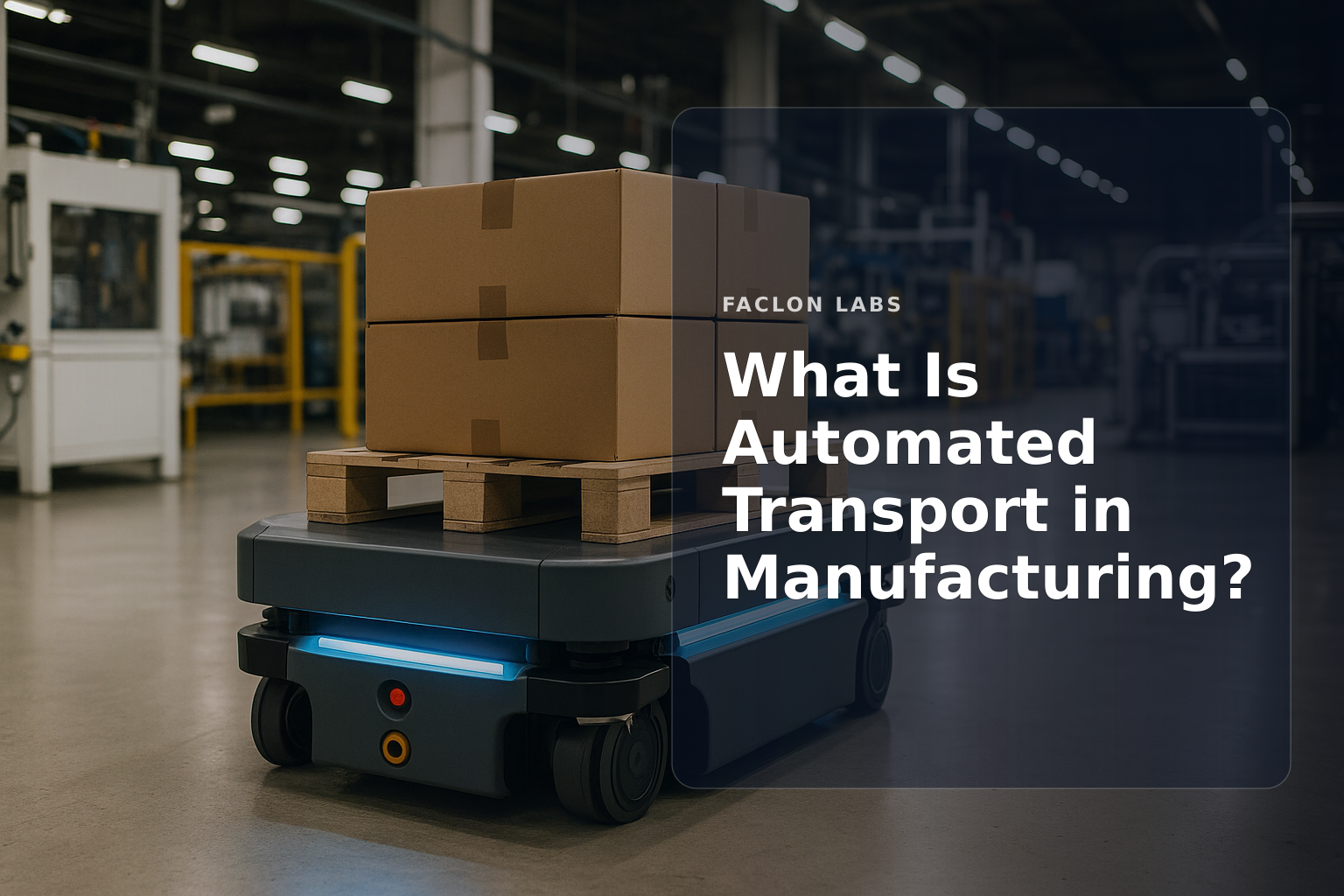
Automated transport is reshaping how manufacturing plants handle internal logistics, addressing the need for faster, safer, and more cost-effective movement of materials. Unlike public autonomous vehicles, automated transport focuses on controlled industrial environments, optimizing workflows from raw material delivery to finished product shipment. Understanding this concept is essential for plant operations leaders aiming to improve throughput and operational resilience.
Automated transport in manufacturing is distinct from autonomous vehicles on public roads. It centers on the internal movement of goods within factories, warehouses, and between production sites. This includes transporting raw materials to workstations, moving work-in-progress (WIP) items along assembly lines, and delivering finished products to storage or shipping areas.
These systems operate with varying degrees of autonomy, often guided by sensors, AI, and pre-programmed routes. Precision in navigation and timing is critical to synchronize with production schedules. Integration with manufacturing execution systems (MES) and enterprise resource planning (ERP) platforms ensures seamless flow and real-time tracking.
Manufacturers adopt automated transport primarily to increase operational efficiency, reduce manual labor risks, and lower costs. Automated systems minimize human error, reduce downtime caused by material delays, and improve workplace safety by limiting human-machine interactions in potentially hazardous zones.
AGVs follow predetermined paths using physical markers or magnetic strips. They are reliable for repetitive transport tasks within clearly defined layouts, such as moving pallets or containers between fixed points.
AMRs use advanced sensors and AI algorithms to navigate dynamically, adapting routes in real-time. This flexibility allows them to operate in more complex, changing environments without infrastructure modifications.
Conveyors provide continuous material flow, ideal for high-volume or assembly line processes. Integration with sensors and controls enables automated sorting, merging, and routing.
| Technology | Navigation Type | Typical Use Case | Flexibility Level |
|---|---|---|---|
| Automated Guided Vehicles | Fixed routes | Pallet transport, repetitive tasks | Low |
| Autonomous Mobile Robots | Dynamic, sensor-based | Complex environments, mixed tasks | High |
| Automated Conveyor Systems | Continuous flow | Assembly lines, bulk movement | Medium |
| Drones | Aerial, sensor-based | Inventory, small part transport | Experimental/Medium |
| Robotic Arms | Fixed or adaptive | Loading/unloading, integration with AGVs | Medium |
| Automated Storage/Retrieval | Automated positioning | Warehouse storage optimization | Medium |
Automated transport reduces material transit times and synchronizes deliveries with production schedules, increasing overall throughput.
By automating transport in hazardous or congested areas, the risk of accidents and injuries is significantly lowered.
Automation reduces dependency on manual labor for repetitive tasks, lowering labor costs and minimizing costly errors or damage.
Systems like AMRs can be reprogrammed and redeployed quickly to adapt to changing production needs or layouts.
Integrated sensors and software provide real-time data on material flow, enabling predictive maintenance and process optimization Essential Tools for Data Analytics in Smart Manufacturing.
Automated transport handles internal logistics, ensuring materials reach the right place at the right time, which is crucial for lean manufacturing.
Precision timing and routing allow automated transport to support just-in-time (JIT) manufacturing by delivering parts exactly when needed.
Automated systems streamline storage, retrieval, and order fulfillment processes, reducing lead times and improving accuracy.
In industries such as steel or chemicals, automation improves safety by limiting human exposure to dangerous conditions while maintaining material flow Implementing Industrial Automation Solutions for Smart Factories.
Automated transport requires upfront capital for hardware, software, and integration. ROI depends on operational scale, complexity, and labor cost savings.
Compatibility with current MES, ERP, and other IT infrastructure is essential to realize full benefits without disrupting ongoing operations.
Connected transport systems increase exposure to cyber risks; robust security measures are necessary to protect data and system integrity.
Successful adoption depends on training staff to operate alongside automated systems and managing change to minimize resistance Addressing Key Challenges in the Manufacturing Industry.
Automated transport focuses on controlled industrial environments with defined routes and tasks, while autonomous driving targets public roads with complex, unpredictable conditions.
Industrial automated transport operates under different safety regulations than autonomous vehicles on public roads, often allowing faster deployment.
Manufacturing facilities offer structured environments, enabling simpler navigation and control compared to the variability of public traffic scenarios.
Automated transport is a foundational technology for modern manufacturing efficiency and safety. If you're exploring how to enhance your plant's material handling capabilities, start by assessing your current workflows and identifying where automation can deliver the most impact. For deeper insights on integrating automated transport with industrial AI and data analytics, explore our related resources Implementing Industrial Automation Solutions for Smart Factories.
An automated transportation system utilizes advanced technologies like AI, sensors, and robotics to operate vehicles and manage transport networks without direct human control. In manufacturing, this primarily involves moving materials and products within factories or supply chains to enhance efficiency and safety.
Automated transport in manufacturing offers numerous benefits, including increased operational efficiency, reduced labor costs, improved workplace safety by minimizing human error, enhanced throughput, and greater flexibility in production processes. It also provides valuable data for continuous optimization.
Key types of automated transport in manufacturing include Automated Guided Vehicles (AGVs) that follow fixed paths, Autonomous Mobile Robots (AMRs) with dynamic navigation capabilities, and automated conveyor systems for continuous material flow. Other forms include robotic arms for handling and automated storage and retrieval systems (AS/RS).
Automated transport improves supply chain management by optimizing internal logistics, reducing transit times, minimizing errors in material handling, and providing real-time tracking of goods. This leads to more predictable operations, lower inventory costs, and faster response times to demand fluctuations.