Join Our Lunch & Learn: How Agentic AI Will Transform Industrial Operations | Register Now →
.svg)
August 19, 2026
5 Mins
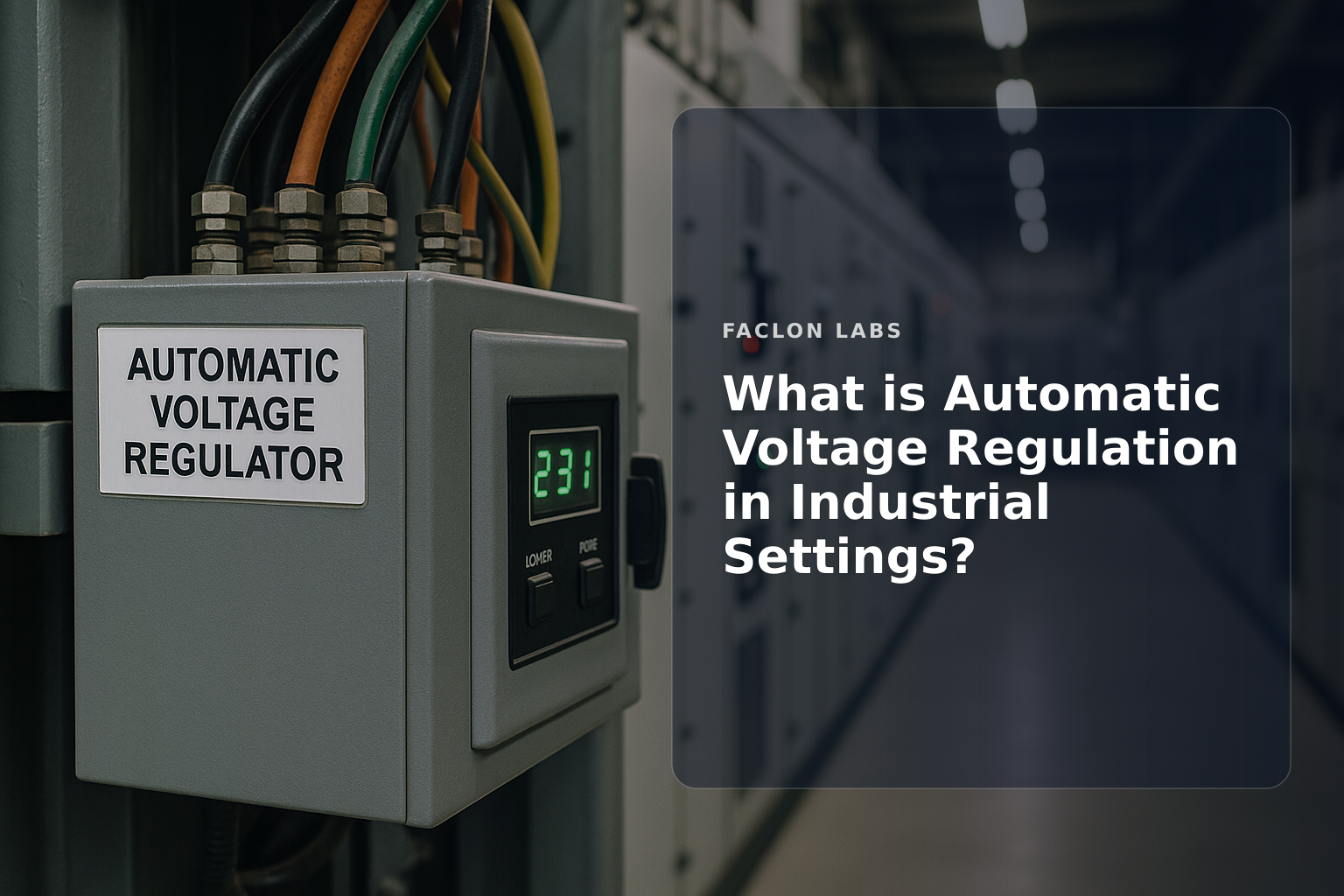
Industrial facilities rely heavily on consistent and reliable electrical power to operate machinery and control systems. Voltage fluctuations such as sags, swells, and transients can cause equipment malfunctions, reduced efficiency, or even damage. Understanding how automatic voltage regulation works is essential for plant operations leaders seeking to safeguard assets and optimize production.
Automatic voltage regulation is a foundational technology in industrial power management. It ensures that voltage remains within specified limits, preserving equipment integrity and process stability. This post explains the nature of voltage fluctuations, how AVRs function, their importance in industrial environments, and how modern IIoT platforms enhance their effectiveness.
Voltage instability refers to deviations from the nominal voltage level that can disrupt industrial operations. Common forms include:
These fluctuations can occur within milliseconds to seconds but have outsized effects on sensitive equipment.
Industrial plants face unique voltage challenges due to:
These events create an unstable power environment requiring active voltage management.
Unstable voltage can lead to:
Proactive voltage regulation mitigates these risks, preserving operational continuity.
Automatic voltage regulation is a control process that keeps the output voltage at a predetermined, stable level regardless of input voltage variations. AVRs continuously monitor incoming voltage and adjust the output dynamically to counteract sags, swells, or transients.
An AVR typically includes:
Together, these components form a closed feedback loop ensuring voltage stability.
Unlike basic voltage stabilizers that may only compensate for minor fluctuations or surge protectors designed solely to block spikes, AVRs provide continuous, precise voltage control. They actively correct voltage deviations, maintaining output within tight tolerances essential for industrial loads.
Traditional AVRs use tap-changing transformers where a servo motor shifts transformer taps to increase or decrease voltage. This mechanical adjustment balances output voltage against input variation but may have slower response times.
Modern AVRs often employ solid-state electronics with power semiconductor devices to regulate voltage. These static AVRs offer:
AVRs operate on feedback principles: the sensing circuit continuously measures voltage, the control circuit compares it against the setpoint, and the regulating element adjusts output accordingly. This real-time loop maintains voltage within strict limits despite load or supply fluctuations.
Voltage instability can cause insulation breakdown, overheating, and electronic component failure. AVRs prevent these by stabilizing voltage, extending equipment life.
Stable voltage supports consistent motor speeds, accurate sensor readings, and reliable control system operation, improving process quality and reducing maintenance costs.
By preventing voltage-related trips or faults, AVRs reduce unplanned downtime, safeguarding production schedules and revenue.
Stable voltage reduces energy losses and inefficiencies caused by equipment operating outside optimal voltage ranges, lowering operational expenses.
| Benefit | Impact on Industrial Operations |
|---|---|
| Equipment protection | Reduces failures and extends lifespan |
| Process consistency | Maintains product quality and control accuracy |
| Downtime reduction | Prevents costly production interruptions |
| Energy efficiency | Lowers operational costs through optimized use |
In generator systems, AVRs regulate excitation to maintain stable output voltage under varying load conditions, ensuring reliable power supply.
These units regulate voltage for entire plants or critical sections, providing centralized voltage management independent of individual equipment.
Some uninterruptible power supplies include AVR features to stabilize voltage without switching to battery, protecting sensitive electronics during minor voltage variations.
Key factors include:
| AVR Type | Typical Use Case | Key Advantage |
|---|---|---|
| Generator-integrated AVR | Power generation systems | Direct voltage control on alternator |
| Standalone industrial AVR | Facility-wide voltage regulation | Centralized, scalable solution |
| Line-interactive UPS with AVR | Sensitive electronics protection | Combined backup and regulation |
IIoT sensors enable continuous data collection on voltage levels, regulator status, and load conditions, providing real-time visibility into AVR health and power quality.
Data analytics can predict wear or failure in AVR components before breakdowns occur, enabling scheduled maintenance and avoiding costly downtime.
Aggregated voltage and load data help identify patterns of fluctuation, informing operational adjustments and infrastructure upgrades for improved power stability.
Integrating AVR data with broader plant monitoring systems supports automated control strategies, energy efficiency programs, and compliance with voltage standards Understanding Energy Consumption in Industrial Plants Benefits of Automated Maintenance Services for Industrial Plants What Is Power Conditioning and Why Is It Important?.
Automatic voltage regulation is a critical element in industrial power management. For plant operations leaders, understanding and deploying the right AVR technology can safeguard assets, improve process reliability, and reduce costs. Explore how integrating AVRs with IIoT platforms can further enhance your facility’s power resilience and operational intelligence.
The main function of an automatic voltage regulator (AVR) is to automatically maintain a stable and constant output voltage, regardless of fluctuations in the input power supply or changes in the electrical load. This ensures that connected equipment receives consistent power, preventing damage and ensuring reliable operation.
An AVR protects industrial equipment by shielding it from harmful voltage sags, swells, and transients. By stabilizing the voltage, it prevents components from overheating, malfunctioning, or experiencing premature failure due to inconsistent power, thereby extending equipment lifespan and reducing maintenance costs.
No, an AVR is not the same as a surge protector. While some AVRs may include surge protection features, their primary role is voltage stabilization—maintaining a consistent voltage level. A surge protector, by contrast, is designed to divert sudden, high-voltage spikes (surges) away from equipment, offering protection against transient overvoltages but not correcting sustained under or over-voltages.
Yes, an AVR can contribute to improved energy efficiency. By providing stable voltage, it allows electrical equipment to operate at its optimal design parameters, reducing wasted energy from inefficient operation due to voltage fluctuations. This can lead to lower energy consumption and reduced operational costs over time.