Join Our Lunch & Learn: How Agentic AI Will Transform Industrial Operations | Register Now →
.svg)
August 20, 2026
5 Mins
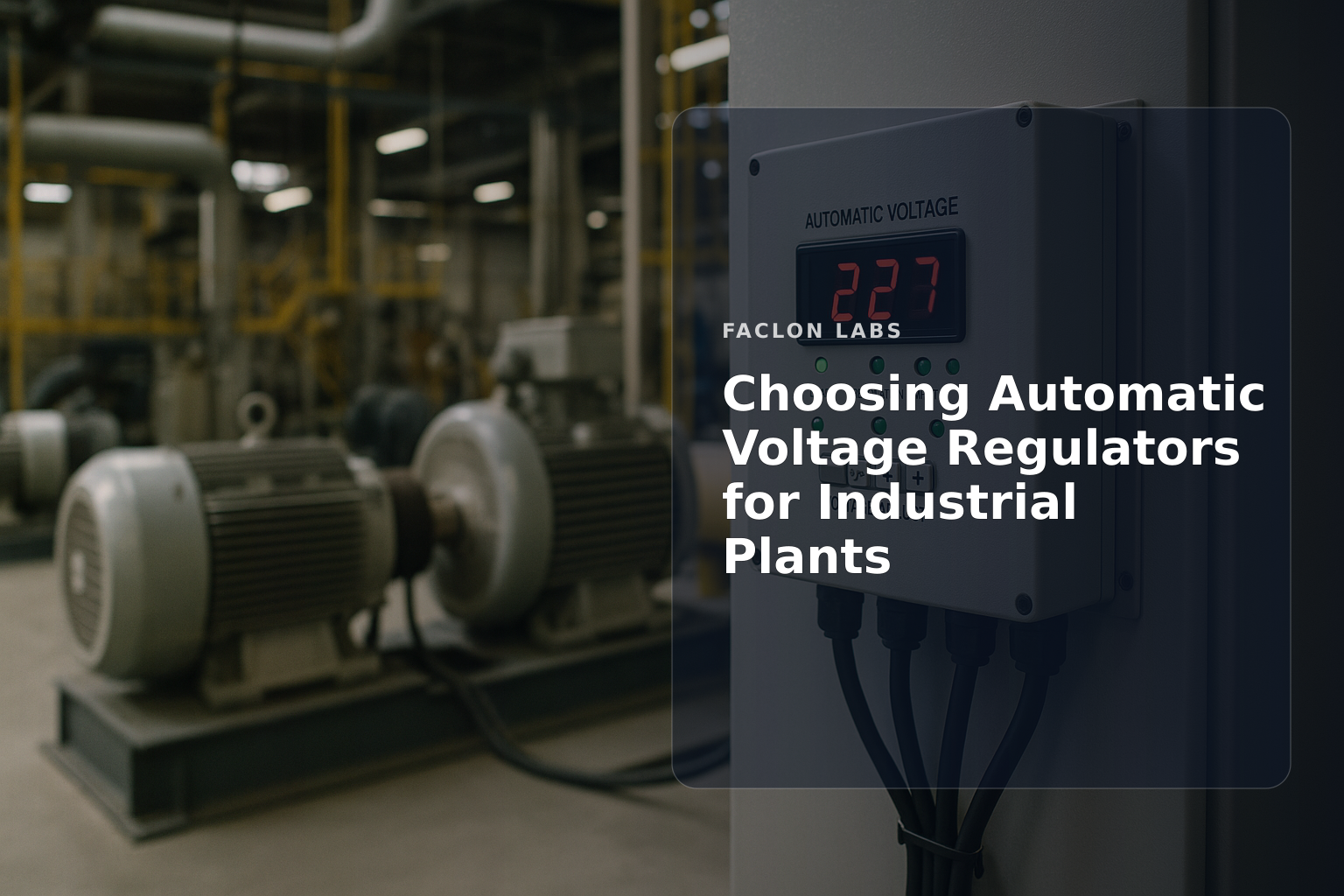
Industrial plants rely heavily on consistent electrical power quality to ensure machinery operates efficiently and safely. Voltage fluctuations can cause equipment malfunctions, reduced lifespan, and costly downtime. Automatic voltage regulators (AVRs) serve as critical devices that stabilize voltage, protecting sensitive industrial processes from power irregularities.
Choosing the right AVR requires a systematic approach tailored to the plant’s specific power profile and operational demands. This guide walks through the steps to evaluate needs, explore AVR types, and implement solutions that enhance reliability and ROI.
An automatic voltage regulator is an electronic or electromechanical device designed to maintain a constant voltage level to electrical equipment. It monitors the output voltage and automatically adjusts it by controlling the excitation of generators or modifying transformer taps, ensuring stable power delivery despite input fluctuations.
Industrial machinery often requires precise voltage levels to operate correctly. Voltage instability can cause motors to overheat, sensors to misread, and control systems to fail. Stable voltage helps maintain product quality, reduces wear and tear, and prevents unexpected shutdowns.
Voltage fluctuations can arise from:
Unstable voltage leads to increased electrical stress on components, accelerating degradation and failure rates. This results in higher maintenance costs, unplanned downtime, and reduced overall equipment effectiveness (OEE).
Begin by measuring voltage levels across different points in the plant using power analyzers. Identify frequency, amplitude, and duration of voltage sags, swells, and transients.
Linear loads (motors, heaters) draw current proportional to voltage, causing predictable voltage drops. Non-linear loads (variable frequency drives, rectifiers) introduce harmonics and distort voltage waveforms, complicating regulation.
Determine which machines and processes are most sensitive to voltage changes. Equipment like PLCs, sensors, and precision motors often require tighter voltage control.
Specify the acceptable voltage tolerance (e.g., ±1-3%) and how quickly the AVR must respond to fluctuations. Faster response is critical for sensitive or fast-cycling loads.
Tap-switching AVRs adjust transformer taps mechanically to regulate voltage. They are robust and suitable for large loads but have slower response times and wear-prone components.
Ferroresonant AVRs provide voltage stabilization through magnetic resonance, offering excellent noise filtering and voltage regulation. Ideal for sensitive electronics but tend to be bulky and less efficient.
Silicon-controlled rectifier (SCR) AVRs use solid-state components for rapid voltage correction with high precision. They handle complex loads well and integrate easily with digital control systems.
Generator-integrated AVRs regulate voltage at the source, essential for stable generator output. Standalone AVRs can be deployed plant-wide to manage distribution-level voltage stability.
| Selection Criterion | Considerations |
|---|---|
| Capacity and power rating | Match AVR rating to peak plant load and future expansion |
| Input voltage range | Ensure AVR covers expected voltage fluctuation spectrum |
| Output voltage stability | Target tight voltage tolerance per equipment needs |
| Efficiency | Minimize power loss to reduce operating costs |
| Harmonics and power factor | AVR should not introduce harmful harmonics or degrade PF |
| Environmental ratings | Select AVRs rated for temperature, dust, and vibration |
| Connectivity | Support IIoT protocols for remote monitoring and control |
Modern AVRs can integrate with IIoT platforms to provide real-time data on voltage quality, device status, and predictive maintenance alerts. This connectivity enables plant operations leaders to optimize performance and reduce downtime proactively.
Place AVRs close to sensitive loads or at strategic points in the power distribution network to maximize voltage stability. Proper sizing prevents undersizing, which can cause regulation failure.
Ensure compatibility with existing transformers, switchgear, and protection devices. Coordination prevents interference and ensures seamless operation.
Test AVRs under various load conditions to verify voltage regulation accuracy and response time. Document baseline performance metrics for ongoing comparison.
Schedule inspections to clean components, check connections, and update firmware. Continuous monitoring through IIoT platforms helps detect anomalies early.
A mid-sized manufacturing plant faced frequent voltage sags causing production halts. After conducting a power quality audit, they installed SCR-based AVRs at critical load points and integrated monitoring via an IIoT platform.
The plant reported a 30% reduction in downtime, extended motor life by 25%, and a 10% decrease in energy waste due to improved power factor and voltage stability.
Data collected from AVRs enabled the operations team to predict voltage-related faults and schedule maintenance proactively, further enhancing plant reliability and reducing unplanned outages.
Choosing the right automatic voltage regulator is a critical step toward ensuring stable power and operational continuity in your industrial plant. For tailored solutions and integration with advanced IIoT monitoring, explore how Faclon Labs can support your voltage regulation strategy and enhance plant performance.
An Automatic Voltage Regulator (AVR) is an electronic device designed to maintain a constant output voltage regardless of fluctuations in the input voltage or changes in the load. It automatically adjusts the voltage to a stable, preset level, protecting connected equipment from damage due to voltage sags, surges, or brownouts.
In industrial plants, stable voltage is crucial because sensitive machinery, PLCs, and control systems can be severely affected by voltage fluctuations. An AVR protects this equipment from damage, prevents operational disruptions, extends equipment lifespan, and ensures consistent product quality, ultimately leading to improved uptime and significant cost savings.
The main difference is in voltage stability. A conventional generator's output voltage can fluctuate with changes in load, potentially harming connected devices. A generator with an integrated Automatic Voltage Regulator (AVR) actively monitors and adjusts its output to maintain a constant, stable voltage, providing cleaner and safer power for sensitive electronics and machinery.
To choose the right capacity, you must calculate the total power consumption (VA or kVA) of all equipment the AVR will protect, including potential future expansions. It's generally recommended to select an AVR with a capacity at least 20-30% higher than your peak load to provide a safety margin and accommodate inrush currents.
Yes, by providing stable voltage, an AVR can contribute to energy efficiency. Equipment operating at its optimal voltage performs more efficiently, reducing wasted energy from over- or under-voltage conditions. Additionally, preventing damage and extending equipment life reduces the energy and resources associated with frequent replacements.