Join Our Lunch & Learn: How Agentic AI Will Transform Industrial Operations | Register Now →
.svg)
September 16, 2026
6 Mins
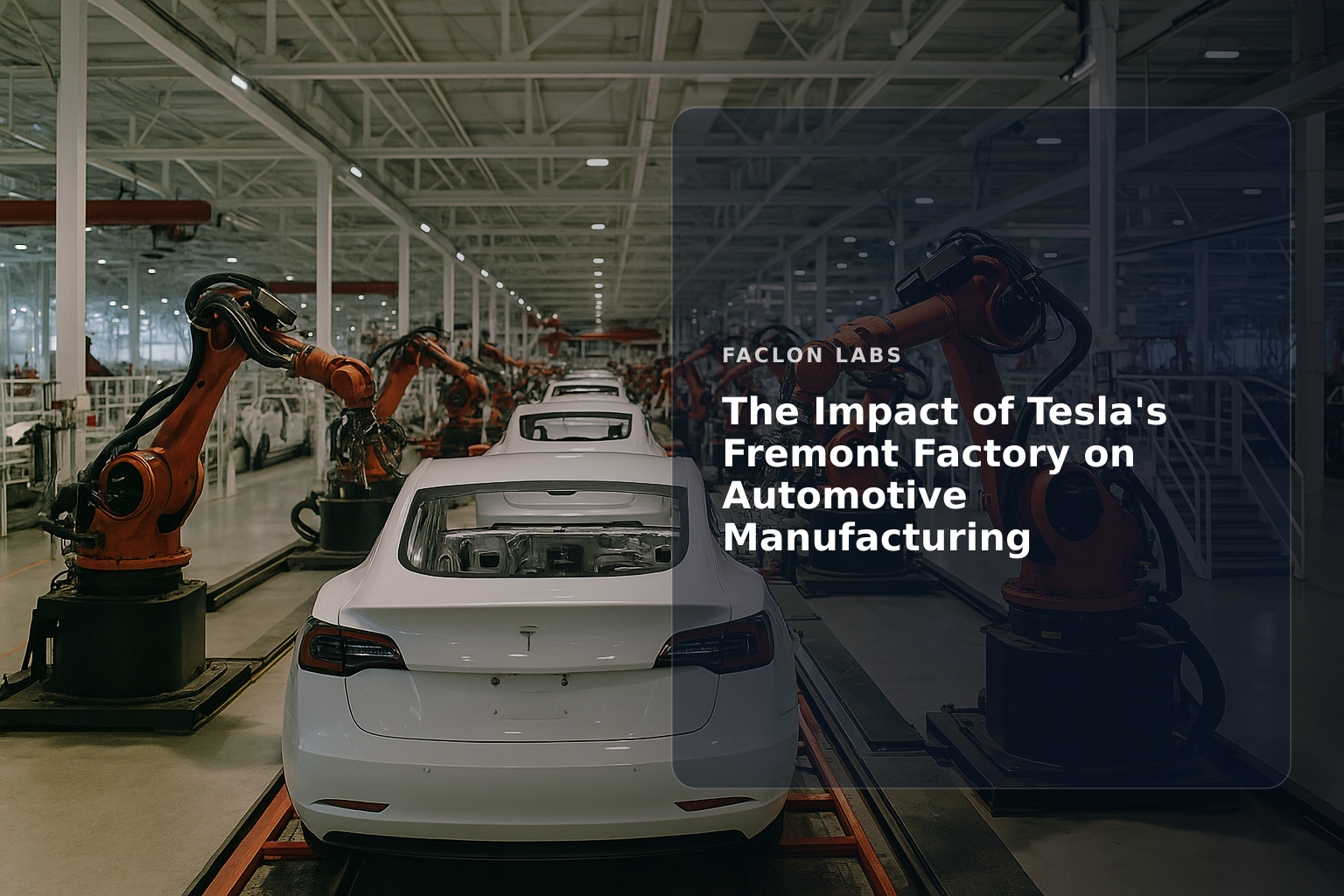
Tesla’s Fremont factory stands as a pivotal site in automotive manufacturing history. Originally a joint venture facility known as NUMMI, it was acquired and transformed by Tesla into one of the largest electric vehicle (EV) production plants globally. This transition marked a significant shift in how vehicles are built, emphasizing speed, technology integration, and vertical control over manufacturing processes.
For plant operations leaders new to the topic, understanding Fremont’s impact means exploring both its legacy and its role in reshaping production methodologies for the EV era. This includes Tesla’s unique approach to automation, data use, and scaling challenges, alongside its influence on the broader automotive industry.
The Fremont factory originally operated as NUMMI (New United Motor Manufacturing, Inc.), a joint venture between General Motors and Toyota established in 1984. NUMMI was notable for combining Toyota’s lean manufacturing principles with GM’s scale. When the plant closed in 2010, Tesla acquired it, inheriting a well-equipped manufacturing site in a strategic Bay Area location.
Tesla repurposed the existing assembly lines and facilities but rapidly overhauled them to suit its electric vehicle production needs. This included integrating more automation and redesigning workflows to support Tesla’s vertically integrated manufacturing model. The Fremont site became a testbed for Tesla’s aggressive production targets and innovative processes.
Located in California’s Silicon Valley region, the Fremont factory provided Tesla proximity to key suppliers, engineering talent, and a supportive regulatory environment. This location was crucial for Tesla’s early Model S and Model X production and later for scaling the mass-market Model 3 and Model Y vehicles.
Tesla’s Fremont factory is known for its extensive use of robotics and automation, aiming to speed up assembly while maintaining quality. The factory incorporates advanced robotic arms for welding, painting, and component installation. However, Tesla’s automation strategy has evolved, balancing robotics with human labor to optimize flexibility and throughput.
Unlike traditional automakers that rely heavily on suppliers, Tesla brings a majority of manufacturing steps under its own control. This vertical integration includes battery pack assembly, motor production, and software development all on-site or nearby, reducing supply chain complexity and enabling faster innovation cycles.
Software plays a critical role in Fremont’s operations, from real-time monitoring of production lines to predictive maintenance of equipment. Tesla uses data analytics to identify bottlenecks, improve quality control, and adapt workflows dynamically, reflecting a broader trend toward industrial AI and IoT in manufacturing High Tech Automotive Manufacturing: Innovations and Trends.
The Fremont factory was central to Tesla’s goal of producing affordable electric vehicles at scale. The Model 3 ramp-up required overcoming initial production bottlenecks through process redesign, automation tuning, and workforce training. Later, the Model Y was integrated into the same lines, leveraging flexible manufacturing techniques.
Tesla faced well-documented challenges in scaling production, including equipment downtime, supply chain constraints, and quality issues. These hurdles underscored the complexity of transitioning from low-volume luxury EVs to mass-market vehicles. Tesla’s iterative problem-solving approach, often described as “production hell,” has informed industry-wide practices.
Despite early setbacks, Fremont established new standards for EV production speed and efficiency. Tesla’s continuous improvements have shortened assembly times and increased output, influencing competitors to adopt more agile manufacturing strategies Addressing Key Challenges in the Manufacturing Industry.
Legacy automakers initially viewed Tesla’s manufacturing as experimental but have since accelerated their own EV production transformations. Companies like Ford and GM are investing heavily in automation, vertical integration, and software-driven operations, inspired by Tesla’s Fremont model.
Fremont exemplifies a shift from rigid, high-volume assembly lines to more adaptable, technology-enabled manufacturing. This agility supports faster product iterations and customization, essential for the rapidly evolving EV market.
The Fremont factory’s integration of data analytics and connected devices has pushed the automotive industry toward embracing industrial AI and IoT solutions. These technologies optimize production, reduce downtime, and enhance quality control, creating a new standard for smart factories Top Manufacturing Execution System (MES) Software Solutions.
Beyond cars, the Fremont site is involved in producing Tesla Optimus, a humanoid robot project. This initiative reflects Tesla’s ambition to extend its manufacturing innovation into robotics, potentially transforming industrial automation.
Humanoid robots like Optimus could perform complex tasks alongside human workers, increasing flexibility and safety. Their development at Fremont signals a future where human-robot collaboration becomes integral to factory operations.
The integration of humanoid robots may redefine workforce roles, requiring new skills and leading to more efficient, adaptable factories. Fremont’s experimentation with these technologies positions it at the forefront of this next industrial evolution.
| Vehicle Model | Production Status | Notes |
|---|---|---|
| Model 3 | Current | High-volume production; mass-market sedan |
| Model Y | Current | Compact SUV; shares platform with Model 3 |
| Model S | Historical | Luxury sedan; production moved to other sites |
| Model X | Historical | Luxury SUV; production shifted away from Fremont |
Currently, Fremont manufactures the Model 3 and Model Y, Tesla’s most popular vehicles. Earlier, it produced the Model S and Model X, but those models’ assembly has since been relocated or scaled down at Fremont. The factory’s capacity supports tens of thousands of vehicles per month, making it a critical asset in Tesla’s global supply chain.
Tesla’s Fremont factory offers a compelling case study in how industrial AI, automation, and vertical integration can reshape automotive manufacturing. For plant operations leaders, the lessons from Fremont underscore the value of combining technology with flexible processes to meet the demands of the evolving EV market. To explore how similar AI and IIoT strategies can optimize your operations, connect with Faclon Labs for insights tailored to industrial manufacturing challenges.
The Tesla Fremont Factory was originally established as the General Motors Fremont Assembly plant in 1962. It later became the New United Motor Manufacturing, Inc. (NUMMI) joint venture between GM and Toyota from 1984 to 2010. Tesla acquired the facility in 2010, transforming it into its primary manufacturing hub for electric vehicles.
Currently, the Fremont Tesla Factory is the primary production site for the Tesla Model 3 and Model Y vehicles. It also plays a role in the development and initial production of the Tesla Optimus humanoid robot.
The Fremont Factory has significantly influenced automotive manufacturing by demonstrating advanced automation, vertical integration, and agile production methods. It has pushed the industry towards greater efficiency, faster iteration cycles, and a stronger focus on software-defined manufacturing, especially for electric vehicles.
While Tesla has offered tours of the Fremont Factory in the past, public availability can vary. It's best to check the official Tesla website or contact them directly for the most up-to-date information on factory tour opportunities.