Join Our Lunch & Learn: How Agentic AI Will Transform Industrial Operations | Register Now →
.svg)
August 12, 2026
5 Mins
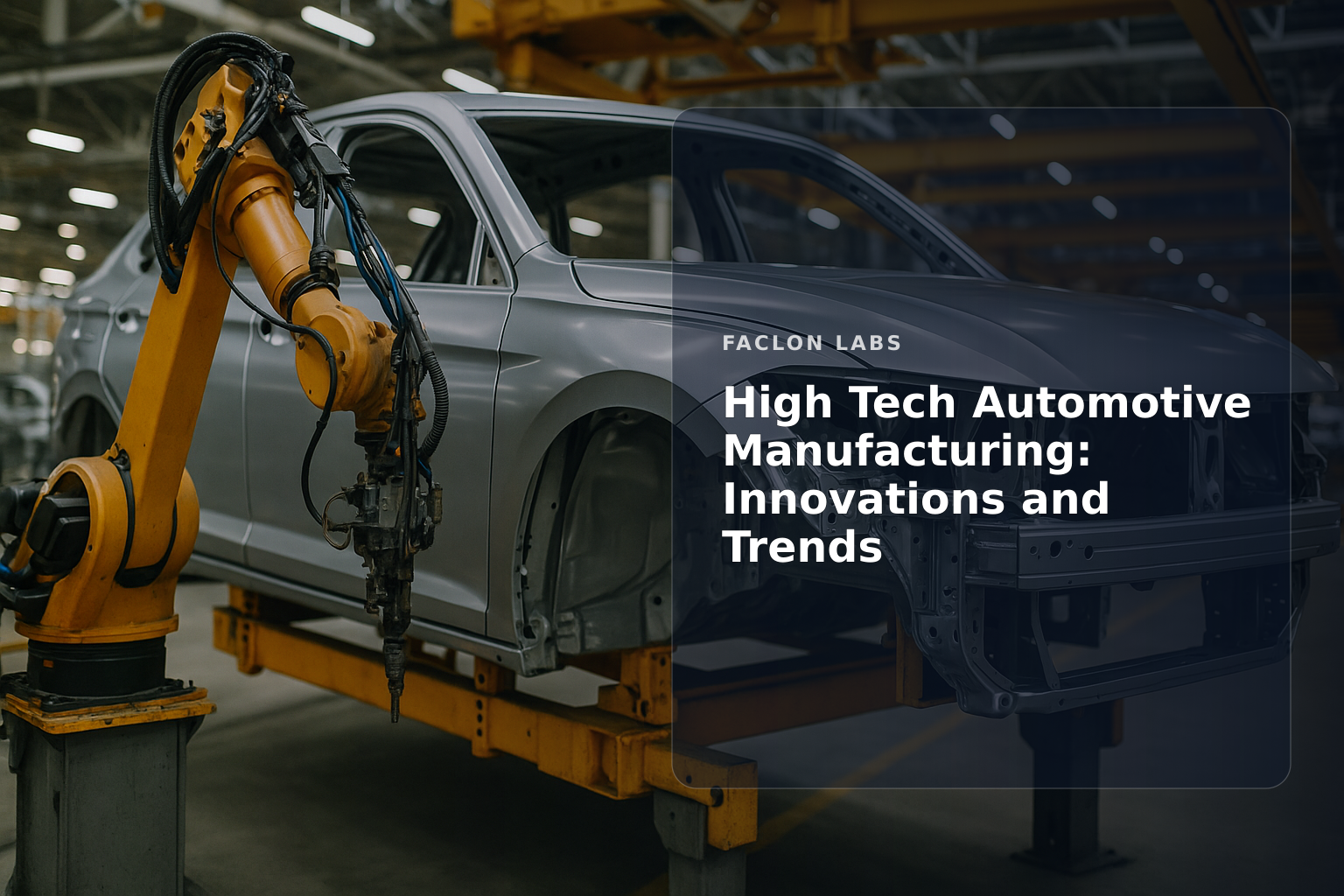
The automotive industry is undergoing a profound transformation driven by advanced digital technologies. High tech automotive manufacturing extends well beyond traditional assembly lines, leveraging innovations such as artificial intelligence (AI), industrial Internet of Things (IIoT), robotics, and big data analytics. These technologies enable manufacturers to shift from reactive maintenance and manual processes to predictive and prescriptive operations, optimizing production and delivering higher-quality vehicles.
Understanding the innovations and trends shaping this sector is essential for plant operations leaders seeking to improve efficiency, product quality, and sustainability. This article explores the core technologies, emerging trends, workforce impacts, and challenges faced in adopting high tech solutions in automotive manufacturing.
High tech automotive manufacturing refers to the integration of cutting-edge digital and automation technologies into vehicle production processes. Unlike traditional manufacturing, which relies heavily on manual labor and mechanical assembly, high tech approaches emphasize connected systems, data-driven decision-making, and automation to enhance precision and speed.
Traditional manufacturing often responds to equipment failures after they occur. High tech automotive manufacturing uses predictive maintenance powered by AI and IIoT sensors to anticipate issues before they cause downtime. Prescriptive analytics then recommend corrective actions, minimizing disruptions and maximizing uptime.
Smart factories integrate cyber-physical systems, IoT connectivity, and cloud computing to create agile, self-optimizing production environments. Industry 4.0 principles emphasize interoperability, real-time data exchange, and decentralized decision-making.
Collaborative robots work alongside human operators, enhancing flexibility and safety on the production floor. Cobots assist with complex assembly tasks and quality inspections, reducing human error and fatigue.
AI-driven vision systems detect defects in real time, while machine learning models optimize process parameters to improve yield and reduce waste.
IIoT devices continuously monitor equipment health, environmental conditions, and production metrics, feeding data into analytics platforms for immediate insights.
Digital twins create virtual replicas of physical assets or entire production lines, enabling simulation of changes before implementation. This reduces trial-and-error and accelerates innovation.
| Innovation | Description | Benefit |
|---|---|---|
| Smart Factories | Connected, self-optimizing production systems | Increased agility and efficiency |
| Collaborative Robots (Cobots) | Robots working safely alongside humans | Enhanced flexibility and safety |
| AI & Machine Learning | Automated quality control and process optimization | Higher product quality |
| Industrial IoT | Real-time sensor data collection and monitoring | Predictive maintenance and insights |
| Digital Twins | Virtual simulations of physical production assets | Reduced risk and faster innovation |
EV production demands new materials, battery assembly processes, and quality standards. High tech manufacturing addresses these challenges through precise automation and real-time monitoring, ensuring reliability and scalability.
Consumers increasingly expect personalized vehicles. Advanced manufacturing technologies enable flexible production lines that can efficiently produce customized variants without sacrificing volume.
Blockchain technology enhances traceability and trust across complex automotive supply chains, helping to mitigate risks from geopolitical disruptions and material shortages.
High tech automotive plants optimize energy consumption and reduce waste through data-driven controls, contributing to environmental goals and regulatory compliance.
As factories become more connected, protecting data and operational technology from cyber threats becomes critical to maintaining production integrity.
Predictive analytics identify potential equipment failures early, allowing maintenance to be scheduled proactively, minimizing unplanned downtime.
Real-time quality monitoring and AI-driven inspections reduce defects, improving customer satisfaction and lowering warranty costs.
Data analytics enable precise control of energy use and material flows, cutting costs and environmental impact.
The shift to high tech manufacturing requires workers to develop skills in data analysis, robotics operation, and digital tools, fostering a more versatile workforce.
Rather than replacing humans, automation technologies augment human capabilities, creating safer and more productive work environments.
High tech manufacturing requires significant upfront capital for equipment and software. Demonstrating clear ROI through efficiency gains and quality improvements is essential for stakeholder buy-in.
Many automotive plants operate legacy machinery that is not natively compatible with modern technologies, requiring careful integration strategies.
Connected systems increase vulnerability to cyberattacks, demanding robust security protocols and continuous monitoring.
There is a shortage of workers skilled in AI, IIoT, and robotics within the automotive sector, necessitating targeted recruitment and training programs.
| Challenge | Description | Mitigation Strategy |
|---|---|---|
| High initial costs | Large capital expenditure for new tech | ROI analysis and phased investment |
| Legacy system integration | Difficulty connecting old and new equipment | Middleware and modular upgrades |
| Data security risks | Increased cyberattack surface | Strong cybersecurity frameworks |
| Talent shortage | Lack of specialized skills | Upskilling programs and partnerships |
| Implementation complexity | Managing change across departments | Pilot projects and stakeholder engagement |
High tech automotive manufacturing is reshaping how vehicles are designed, produced, and delivered. For plant operations leaders, embracing these technologies offers a path to improved efficiency, quality, and sustainability. To stay competitive, begin exploring how these innovations can be integrated into your manufacturing processes today. For deeper insights on industrial AI applications in automotive, explore our posts on Benefits of Automated Maintenance Services for Industrial Plants and Generative AI Platforms: Capabilities, Applications, and Selection for Industrial AI.
High tech automotive manufacturing is characterized by the integration of advanced digital technologies such as AI, IoT, robotics, and big data analytics into every stage of vehicle production. This approach aims to create smart, connected, and highly efficient factories capable of producing complex vehicles with superior quality and flexibility.
AI significantly impacts automotive manufacturing by enabling predictive maintenance, optimizing production schedules, enhancing quality control through computer vision, and improving supply chain logistics. It helps analyze vast amounts of data to identify patterns, predict failures, and automate decision-making processes, leading to increased efficiency and reduced costs.
Smart factories in the automotive industry are highly digitized and connected production facilities that leverage IoT, AI, and automation to achieve self-optimizing operations. They feature interconnected machines, real-time data exchange, and autonomous systems that can adapt to changes, predict issues, and continuously improve processes without extensive human intervention.
Sustainability is crucial in high tech automotive manufacturing to reduce environmental impact, comply with regulations, and meet consumer demand for eco-friendly products. This involves optimizing energy consumption, minimizing waste, using sustainable materials, and implementing circular economy principles throughout the production lifecycle, often aided by advanced monitoring and analytics.