Join Our Lunch & Learn: How Agentic AI Will Transform Industrial Operations | Register Now →
.svg)
August 20, 2026
6 Mins
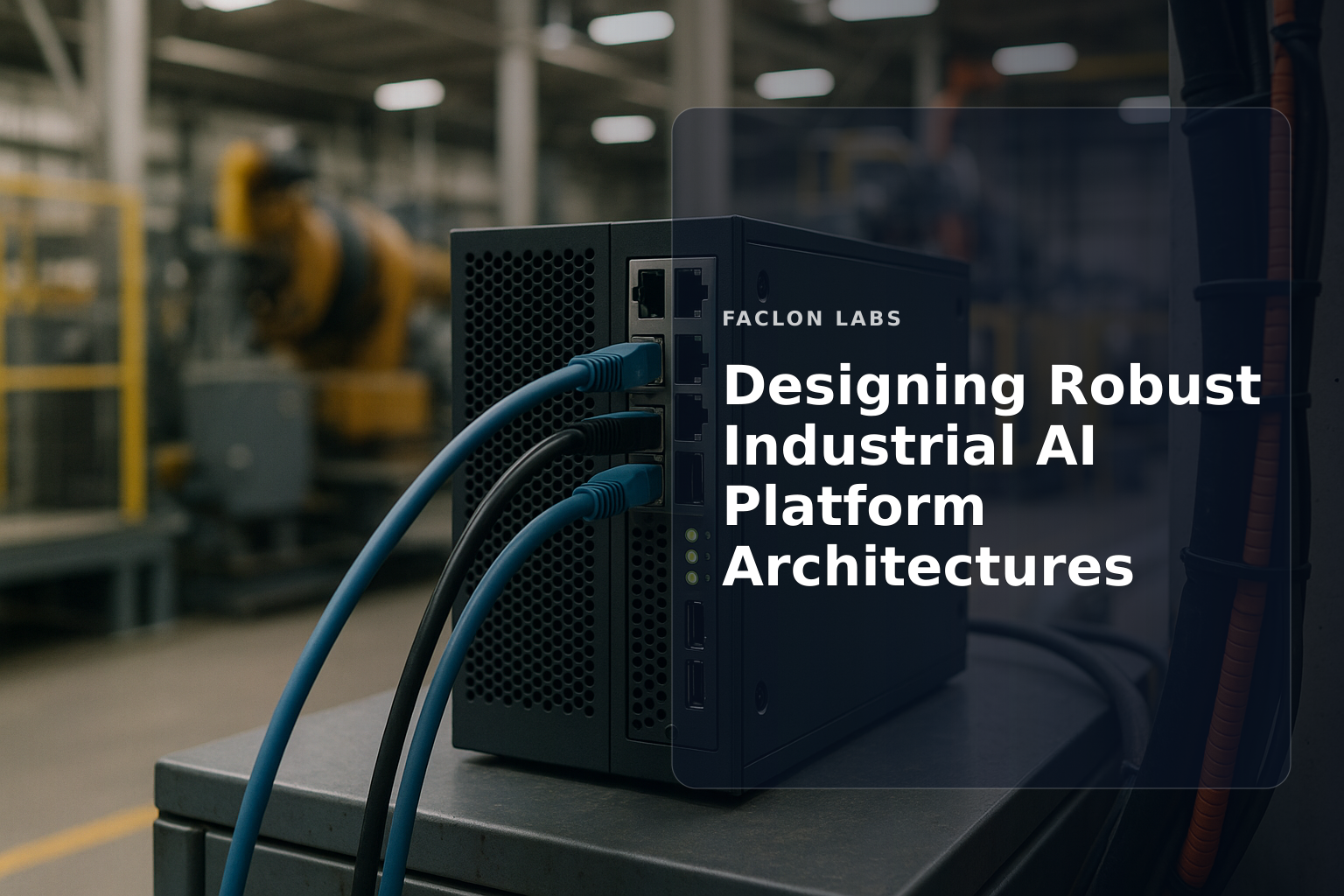
Industrial AI and IIoT platforms are transforming how manufacturing and plant operations optimize processes, reduce downtime, and improve decision-making. At the heart of these platforms lies system architecture—the blueprint that organizes all technical components to work cohesively. Understanding system architecture is essential for plant operations leaders who want to ensure their digital transformation initiatives deliver measurable value and long-term sustainability.
A well-designed system architecture addresses the complexity of industrial environments, balancing real-time data needs with security, scalability, and integration challenges. This foundational design influences every aspect of how AI models, sensor data, and operational technology come together to support smarter plant operations.
System architecture is the conceptual and structural design that defines how a complex industrial AI platform’s components interact. It includes the arrangement and relationships between hardware like sensors and edge devices, software applications, data management systems, and networking infrastructure. This architecture guides how the system behaves and evolves over time.
System architecture not only organizes components but also defines system behavior—how data is collected, processed, and used. It provides multiple views: physical deployment, logical data flows, and functional interactions, which are critical for planning, development, and maintenance.
Without a clear system architecture, industrial AI initiatives risk fragmentation, poor scalability, and security vulnerabilities. Architecture ensures alignment with operational goals and compliance, enabling effective integration of new technologies and future enhancements Implementing Industrial Automation Solutions for Smart Factories.
Industrial environments generate vast amounts of data from sensors and machines. A robust architecture allows the platform to scale horizontally, handling increasing data streams and device connections without performance degradation.
Downtime can be costly. Reliable system architecture incorporates redundancy, failover mechanisms, and monitoring to maintain continuous operation even during hardware or software failures.
Industrial AI platforms must unify data from heterogeneous OT devices and IT systems. Robust architecture supports standardized protocols and middleware to enable seamless data ingestion and interoperability.
Security-by-design principles embedded in the architecture protect sensitive operational data and ensure compliance with industry standards and regulations.
A flexible architecture anticipates emerging technologies and evolving business requirements, allowing for modular upgrades and integration of new AI models or analytics capabilities.
Modularity allows components to be developed, tested, and replaced independently, reducing downtime and simplifying maintenance.
Using open standards and APIs facilitates data exchange across diverse systems, enabling unified analytics and control.
Resilient architectures detect faults early and recover gracefully, minimizing impact on operations.
Embedding security controls in every layer, from device authentication to encrypted data transmission, safeguards against cyber threats.
Efficient data pipelines and storage solutions ensure timely availability of high-quality data for AI and analytics workloads.
| Consideration | Description | Example Technologies |
|---|---|---|
| Edge vs. Cloud Computing | Balancing low-latency local processing with scalable centralized analytics | Edge gateways, AWS IoT, Azure IoT |
| Data Ingestion & Streaming | Reliable, real-time data flow mechanisms | MQTT, Apache Kafka |
| Data Storage Strategies | Choosing appropriate storage for time-series and unstructured data | Time-series DBs, data lakes |
| API Design | Enabling extensibility and integration with third-party applications | RESTful APIs, GraphQL |
| Deployment Models | Selecting on-premise, hybrid, or cloud-native setups based on operational constraints | Kubernetes, private clouds |
Edge computing processes data near the source, reducing latency for critical decisions. Cloud computing offers scalable storage and powerful analytics but may introduce delays. A hybrid approach often optimizes performance and cost.
Protocols like MQTT support lightweight messaging for constrained devices, while Kafka provides high-throughput streaming for large-scale data pipelines.
Time-series databases efficiently store sensor data, data lakes handle raw and diverse data types, and warehouses support structured, query-optimized data for reporting.
Well-designed APIs allow easy integration of new applications, visualization tools, and AI services, enabling platform extensibility What is BESS? Battery Energy Storage Systems for Industrial Plants.
Deployment choices depend on latency needs, security policies, and existing infrastructure. Hybrid models combine on-premise control with cloud scalability.
Systems architects translate plant operation goals into technical specifications, ensuring the platform addresses real-world challenges.
They evaluate technology stacks, protocols, and tools to build a coherent and efficient architecture.
Architects focus on solutions that maximize uptime, reduce costs, and deliver measurable improvements.
By anticipating integration challenges and potential failure points, architects reduce deployment risks and simplify maintenance Understanding Energy Consumption in Industrial Plants.
Architectures should accommodate new AI techniques, communication standards, and compliance requirements without major redesign.
Separating data pipelines from model execution environments allows seamless updates and experimentation.
Design choices impact ongoing support costs, upgrade complexity, and operational efficiency.
Implementing monitoring, feedback loops, and modular upgrades fosters ongoing optimization and adoption of emerging technologies Standardized Work Procedures: A Key to Manufacturing Excellence.
For plant operations leaders starting with industrial AI, prioritizing a well-structured system architecture is essential. It lays the groundwork for scalable, secure, and adaptable digital transformation. Explore how these architectural principles apply to your environment to realize tangible operational improvements.
The primary purpose of system architecture in industrial AI is to provide a conceptual model that defines the structure, behavior, and views of an IIoT platform. It ensures that the system's components, their relationships, and guiding principles are well-defined, leading to a robust, scalable, and reliable solution that meets operational requirements and delivers tangible value.
System architecture directly impacts scalability by designing the platform with modular components and distributed processing capabilities. A well-designed architecture allows for the addition of more devices, data sources, and users without compromising performance, ensuring the platform can grow with the industrial operation's evolving needs.
IT (Information Technology) considerations in industrial AI system architecture typically focus on enterprise-level data processing, cloud infrastructure, and business application integration. OT (Operational Technology) considerations, however, prioritize real-time data acquisition from industrial control systems, device connectivity, network reliability, and cybersecurity within the plant environment, often requiring edge computing solutions.
Security-by-design is crucial because industrial AI platforms often handle sensitive operational data and control critical infrastructure. Integrating security measures from the initial design phase helps prevent vulnerabilities, protect against cyber threats, ensure data integrity, and maintain operational continuity, reducing risks and compliance issues.