Join Our Lunch & Learn: How Agentic AI Will Transform Industrial Operations | Register Now →
.svg)
August 25, 2026
5 Mins
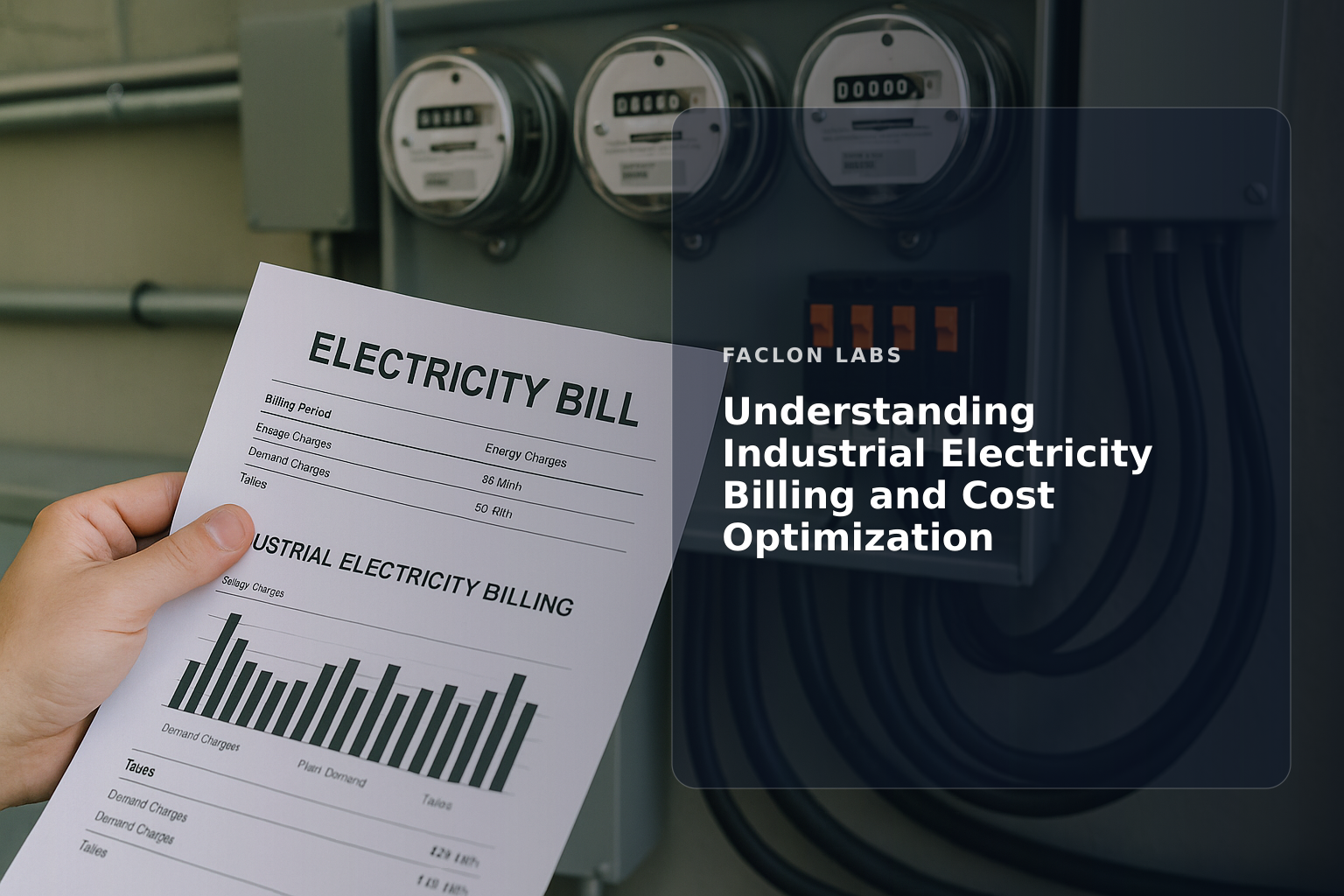
Industrial electricity billing differs significantly from residential billing due to the scale and complexity of consumption patterns. Plant operations leaders must grasp how their bills are structured to identify cost-saving opportunities and optimize energy use. This foundational understanding enables better decision-making around energy management and financial planning.
Industrial electricity bills typically include more detailed charges and higher consumption volumes than residential bills. They reflect the operational demands of manufacturing equipment, HVAC systems, and other heavy machinery, which require both energy and capacity considerations.
Energy charges are based on the total kilowatt-hours (kWh) consumed during the billing period. Many industrial tariffs apply time-of-use (TOU) rates, where electricity costs vary depending on the time of day or season, encouraging off-peak consumption.
Demand charges are fees based on the highest rate of electricity usage (kilowatts, kW) during a specified interval, usually 15 minutes. These charges can represent a significant portion of the bill, reflecting the infrastructure cost to supply peak power.
In addition to variable charges, industrial bills include fixed monthly fees, regulatory taxes, and environmental surcharges that support renewable energy programs or grid maintenance.
Industrial customers are often billed under rate schedules such as General Service or Large Power, each with distinct pricing models tailored to different load sizes and usage patterns.
Tariffs determine how energy and demand charges are calculated, including provisions for peak demand windows, seasonal rates, and minimum charges. Selecting the appropriate tariff aligns your billing with operational realities.
Power factor measures the efficiency of electricity usage. Utilities may impose penalties if the power factor falls below a threshold, increasing costs. Improving power factor reduces wasted energy and avoids penalties.
Contracts with utilities may include clauses on rate adjustments, minimum usage commitments, and demand limits. Understanding these terms helps avoid unexpected charges and supports negotiation.
Adjusting operations to shift energy use away from peak demand periods or reducing peak loads can lower demand charges significantly.
Installing capacitor banks or upgrading motors can enhance power factor, reducing penalties and improving overall electrical efficiency.
Implementing LED lighting, optimizing HVAC systems, and improving motor efficiency reduce total energy consumption and associated costs.
Engaging with utilities for better rate plans or integrating onsite renewable energy can provide cost advantages and energy resilience.
Detailed data allows identification of inefficiencies and targeted energy management.
Advanced analytics platforms provide real-time insights to optimize usage and reduce costs.
Comparing your facility’s energy metrics against peers highlights improvement opportunities.
Predictive models help plan for rate changes and operational adjustments.
Kilowatt-hours measure the total electricity used over the billing period.
Kilowatts represent the instantaneous power draw, especially peak demand that utilities use to size infrastructure.
Energy charges are based on kWh, while demand charges are based on kW peaks, both affecting the total bill.
Reducing a peak load by 100 kW during peak intervals can save thousands in demand charges monthly.
IIoT sensors provide continuous data on energy consumption at granular levels.
Machine learning models detect anomalies and forecast inefficiencies before they escalate.
Automated systems can adjust loads dynamically to minimize peak demand and energy waste.
Facilities using IIoT report measurable reductions in demand charges and improved energy efficiency Essential Tools for Data Analytics in Smart Manufacturing Benefits of Automated Maintenance Services for Industrial Plants.
| Component | Description | Impact on Bill |
|---|---|---|
| Energy Charges (kWh) | Total electricity consumed over time | Variable cost, often largest portion |
| Demand Charges (kW) | Peak power demand during billing period | Significant fixed-like cost |
| Fixed Charges | Monthly fees independent of usage | Stable baseline cost |
| Taxes and Surcharges | Regulatory and environmental fees | Varies by jurisdiction |
| Power Factor Penalties | Charges for inefficient power usage | Avoidable with corrective measures |
Understanding your industrial electricity bill is the first step toward managing and reducing your energy costs. By breaking down charges and applying targeted strategies, plant operations leaders can improve financial performance and operational efficiency. For deeper insights on energy analytics and optimization, explore our resources on Understanding Energy Consumption in Industrial Plants and Understanding Energy Consumption in Industrial Plants.
Demand charges are a significant component of industrial electricity billing, calculated based on the highest rate of power consumption (kW) recorded during a billing period, typically in 15-minute intervals. These charges cover the utility's cost of maintaining infrastructure to meet your facility's peak power needs, regardless of total energy consumed. Reducing peak demand through load shedding or shifting can significantly lower these costs.
Reducing your industrial electricity bill involves several strategies: optimizing demand charges through peak shaving and load shifting, improving power factor to avoid penalties, investing in energy-efficient equipment (e.g., LED lighting, high-efficiency motors), implementing an energy management system for real-time monitoring, and potentially negotiating better rates with your utility provider.
Power factor is a measure of how effectively electrical power is being converted into useful work. A low power factor indicates inefficient use of electrical power, often due to inductive loads like motors. Utilities may impose penalties for low power factor because it requires them to supply more reactive power, increasing losses in the distribution system. Improving power factor, typically with capacitor banks, can eliminate these penalties and improve overall system efficiency.
Yes, industrial electricity bills are significantly more complex than residential bills. While both include energy consumption (kWh), industrial bills heavily feature demand charges (kW), power factor penalties, and often have intricate time-of-use rates, specific tariffs, and contract terms tailored to high-volume, continuous operations. Residential bills are typically simpler, focusing primarily on kWh usage.