Join Our Lunch & Learn: How Agentic AI Will Transform Industrial Operations | Register Now →
.svg)
August 13, 2026
5 Mins
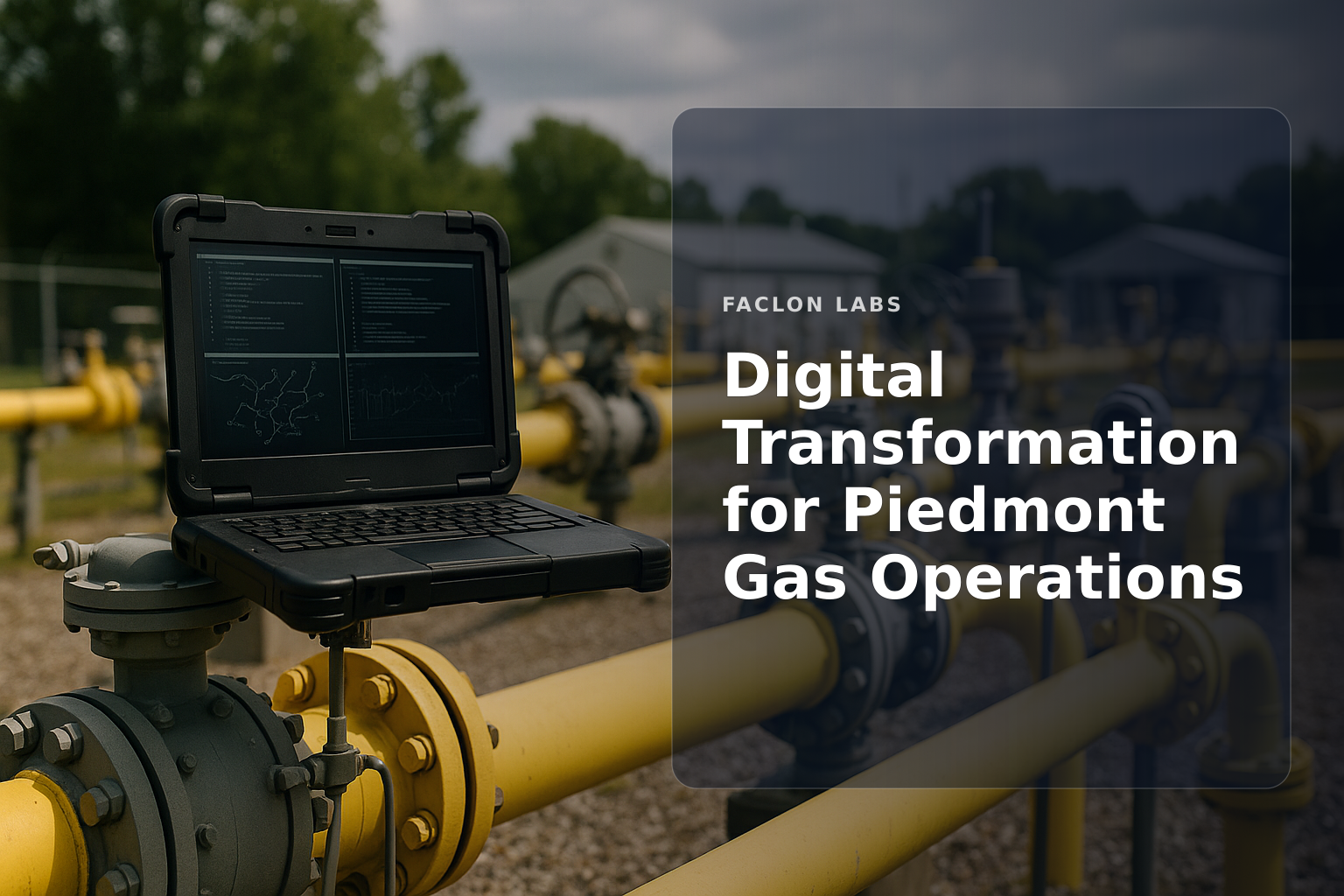
Digital transformation is reshaping how utility companies like Piedmont Natural Gas operate, moving beyond traditional practices to embrace data-driven, connected technologies. As a key natural gas distributor in North Carolina, South Carolina, and Tennessee, Piedmont Gas faces increasing demands for reliability, safety, and efficiency—pressures that digital tools are uniquely positioned to address.
Understanding the scope and impact of this transformation is essential for plant operations leaders and utility managers who aim to improve service delivery while managing costs and regulatory requirements. This article explains the fundamentals of Piedmont Gas operations, the meaning of digital transformation in utilities, key enabling technologies, benefits, and strategic implementation considerations.
Piedmont Natural Gas serves over one million residential, commercial, and industrial customers across North Carolina, South Carolina, and Tennessee. As a vital energy provider, it ensures the safe and reliable distribution of natural gas, supporting heating, cooking, and industrial processes.
Beyond gas distribution, Piedmont offers appliance sales, installation, and repair services, including furnaces, water heaters, and grills. These services complement their core utility operations and enhance customer experience.
Natural gas reliability is critical for safety, comfort, and economic activity. Interruptions can cause safety hazards and operational disruptions, making continuous, secure supply a top priority.
Utilities like Piedmont Gas face aging infrastructure, growing regulatory scrutiny, fluctuating demand, and the need for sustainability improvements. Legacy systems often limit real-time visibility and agility in responding to incidents.
Digital transformation in utilities means fundamentally changing how operations are conducted using digital technologies to create new value and improve outcomes—not just adding new tools but rethinking processes and culture.
At its heart, digital transformation relies on collecting and analyzing data, automating routine tasks, connecting assets and systems, and applying AI to predict and optimize performance.
Digital transformation addresses critical challenges: it enhances safety, reduces costs, improves customer service, and helps utilities meet stricter environmental and regulatory requirements.
Digitalization is the process of converting analog information to digital formats. Digital transformation uses that digital data to change business models and operations fundamentally.
IIoT sensors installed on pipelines and equipment provide continuous data on pressure, temperature, and flow, enabling early detection of leaks or failures.
AI models analyze historical and real-time data to predict maintenance needs, optimize resource allocation, and prevent outages.
Cloud platforms allow Piedmont Gas to store vast amounts of operational data securely and run complex analytics without heavy on-premises infrastructure.
Digital twins create virtual replicas of physical assets and systems, allowing simulation of scenarios to test maintenance strategies or emergency responses.
With increased connectivity comes heightened risk of cyber threats. Robust cybersecurity frameworks protect sensitive data and ensure system integrity.
| Technology | Purpose | Benefits |
|---|---|---|
| Industrial IoT | Real-time asset monitoring | Early fault detection, safety |
| AI & ML | Predictive analytics | Proactive maintenance, cost savings |
| Cloud Computing | Data storage & processing | Scalability, accessibility |
| Digital Twins | Virtual asset modeling | Risk-free testing, optimization |
| Cybersecurity | Protection of digital assets | Data integrity, operational safety |
Continuous monitoring detects anomalies early, reducing the risk of leaks, explosions, or service interruptions.
Automation and predictive maintenance lower downtime and reduce manual inspection costs.
Data-driven insights enable better maintenance scheduling, extending asset life and reducing capital expenditures.
Real-time data improves outage detection and restoration times, enhancing customer satisfaction.
Digital tools help track emissions and ensure adherence to safety and environmental standards, supporting sustainability goals.
Start with pilot projects focused on high-impact areas, then scale gradually while integrating new tools with legacy systems.
Establish clear policies for data quality, ownership, and security to maximize the value of collected data.
Equip employees with digital skills and change management support to ensure smooth adoption.
Track key performance indicators like downtime reduction, maintenance cost savings, and customer satisfaction improvements.
Utilities that have implemented IIoT and AI report up to 20% reductions in maintenance costs and significant improvements in safety metrics Industrial Automation and Its Role in Modern Factories.
Digital transformation is no longer optional for utilities like Piedmont Gas; it is essential for maintaining safe, efficient, and customer-focused operations. Plant operations leaders should prioritize technology adoption alongside workforce development and data governance to realize measurable improvements. For deeper insights on enabling technologies and strategic planning, explore our resources on Understanding Energy Consumption in Industrial Plants, Generative AI Platforms: Capabilities, Applications, and Selection for Industrial AI, and Choosing the Right Operational Software for Your Plant.
Piedmont Natural Gas Company, Inc. is an energy services company and a wholly owned subsidiary of Duke Energy. It is primarily engaged in the distribution of natural gas to residential, commercial, and industrial customers across North Carolina, South Carolina, and Tennessee.
Digital transformation benefits natural gas utilities by enhancing operational efficiency, improving safety through real-time monitoring and predictive maintenance, optimizing asset management, reducing costs, and enabling better customer service. It allows for a more resilient and responsive infrastructure.
Essential technologies for digital transformation in gas operations include Industrial IoT (IIoT) for sensor data, Artificial Intelligence (AI) and Machine Learning (ML) for data analysis and prediction, cloud computing for scalable infrastructure, and digital twins for virtual modeling and simulation.
Piedmont Gas can improve safety with digital transformation by deploying IIoT sensors for continuous pipeline monitoring, using AI to detect anomalies and predict potential failures, and implementing real-time data analytics to identify and mitigate risks before they escalate. This proactive approach significantly reduces incident likelihood.