Join Our Lunch & Learn: How Agentic AI Will Transform Industrial Operations | Register Now →
.svg)
August 13, 2026
5 Mins
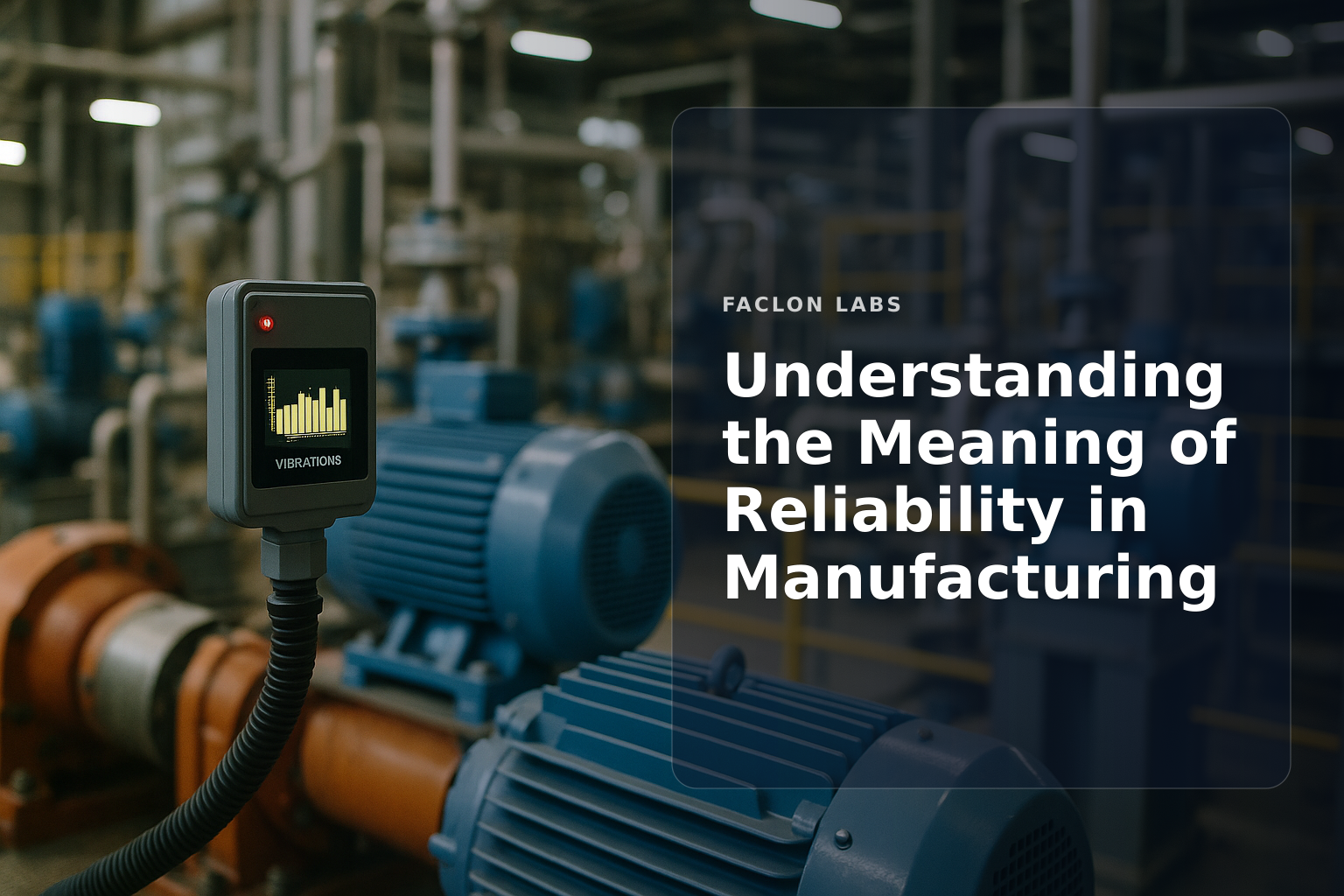
Reliability is a cornerstone concept in manufacturing that underpins operational stability and product consistency. Understanding its meaning helps plant operations leaders make informed decisions about equipment design, maintenance strategies, and process improvements. This foundational knowledge clarifies why reliability is critical for minimizing downtime, ensuring safety, and optimizing costs.
By exploring reliability beyond simple definitions, we can appreciate its probabilistic nature and the practical metrics that drive manufacturing performance. This perspective sets the stage for effective reliability management and continuous improvement.
Reliability in manufacturing means more than just “working well.” It is the consistent ability of a machine, system, or process to perform its intended function without failure over time. This includes dependability—being trusted to operate as expected—and consistency in output quality and performance.
Reliability is fundamentally a probability measure. It quantifies the likelihood that equipment will function correctly over a specified period under defined conditions. This probabilistic approach helps organizations predict failures and plan maintenance proactively rather than reactively.
To fully define reliability, three elements must be clear:
This definition aligns with industry standards such as ASTM E3159-21, which guides industrial reliability methods and applications.
Reliable equipment ensures steady production flow, reducing delays and preventing bottlenecks. When machines perform consistently, manufacturing schedules can be maintained with confidence, supporting customer commitments.
Unplanned downtime due to equipment failure disrupts operations and incurs high costs from lost production, emergency repairs, and potential penalties. Reliability aims to minimize these interruptions by preventing failures before they occur.
Reliable machinery reduces the risk of accidents caused by sudden malfunctions. It also supports compliance with safety regulations and quality standards, which often mandate specific reliability levels.
Consistent equipment performance leads to uniform product quality, reducing defects and rework. This reliability builds customer trust and satisfaction, which are vital for competitive advantage.
Reliability improvements translate directly into financial benefits through lower maintenance costs, higher throughput, and longer asset lifespans. This connection makes reliability a key driver of return on investment (ROI) and operational profitability Understanding Energy Consumption in Industrial Plants.
Validity refers to the accuracy of a measurement or test—whether it truly measures what it claims to measure. For example, a sensor reading temperature accurately is valid.
A valid measurement must be reliable (consistent over time), but a reliable measurement can be consistently wrong and thus invalid. For instance, a sensor consistently giving the wrong temperature reading is reliable but not valid.
Understanding this distinction helps in selecting and maintaining sensors and measurement systems critical for reliability assessments AI-Powered Gas Leak Sensors for Oil & Gas Operations.
| Metric | Description | Relevance to Manufacturing |
|---|---|---|
| Mean Time Between Failures (MTBF) | Average operational time between failures | Indicates equipment reliability and expected uptime |
| Mean Time To Repair (MTTR) | Average time required to repair a failed component | Impacts downtime and maintenance planning |
| Availability | Percentage of time equipment is operational and ready to use | Combines reliability and maintainability |
| Maintainability | Ease and speed of performing maintenance | Affects repair time and operational continuity |
| Failure Rate | Frequency of failures in a given timeframe | Guides preventive maintenance scheduling |
| Life Cycle Costing | Total cost of ownership including maintenance and downtime | Supports investment and replacement decisions |
These metrics provide quantitative ways to assess and improve reliability, enabling data-driven decision-making [Review Reliability assessment of manufacturing systems: A comprehensive overview, challenges and opportunities].
Reliability starts with design choices. Selecting durable materials, simplifying systems, and incorporating redundancy reduce failure risks. Early engineering decisions heavily influence long-term reliability outcomes [Reliability, Availability, and Maintainability (RAM) in Manufacturing | ATS].
Both approaches extend equipment life and reduce unexpected downtime, but predictive maintenance offers more precise reliability management [What is Reliability in Maintenance and Manufacturing? | ATS].
Industrial IoT and AI platforms collect vast operational data, enabling real-time reliability tracking and root cause analysis. Analytics identify patterns and failure precursors, informing maintenance and design improvements Essential Tools for Data Analytics in Smart Manufacturing.
Reliability improvement requires ongoing feedback, cross-functional collaboration, and a culture prioritizing operational excellence. Continuous improvement cycles ensure that reliability gains are sustained and evolve with changing conditions.
Understanding the meaning of reliability is the first step toward building more resilient manufacturing operations. By focusing on consistent performance and informed maintenance, plant leaders can reduce downtime, improve safety, and enhance profitability. Explore how industrial AI and IIoT solutions can provide the data and insights you need to advance your reliability goals Benefits of Automated Maintenance Services for Industrial Plants.
Reliability is fundamentally the quality or state of being reliable; in a technical context, it's the probability that a system, product, or service will perform its specified function adequately for a defined period under given conditions without failure.
Reliability refers to the consistency of a measurement or system (it produces the same results repeatedly), while validity refers to the accuracy of a measurement or system (it measures what it's supposed to measure). A system can be reliable without being valid, but it cannot be valid without being reliable.
Reliability is crucial in manufacturing because it directly impacts operational efficiency, production consistency, safety, and profitability. High reliability reduces unplanned downtime, lowers maintenance costs, improves product quality, and ensures stable output, leading to greater customer satisfaction and competitive advantage.
Common metrics include Mean Time Between Failures (MTBF), which indicates the average time a system operates before failing; Mean Time To Repair (MTTR), which measures the average time to restore a system after failure; and availability, which combines reliability and maintainability to show the percentage of time a system is operational.