Join Our Lunch & Learn: How Agentic AI Will Transform Industrial Operations | Register Now →
.svg)
September 24, 2026
6 Mins
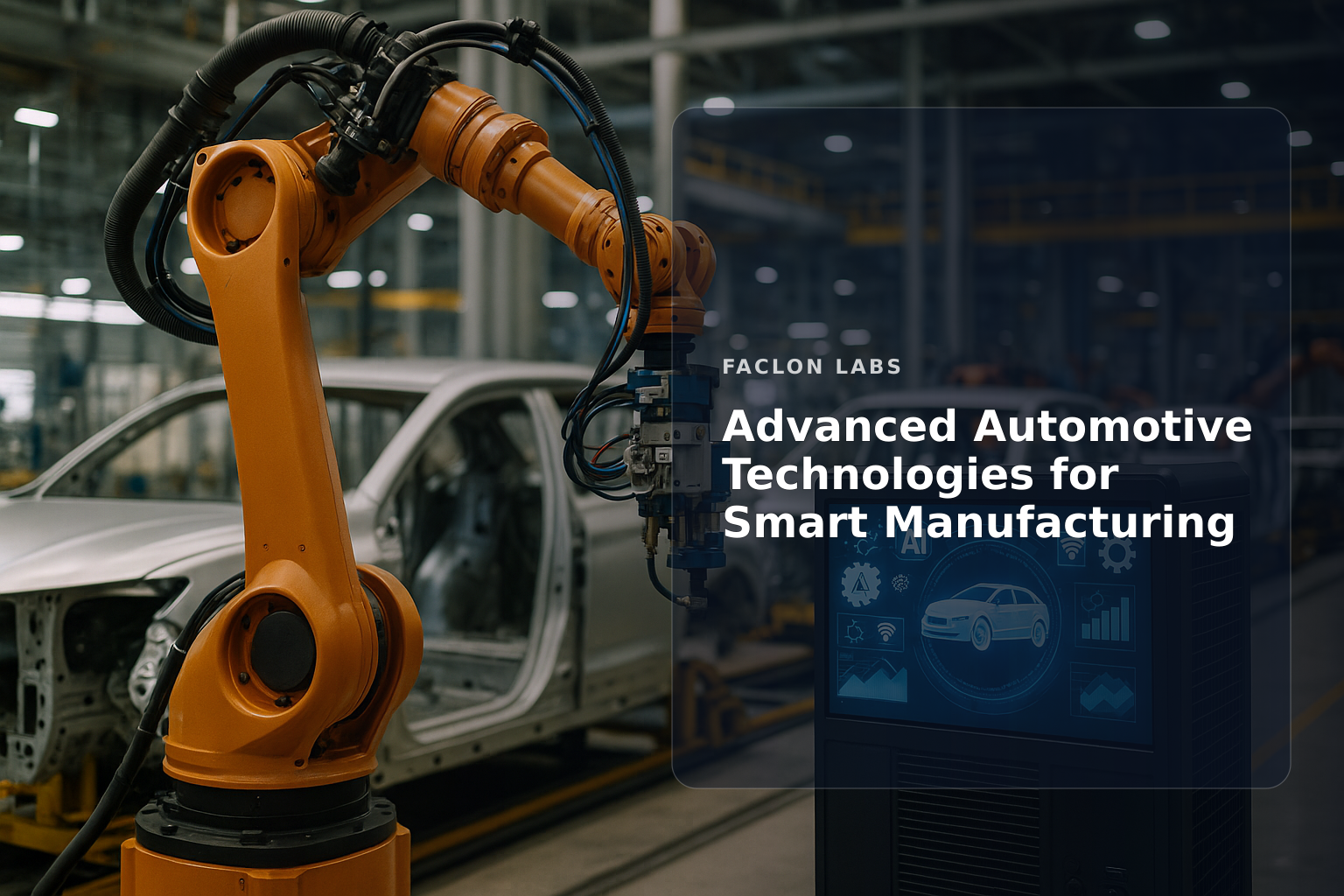
The automotive industry is undergoing a profound transformation, not only in the vehicles themselves but also in how those vehicles are manufactured. As production complexity grows and consumer demands shift toward electric and digitally integrated vehicles, manufacturers are adopting advanced automotive technologies to create smarter, more efficient factories. This evolution goes beyond traditional automation, integrating intelligence and connectivity into every aspect of manufacturing.
Smart manufacturing powered by advanced automotive technologies offers plant operations leaders new ways to optimize processes, reduce defects, and anticipate maintenance needs. Understanding these technologies and their impact helps industrial leaders prepare for the future of automotive production and apply these innovations across other sectors.
Advanced automotive technologies refer not only to innovations within vehicles—such as electric drivetrains or autonomous driving systems—but also to the sophisticated tools and systems used to manufacture these vehicles. This includes intelligent machines, data-driven decision-making, and interconnected systems that improve production efficiency and product quality.
These technologies rest on several foundational pillars:
Traditional manufacturing automation focused on mechanizing manual tasks. Advanced automotive technologies represent the next stage: intelligent systems that learn, adapt, and collaborate with human operators to optimize workflows dynamically. This shift enables factories to handle increased complexity and variability, especially important as automotive designs evolve rapidly.
Automotive R&D has long been a driver of industrial innovation, pushing boundaries in materials science, electronics, and software. The push for electric vehicles (EVs) and connected cars accelerates adoption of AI and digital tools in manufacturing, which then spread to other industries facing similar challenges of complexity and customization.
Technologies developed for automotive production, such as predictive welding analytics or AI-driven quality inspection, have been adapted in aerospace, electronics, and heavy machinery manufacturing. These cross-sector applications demonstrate the broad value of automotive-driven smart manufacturing innovations.
Connectivity through IIoT devices enables continuous data flow from machines, materials, and operators. This data fuels AI models that optimize scheduling, detect defects early, and predict equipment failures, creating a responsive and efficient production environment Understanding Energy Consumption in Industrial Plants.
Smart manufacturing technologies reduce cycle times and increase throughput by automating decision-making and minimizing manual interventions. Real-time monitoring allows rapid response to bottlenecks or quality issues.
AI-powered vision systems and sensor analytics detect defects with greater accuracy than human inspectors, reducing scrap rates and rework. Digital twins simulate production scenarios to identify potential quality risks before they occur.
By analyzing sensor data, predictive maintenance systems forecast equipment failures, allowing maintenance to be scheduled proactively. This approach minimizes unexpected downtime and extends the lifespan of critical assets.
Advanced data analytics improve inventory management and supplier coordination, ensuring materials arrive just in time and production schedules remain uninterrupted. This reduces carrying costs and enhances responsiveness to market changes.
| Benefit | Impact on Manufacturing |
|---|---|
| Operational efficiency | Faster production cycles, higher throughput |
| Quality control | Lower defect rates, improved product consistency |
| Predictive maintenance | Reduced unplanned downtime, longer equipment life |
| Supply chain optimization | Streamlined inventory, improved supplier collaboration |
AI algorithms analyze vast amounts of production data to optimize workflows, detect anomalies, and recommend adjustments. Machine learning models improve over time, enabling continuous process refinement.
IIoT devices connect machines and sensors to centralized platforms, providing live visibility into equipment status, environmental conditions, and production metrics. This connectivity supports rapid decision-making and automation.
Robotic systems perform repetitive or hazardous tasks with high precision and consistency. Collaborative robots (cobots) work alongside humans to enhance flexibility and safety on the factory floor The Future of Automated Manufacturing: Trends for 2025.
Digital twins create virtual replicas of physical assets or processes, enabling simulation of scenarios without disrupting actual production. This supports predictive maintenance, process optimization, and risk mitigation.
The proliferation of connected devices raises risks of cyberattacks and data breaches. Manufacturers must implement robust cybersecurity frameworks and comply with data privacy regulations to protect sensitive information.
Many automotive plants operate legacy equipment not designed for connectivity. Integrating advanced technologies requires careful planning, middleware solutions, and sometimes phased upgrades to avoid disruption.
Adopting advanced automotive technologies demands new skill sets among operators and engineers. Continuous training programs and change management initiatives are essential to ensure smooth technology adoption.
Quantifying the return on investment involves measuring improvements in efficiency, quality, and downtime reduction against implementation costs. Pilot projects and phased rollouts help validate benefits before full-scale deployment.
Edge computing enables AI processing close to the data source, reducing latency and bandwidth needs. 5G networks provide high-speed, reliable connectivity for real-time control. Collaborative robots enhance human-machine interaction and flexibility.
The vision for the future includes factories capable of self-optimizing production, autonomous material handling, and minimal human intervention. Achieving this requires seamless integration of AI, robotics, and IIoT systems.
Faclon Labs specializes in delivering industrial AI and IIoT platforms tailored for complex manufacturing environments. By enabling data-driven decision-making and predictive analytics, Faclon Labs supports automotive manufacturers on their journey to smart, connected factories Understanding Energy Consumption in Industrial Plants.
For plant operations leaders exploring smart manufacturing, understanding advanced automotive technologies is essential to staying competitive. Reach out to Faclon Labs to learn how industrial AI and IIoT can be applied in your facility to drive measurable improvements in efficiency and quality.
Smart manufacturing refers to a highly digitized and connected production environment that leverages advanced automotive technologies like AI, IoT, and robotics to optimize processes, improve efficiency, and enable real-time decision-making. It transforms traditional factories into intelligent, adaptive systems.
They improve efficiency through automation, predictive maintenance, and data-driven insights. AI and machine learning optimize production schedules, IoT sensors monitor equipment health to prevent failures, and robotics accelerate tasks, all contributing to higher throughput and reduced waste.
AI plays a crucial role by enabling predictive analytics for maintenance, optimizing quality control through computer vision, streamlining supply chain logistics, and enhancing robotic precision. It allows systems to learn, adapt, and make intelligent decisions autonomously.
Industry 4.0 is the broader concept describing the fourth industrial revolution, characterized by the fusion of digital, physical, and biological worlds. Smart manufacturing is a key outcome and application of Industry 4.0 principles, specifically focusing on the intelligent transformation of production processes within that framework.
