Join Our Lunch & Learn: How Agentic AI Will Transform Industrial Operations | Register Now →
.svg)
August 7, 2026
5 Mins
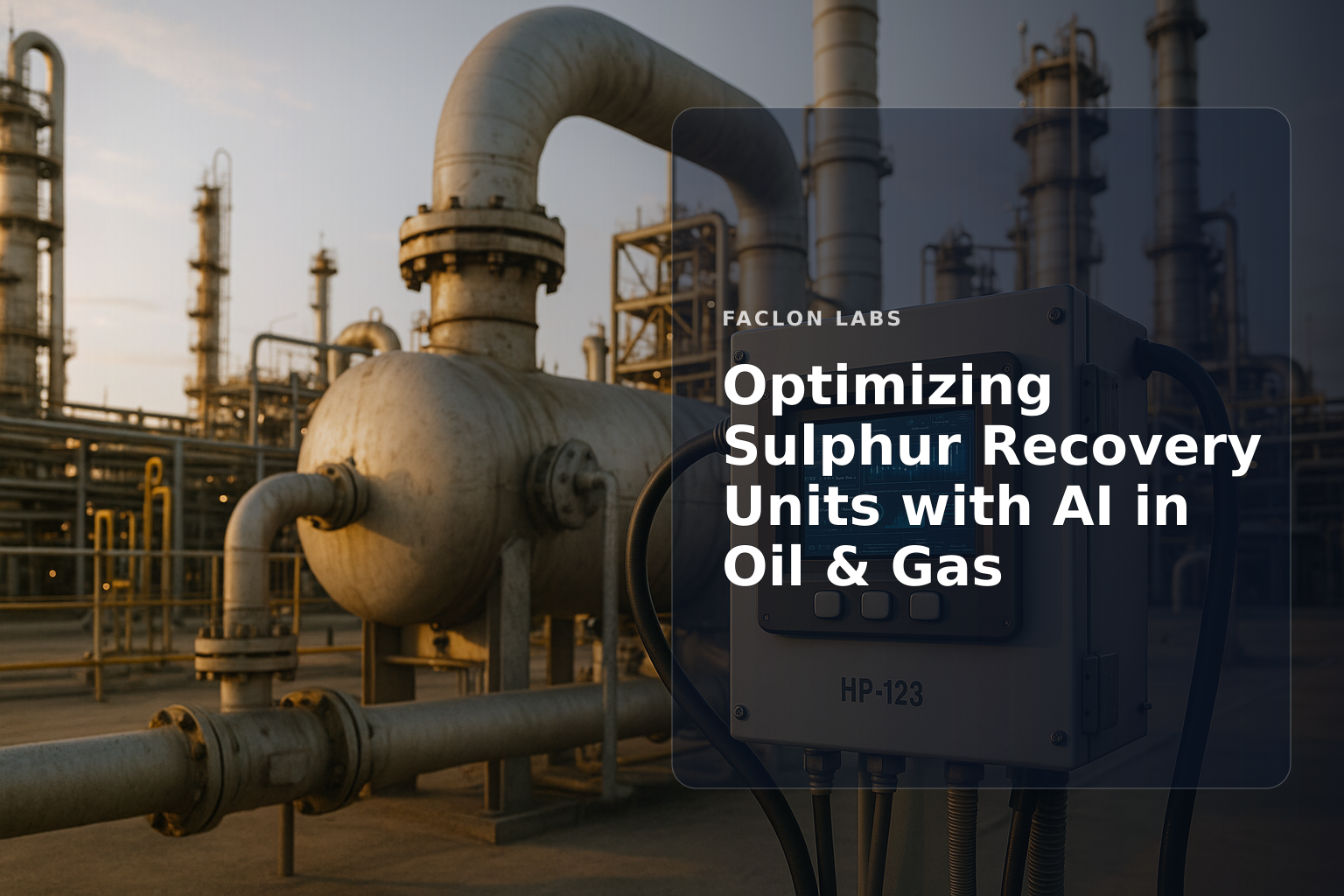
Sulphur recovery units (SRUs) are essential components in oil and gas processing facilities, tasked with converting hazardous sulfur compounds into safer, elemental sulfur. These units not only protect the environment by limiting sulfur emissions but also help companies meet strict regulatory requirements. As the industry evolves, integrating advanced technologies like artificial intelligence (AI) into SRU operations is becoming key to improving efficiency and compliance.
Understanding the fundamentals of SRUs and the processes involved provides a foundation for appreciating how AI can optimize these complex systems. This post explores the core concepts, challenges, and AI-driven solutions that enhance sulphur recovery in oil and gas plants.
A sulphur recovery unit is designed to extract sulfur from acid gas streams primarily containing hydrogen sulfide (H2S), a toxic byproduct of oil and gas production. The SRU converts this harmful gas into elemental sulfur, which is less hazardous and can be sold or safely disposed of.
SRUs play a vital role in reducing sulfur dioxide (SO2) emissions that result from burning H2S. This reduction is crucial for meeting environmental regulations aimed at controlling air pollution and minimizing acid rain. By recovering sulfur, plants not only comply with legal limits but also reduce their environmental footprint.
The main input to an SRU is acid gas, often rich in H2S, sourced from processes like sour water stripping or gas sweetening. The unit typically includes reactors, catalytic beds, condensers, and tail gas treating units to maximize sulfur recovery.
The Claus process is the foundational chemical reaction in most SRUs. It involves partially combusting H2S to form sulfur dioxide (SO2), which then reacts with remaining H2S over a catalyst to produce elemental sulfur and water. This two-step reaction scheme efficiently converts toxic gases into usable sulfur.
Standard Claus units achieve about 95–97% sulfur recovery. However, due to residual sulfur compounds in the tail gas, further treatment is often necessary to meet ultra-low emission requirements.
Tail Gas Treating Units process the Claus unit’s tail gas to remove residual sulfur compounds, converting them back into H2S for recycling or destruction. This step is critical for plants targeting recovery efficiencies above 99%.
TGTUs use reduction-absorption-regeneration processes to convert sulfur compounds like SO2 and COS into H2S. This recycled H2S is then fed back into the Claus process or safely destroyed, minimizing emissions.
By combining the Claus process with an optimized TGTU, facilities can push sulphur recovery efficiencies close to 99.98%, dramatically reducing environmental impact and improving compliance [detecting and preventing SO2 breakthrough].
Variability in the acid gas feed—such as changes in H2S concentration or the presence of hydrocarbons—can disrupt the delicate balance of reactions in the SRU, reducing sulfur recovery and increasing emissions.
The Claus reaction requires precise temperature control to maintain catalyst activity and prevent sulfur buildup or catalyst poisoning. Deviations can lead to incomplete conversion or equipment damage.
Regulatory agencies continue to tighten emission limits, pushing plants to achieve near-total sulfur recovery and lower SO2 emissions, which increases operational complexity and cost.
AI models analyze historical and real-time data to predict fluctuations in feed gas composition. These insights enable operators to proactively adjust process parameters, maintaining optimal reaction conditions and avoiding efficiency losses.
AI-powered monitoring systems track key process variables such as temperature, pressure, and gas composition. Automated control adjustments help maintain ideal operating windows, improving sulfur yield and reducing emissions.
Machine learning algorithms detect early signs of catalyst degradation or equipment anomalies, allowing timely maintenance before failures occur. This reduces downtime and maintains continuous high performance.
By optimizing process control and maintenance schedules, AI helps plants consistently meet strict emission standards while minimizing energy consumption and operational costs [SRU process control].
AI-driven optimization can increase sulfur recovery rates by up to 2–3%, translating into significant reductions in sulfur emissions and penalties. Energy efficiency improvements and reduced maintenance costs further enhance ROI.
Investing in AI technology for SRUs is a strategic move that delivers measurable operational improvements, environmental compliance, and long-term cost savings, positioning plants for future regulatory challenges.
The evolution of AI promises fully autonomous SRU control systems capable of self-optimizing in real time, further increasing reliability and reducing human intervention Benefits of Automated Maintenance Services for Industrial Plants Understanding Generative AI Tasks in Industrial Applications.
| Aspect | Traditional SRU Operation | AI-Optimized SRU Operation |
|---|---|---|
| Sulphur recovery rate | 95–97% | Up to 99.98% |
| Feed gas variability | Manually managed | Predictive analytics driven |
| Process control | Reactive adjustments | Real-time, automated control |
| Maintenance approach | Scheduled or reactive | Proactive, condition-based |
| Emission compliance | Challenging under variable loads | Consistently met with AI support |
Optimizing your sulphur recovery unit with AI technologies is a practical step toward better environmental compliance and operational efficiency. Explore how industrial AI platforms can tailor solutions to your SRU’s unique challenges and unlock measurable improvements in sulfur recovery and cost savings. Reach out to learn more about integrating AI into your plant’s operations.
The primary function of a Sulphur Recovery Unit (SRU) is to convert hydrogen sulfide (H2S), a hazardous byproduct from oil and gas processing, into elemental sulfur. This process is crucial for environmental protection and meeting regulatory emission standards.
The Claus process is a two-step thermochemical reaction that converts H2S into elemental sulfur. It involves burning a portion of the H2S to form sulfur dioxide (SO2), which then reacts with the remaining H2S over a catalyst to produce elemental sulfur and water.
TGTUs are important because the Claus process typically achieves 95-97% sulphur recovery. To meet ultra-high recovery levels and stricter environmental regulations, TGTUs further process the tail gas from the Claus unit to recover or remove remaining sulfur compounds, often achieving efficiencies up to 99.98%.
SRUs face challenges such as varying feed gas compositions, which can impact efficiency; maintaining optimal operating temperatures and catalyst performance; and continuously adapting to increasingly stringent environmental regulations regarding sulfur emissions.
AI can improve SRU performance through predictive analytics for feed variability, real-time process optimization to maximize recovery and minimize emissions, and proactive maintenance scheduling. This leads to enhanced efficiency, reduced operational costs, and consistent environmental compliance.