Join Our Lunch & Learn: How Agentic AI Will Transform Industrial Operations | Register Now →
.svg)
September 10, 2026
5 Mins
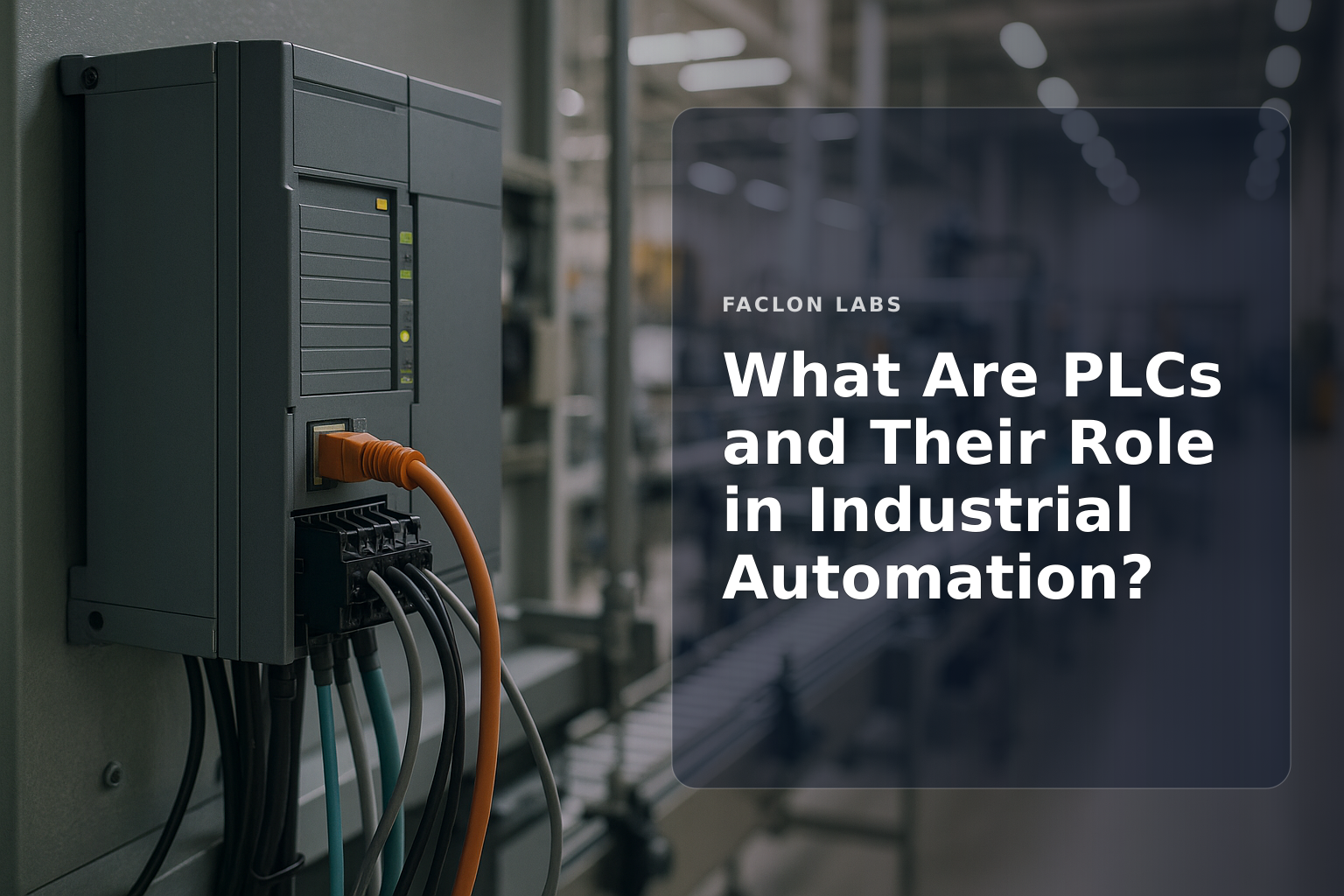
Industrial automation relies heavily on systems that can reliably control complex machinery and processes. Programmable logic controllers (PLCs) have become fundamental to this effort, serving as the digital brains behind automated operations across manufacturing and processing industries. Understanding what PLCs are and how they function is essential for plant operations leaders aiming to optimize efficiency and safety.
PLCs evolved from early relay-based control systems to become versatile, programmable devices capable of managing diverse industrial tasks. They bridge the gap between physical equipment and digital control, enabling automated decision-making that enhances productivity and reduces manual intervention. This article defines PLCs, explains their operation, and explores their critical role in industrial automation.
A programmable logic controller (PLC) is an industrial-grade computer specifically designed to control electromechanical processes. Unlike general-purpose computers, PLCs are built to operate in challenging environments with exposure to dust, moisture, vibration, and extreme temperatures. Their primary function is to automate machinery by processing input signals and triggering appropriate outputs in real time.
PLCs are characterized by:
PLCs originated in the late 1960s as a replacement for complex relay control panels used in manufacturing. Early PLCs simplified wiring and increased flexibility by allowing control logic to be programmed rather than hardwired. Over time, PLCs have evolved to support advanced programming languages and networking capabilities, expanding their role in industrial automation [industry analysis].
PLCs interact with the physical world through:
The PLC control loop involves:
This loop repeats cyclically, often within milliseconds, enabling dynamic and precise control.
PLCs are programmed using specialized languages standardized under IEC 61131-3, including:
These languages allow operators and engineers to define the control behavior flexibly [controls guide].
PLCs provide consistent control over machinery, enabling exact repetition of tasks that manual operation cannot match. This precision improves product quality and reduces waste.
Automated control reduces the need for human operators to manually adjust machines, lowering labor costs and minimizing human error.
PLCs are integral to safety systems, capable of executing emergency shutdowns and monitoring hazardous conditions with high reliability.
PLCs often serve as the control layer beneath supervisory control and data acquisition (SCADA) and human-machine interface (HMI) systems, providing real-time data and control commands for broader plant management [industrial automation overview].
| Advantage | Description | Impact on Operations |
|---|---|---|
| Flexibility | Easy software updates and logic changes | Faster adaptation to process changes |
| Durability | Resistant to industrial hazards | Reduced downtime due to hardware failure |
| Cost-effectiveness | Lower installation and maintenance costs | Better ROI compared to relay systems |
| Diagnostic tools | Real-time monitoring and error reporting | Quicker troubleshooting and repair |
PLCs are versatile and find use in many sectors:
Modern PLCs often include networking capabilities to connect with IIoT platforms, enabling centralized monitoring and control.
PLCs gather operational data that can be analyzed to optimize processes, predict maintenance needs, and improve overall efficiency.
PLCs are evolving to incorporate edge computing, performing data processing locally to reduce latency and support complex control algorithms within Industry 4.0 frameworks [future trends].
For plant operations leaders seeking to improve automation outcomes, understanding PLCs is foundational. Explore how integrating PLCs with modern IIoT platforms can unlock deeper insights and control over your industrial processes Implementing Industrial Automation Solutions for Smart Factories Designing Robust Industrial AI Platform Architectures Benefits of Industrial AI on Cloud Platforms. Reach out to learn how to align your automation strategy with the evolving industrial landscape.
The main purpose of a PLC is to automate electromechanical processes in industrial settings. It monitors inputs from sensors, executes a pre-programmed logic, and controls outputs to actuators, ensuring precise, repeatable, and reliable operation of machinery and systems without constant human intervention.
A PLC is specifically designed for industrial control, featuring ruggedized hardware, real-time operating systems, and specialized I/O modules for harsh environments. A general-purpose computer is built for broader tasks, often lacks industrial-grade durability, and typically doesn't offer the deterministic real-time control capabilities essential for industrial automation.
PLCs commonly use several programming languages defined by the IEC 61131-3 standard. The most prevalent is Ladder Diagram (LD), which visually resembles electrical relay logic. Other languages include Structured Text (ST), Function Block Diagram (FBD), Instruction List (IL), and Sequential Function Chart (SFC).
Yes, modern PLCs are increasingly equipped with communication capabilities (e.g., Ethernet/IP, Modbus TCP/IP, OPC UA) that allow them to connect to local networks, SCADA systems, and even cloud-based IIoT platforms. This enables data collection, remote monitoring, and integration with advanced analytics for operational insights.