Join Our Lunch & Learn: How Agentic AI Will Transform Industrial Operations | Register Now →
.svg)
August 13, 2026
5 Mins
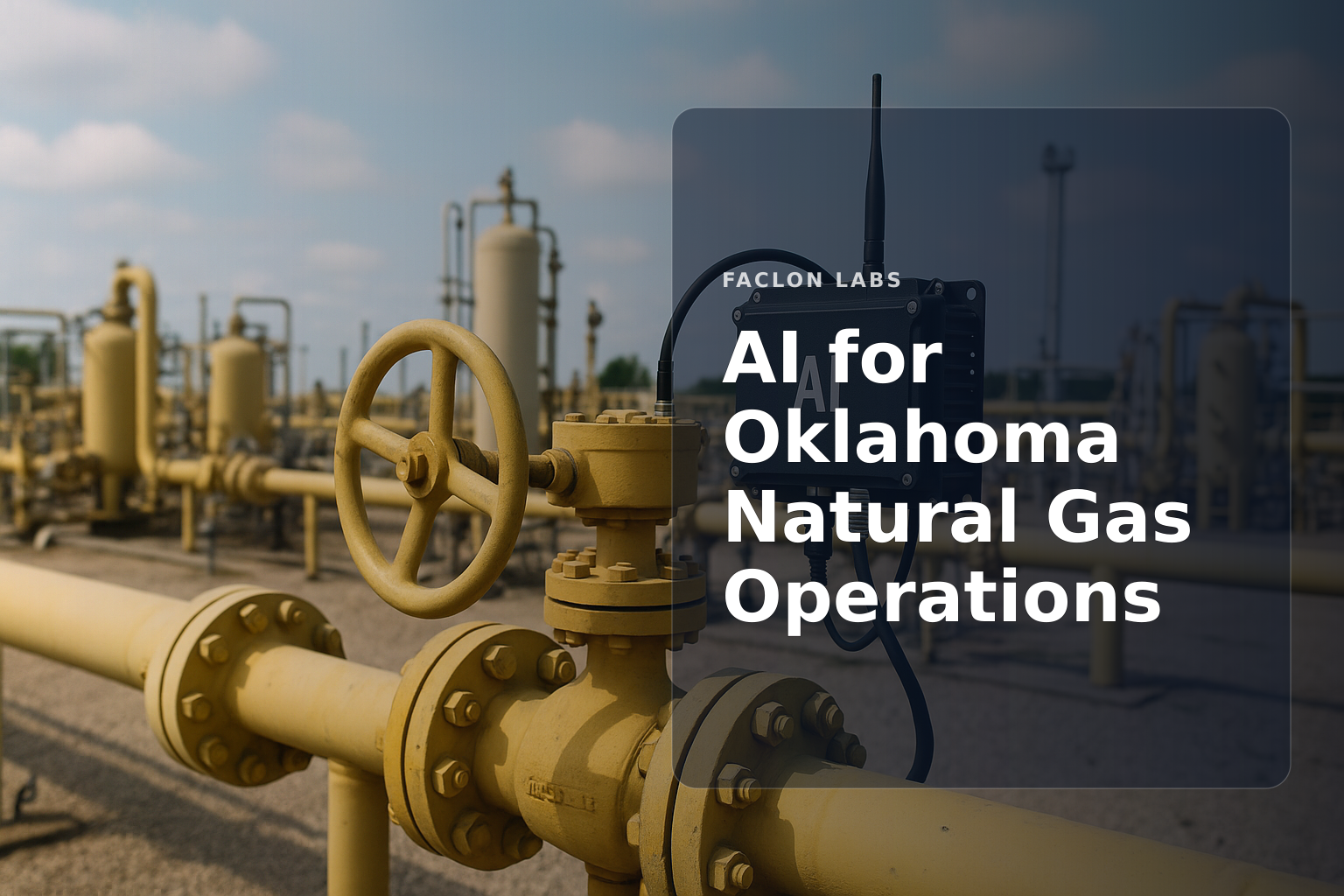
Oklahoma’s natural gas sector plays a critical role in the state’s energy supply and economy, serving hundreds of thousands of residential, commercial, and industrial customers. As the industry faces challenges such as aging pipelines, regulatory demands, and the need for operational efficiency, advanced technologies like Artificial Intelligence (AI) and the Industrial Internet of Things (IIoT) are increasingly relevant.
This article explains how AI is applied within Oklahoma natural gas operations, what it means for utilities, and the benefits it brings to safety, cost management, and environmental stewardship. The goal is to provide plant operations leaders with a clear understanding of AI’s practical value in this vital energy sector.
Natural gas is a cornerstone of Oklahoma’s energy infrastructure, powering homes, businesses, and industries across the state. Oklahoma Natural Gas (ONG), founded in 1906, is the largest distributor in Oklahoma, serving over 847,000 customers and employing more than 1,100 staff members. The natural gas sector supports local economies by providing affordable, efficient energy and contributing to the state’s gross domestic product.
Oklahoma’s natural gas system includes extensive pipelines, distribution networks, and storage facilities designed to ensure reliable delivery. These assets span urban and rural areas, requiring constant monitoring and maintenance to prevent disruptions. The infrastructure must balance capacity, pressure management, and safety while adapting to evolving regulatory standards.
Operators confront several challenges, including:
Addressing these challenges demands innovative solutions that enhance visibility and predictive capabilities across the network.
Industrial AI refers to machine learning and advanced analytics applied to operational data within industrial environments. The Industrial Internet of Things (IIoT) involves interconnected sensors, devices, and systems that collect real-time data from physical assets.
Together, AI and IIoT enable utilities to transform vast amounts of sensor data into actionable insights, automating decision-making processes that were previously manual or reactive.
Sensors embedded in pipelines, valves, compressors, and meters continuously gather data such as pressure, temperature, flow rates, and vibration. This operational technology data is streamed to AI platforms that analyze patterns, detect anomalies, and predict equipment behavior.
Traditional automation follows predefined rules and schedules, often reacting to events after they occur. AI-driven intelligence uses predictive algorithms and adaptive learning to anticipate issues before they happen, optimizing operations proactively rather than reactively.
This shift allows natural gas utilities to improve safety, reduce maintenance costs, and maintain regulatory compliance more effectively.
AI models analyze equipment condition data to forecast failures before they occur. This minimizes unplanned downtime and extends asset life by scheduling maintenance only when necessary.
AI processes sensor data to detect leaks or irregular pressure changes instantly, enabling rapid response to minimize safety risks and product loss.
AI algorithms dynamically adjust gas flow and pressure to match demand fluctuations, improving energy efficiency and service reliability.
AI systems monitor emissions and operational parameters to ensure adherence to environmental regulations, helping utilities reduce their carbon footprint and avoid penalties.
| AI Application | Benefits | Impact on Operations |
|---|---|---|
| Predictive Maintenance | Reduced downtime, cost savings | Fewer emergency repairs |
| Leak Detection & Anomaly ID | Enhanced safety, reduced product loss | Faster incident response |
| Distribution & Pressure Optimization | Improved efficiency, consistent supply | Lower energy consumption |
| Environmental Monitoring | Compliance assurance, emission reduction | Supports sustainability goals |
These benefits translate into stronger regulatory compliance and improved customer satisfaction, critical for utilities operating in a regulated market environment.
Utilities must evaluate existing sensors, data collection systems, and IT infrastructure to identify gaps and readiness for AI integration.
Starting with focused pilots allows utilities to validate AI applications such as leak detection or predictive maintenance on a smaller scale before broader rollout.
Successful pilots inform enterprise-wide deployment strategies, integrating AI into daily operations and decision-making processes.
As utilities increase connectivity and data sharing, robust cybersecurity measures are essential to protect critical infrastructure and customer information from cyber threats.
Oklahoma natural gas providers stand to gain substantial operational improvements by adopting AI and IIoT technologies. These tools help address legacy challenges while positioning utilities for future demands and regulatory expectations.
For Oklahoma natural gas operators exploring AI, starting with targeted pilot projects can demonstrate value and build confidence. Contact us to learn how industrial AI can help your utility improve safety, efficiency, and compliance in today’s dynamic energy landscape.
Generative AI Platforms: Capabilities, Applications, and Selection for Industrial AI Benefits of Automated Maintenance Services for Industrial Plants Generative AI Platforms: Capabilities, Applications, and Selection for Industrial AI
Oklahoma Natural Gas is the largest natural gas distributor in the state of Oklahoma, providing natural gas service to homes and businesses. It is a division of ONE Gas, Inc., and has been operating since 1906, playing a crucial role in the state's energy infrastructure.
AI improves safety by enabling predictive maintenance to prevent equipment failures, real-time leak detection through sensor data analysis, and anomaly detection in pipeline operations. This proactive approach helps mitigate risks, prevent incidents, and ensure the well-being of personnel and the public.
Yes, AI can significantly reduce costs for natural gas companies. By optimizing maintenance schedules, reducing unplanned downtime, improving energy efficiency in distribution, and minimizing product loss from leaks, AI-driven solutions lead to substantial operational savings and improved ROI.
AI in natural gas operations utilizes various types of data, including sensor data from pipelines and equipment (pressure, temperature, flow rates), historical maintenance records, weather data, satellite imagery, and operational logs. This data is processed and analyzed to identify patterns, predict failures, and optimize performance.