Join Our Lunch & Learn: How Agentic AI Will Transform Industrial Operations | Register Now →
.svg)
September 15, 2026
5 Mins
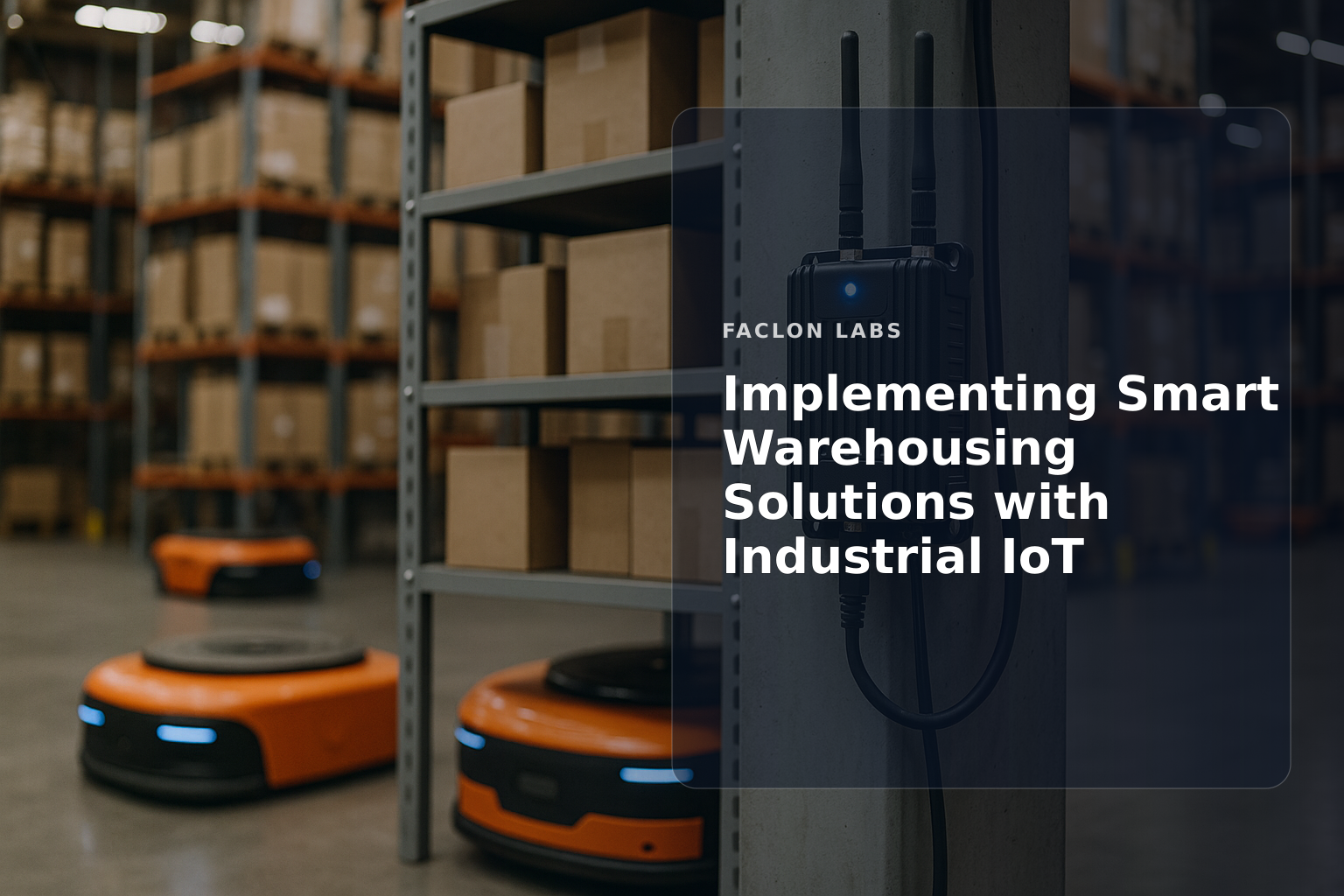
Smart warehousing is transforming traditional storage and distribution centers by embedding Industrial IoT (IIoT) technologies into everyday operations. As supply chains face increasing complexity, volatility, and labor challenges, adopting smart warehousing solutions becomes essential for maintaining competitive advantage and operational resilience.
This guide outlines practical steps to implement smart warehousing using IIoT, highlighting key technologies, benefits, challenges, and measurable outcomes. Plant operations leaders can use this to plan and execute a successful digital transformation in their warehousing environments.
A smart warehouse uses connected technologies—Industrial IoT devices, artificial intelligence, and automation systems—to digitize and optimize storage, inventory, and material handling processes. Core components include:
Traditional warehouses rely heavily on manual processes and periodic data updates, limiting accuracy and responsiveness. Smart warehousing replaces these with continuous, automated data collection and decision-making, enabling dynamic adaptation to changing conditions and customer demands Implementing Industrial Automation Solutions for Smart Factories.
Smart warehousing delivers measurable improvements across multiple dimensions:
These benefits translate into lower total warehousing costs and improved customer satisfaction.
Begin with a thorough assessment of existing workflows, technology, and performance metrics. Identify inefficiencies, error-prone processes, and capacity constraints.
Establish clear goals such as reducing order cycle time, increasing inventory accuracy, or improving safety. Define KPIs to measure progress, for example:
| KPI | Description | Target Example |
|---|---|---|
| Order cycle time | Time from order receipt to shipment | Reduce by 20% |
| Inventory accuracy | Percentage of correct stock records | Achieve 99.5% accuracy |
| Warehouse utilization | Ratio of used storage space | Increase by 15% |
| Picking efficiency | Orders picked per labor hour | Improve by 25% |
| Safety incident rate | Number of workplace accidents | Reduce to zero |
Choose technologies aligned with objectives:
Integration requires ensuring interoperability and secure data exchange.
Implement a scalable data architecture to collect, store, and analyze sensor and operational data. Use AI and machine learning models to generate actionable insights and automate decision-making.
Start with a pilot project in a controlled area to validate technology and processes. Use pilot data to refine systems, then scale across the warehouse. Establish continuous monitoring and improvement cycles to adapt to evolving needs Generative AI Platforms: Capabilities, Applications, and Selection for Industrial AI.
These technologies collectively enable a responsive, data-driven warehouse environment.
Addressing these factors early improves the likelihood of successful adoption.
Tracking relevant KPIs ensures smart warehousing delivers expected benefits:
| KPI | Measurement Method | Importance |
|---|---|---|
| Order cycle time | Timestamp tracking in WMS | Measures fulfillment speed |
| On-time shipping rate | Percentage of orders shipped on time | Reflects customer service |
| Inventory accuracy | Cycle counts vs. system records | Reduces stock discrepancies |
| Warehouse utilization | Space usage metrics from sensors | Optimizes storage costs |
| Picking efficiency | Orders picked per labor hour | Indicates labor productivity |
| ROI of IIoT | Cost savings vs. investment | Validates financial benefits |
| Safety incident rate | Incident reports and logs | Ensures workforce safety |
Continuous KPI monitoring supports ongoing optimization and justifies further investment Understanding Performance Analytics for Manufacturing Operations.
Implementing smart warehousing with Industrial IoT is a strategic investment that improves accuracy, throughput, and safety while reducing costs. Start with a detailed assessment, select appropriate technologies, and focus on measurable outcomes to transform your warehouse into a competitive asset in your supply chain. Reach out to experts to explore tailored solutions that fit your operational context.
A smart warehouse is a facility that leverages advanced technologies like Industrial IoT (IIoT), artificial intelligence (AI), robotics, and automation to optimize and streamline various operations. Its goal is to enhance efficiency, accuracy, and productivity through real-time data collection, predictive analytics, and automated processes.
The benefits of smart warehousing include increased operational efficiency, reduced labor costs, improved inventory accuracy, faster order fulfillment, better space utilization, enhanced worker safety, and the ability to make data-driven decisions. These advantages lead to significant cost savings and improved customer satisfaction.
Smart warehousing utilizes a range of technologies such as IoT sensors (for tracking and monitoring), Automated Guided Vehicles (AGVs) and Autonomous Mobile Robots (AMRs) for material handling, AI and machine learning for demand forecasting and optimization, RFID and barcode systems for asset tracking, and advanced Warehouse Management Systems (WMS) and Warehouse Execution Systems (WES).
Industrial IoT (IIoT) is fundamental to smart warehousing by providing the connectivity and data necessary for automation and intelligence. IIoT sensors collect real-time data on inventory levels, equipment status, environmental conditions, and material flow. This data is then used to monitor operations, trigger automated actions, provide insights for predictive maintenance, and optimize overall warehouse performance.
Implementing a smart warehouse can present challenges such as high initial investment costs, complexity in integrating diverse technologies, ensuring data security and privacy, managing the transition and training the workforce, and accurately measuring the return on investment. Careful planning and a phased approach are crucial for success.