Join Our Lunch & Learn: How Agentic AI Will Transform Industrial Operations | Register Now →
.svg)
September 11, 2026
5 Mins
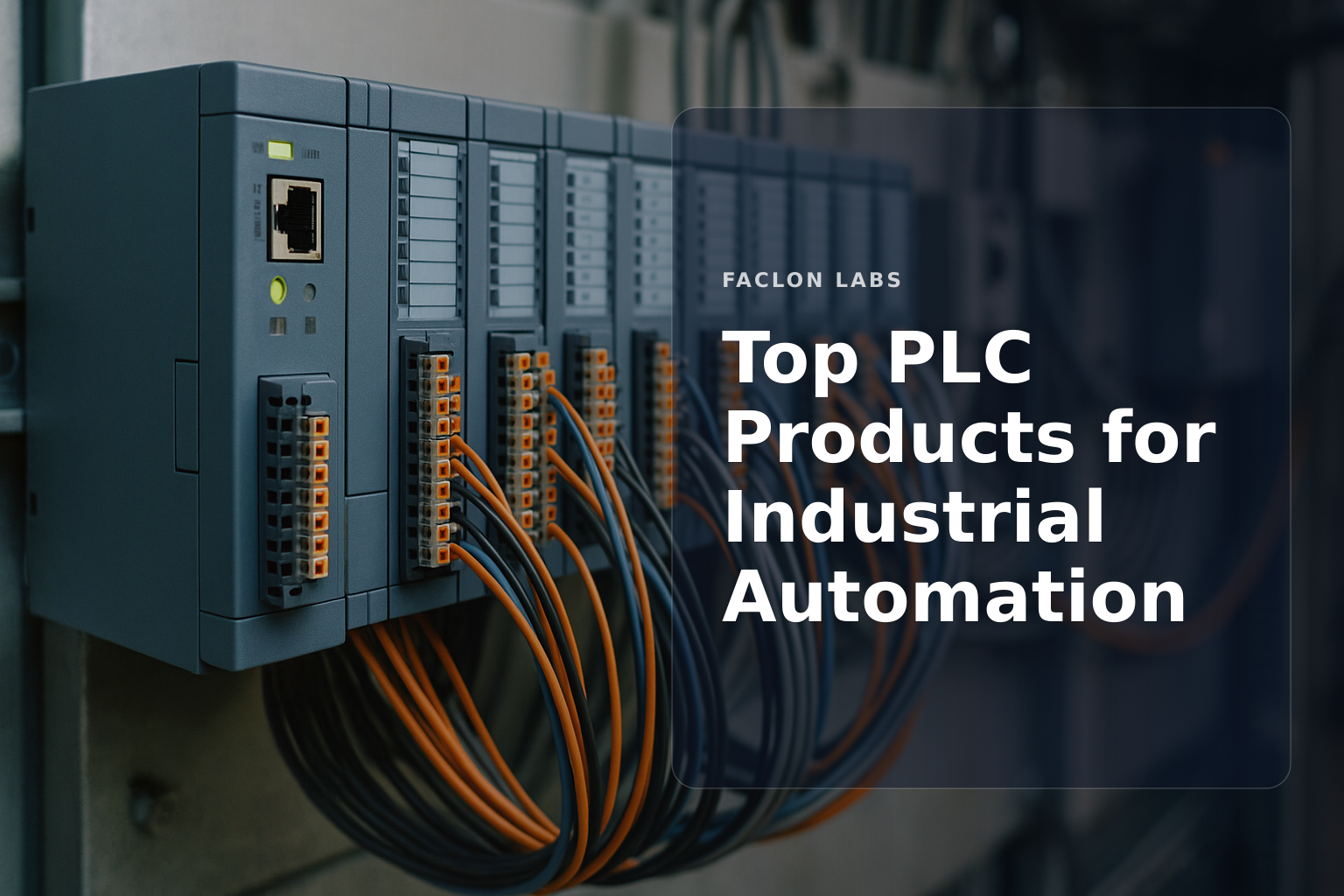
Programmable Logic Controllers (PLCs) are foundational to industrial automation, enabling precise control and monitoring of complex processes. As manufacturing environments evolve with Industry 4.0 and IIoT, selecting the right PLC product is crucial for operational efficiency, scalability, and integration with advanced analytics platforms. This guide breaks down top PLC products and how to choose the best fit for your plant.
PLCs started as ruggedized industrial computers replacing relay logic for automation tasks. Over decades, they evolved from simple relay replacements to sophisticated controllers capable of complex logic, motion control, and data processing. Modern PLCs blend hardware reliability with flexible software programming, enabling dynamic control of industrial equipment.
At their core, PLCs execute logic operations, manage sequential steps, handle timing delays, count events, and process data inputs and outputs. These functions allow automation of repetitive and critical tasks such as conveyor control, robotic movements, and batch processing.
Integration of PLCs with IIoT platforms enables real-time data collection and advanced analytics. This connectivity empowers predictive maintenance, energy optimization, and remote monitoring, extending PLC utility beyond control to strategic asset management.
Choosing an appropriate PLC influences system responsiveness, scalability, and compatibility with existing infrastructure. A mismatched PLC can limit expansion, reduce uptime, or increase integration costs, impacting overall plant productivity.
High-speed processors are essential for applications requiring rapid data acquisition and control decisions, such as packaging lines or robotic assembly.
Modular PLCs allow incremental addition of input/output modules, supporting plant growth without full system replacement.
Support for protocols like Ethernet/IP, Modbus TCP, and Profinet ensures seamless integration with other devices and supervisory systems.
User-friendly programming environments supporting ladder logic, structured text, and function block diagrams facilitate faster development and maintenance.
Industrial-grade PLCs comply with IP standards for dust and moisture resistance, ensuring operation in harsh environments.
Built-in cybersecurity measures, such as encrypted communication and user authentication, safeguard against unauthorized access and cyber threats.
| Brand | Flagship Product Line | Key Features |
|---|---|---|
| Siemens | SIMATIC S7 (S7-1200, S7-1500) | High performance, integration with TIA Portal |
| Rockwell Automation | ControlLogix, CompactLogix | Scalability, extensive I/O options, EtherNet/IP |
| Schneider Electric | Modicon Series | Versatility, rugged design, broad protocol support |
| Mitsubishi Electric | MELSEC Series | High-speed processing, reliability |
| Omron | Sysmac, CJ Series | Integrated motion control, flexible programming |
| Beckhoff | TwinCAT, PC-based Control | Advanced motion, IoT-ready, software PLC options |
These brands dominate industrial automation, each offering unique strengths tailored to diverse manufacturing requirements Implementing Industrial Automation Solutions for Smart Factories.
Identify process speed, I/O count, signal types, and complexity to determine necessary PLC specifications.
Consider compatibility with existing SCADA, MES, and IIoT systems to ensure seamless data exchange.
Choose PLCs with programming environments that align with your team’s expertise and support future scalability.
Account for hardware costs, software licenses, training, and long-term maintenance expenses.
Reliable technical support and comprehensive documentation reduce downtime and accelerate troubleshooting.
A packaging line running at 120 cycles per minute requires a PLC with a processor capable of sub-millisecond scan times and at least 64 digital I/O points for sensors and actuators. Integration with an IIoT platform for predictive maintenance mandates Ethernet/IP support. Siemens SIMATIC S7-1500 or Allen-Bradley ControlLogix are suitable candidates, offering robust processing power and modular I/O expansion.
PLCs provide continuous streams of operational data that IIoT platforms analyze to detect anomalies and optimize performance.
Cloud integration enables centralized data visualization, historical trending, and remote diagnostics across multiple sites.
AI algorithms analyze PLC data to predict equipment failures, reducing unplanned downtime and maintenance costs.
A manufacturer increased Overall Equipment Effectiveness (OEE) by 15% after integrating PLC data with an AI-powered IIoT platform, enabling early detection of bottlenecks and machine degradation Benefits of Automated Maintenance Services for Industrial Plants.
Software PLCs running on industrial PCs offer flexibility and scalability for complex automation tasks.
Future PLCs will incorporate advanced encryption, anomaly detection, and secure boot to protect against cyber threats.
Embedding AI capabilities directly on PLCs will enable faster decision-making and adaptive control.
PLCs will increasingly serve as intelligent edge devices, bridging operational technology and information technology layers Addressing Key Challenges in the Manufacturing Industry.
Choosing the right PLC product is a strategic decision that directly impacts your plant’s efficiency and scalability. Evaluate your specific operational needs carefully and consider how modern PLCs can integrate with IIoT platforms for enhanced insights. For tailored guidance on selecting and deploying PLC solutions, reach out to Faclon Labs to explore how industrial AI can elevate your automation strategy.
A PLC (Programmable Logic Controller) is a ruggedized industrial computer that automates electromechanical processes. It monitors input devices, makes decisions based on programmed logic, and controls output devices to execute specific tasks, forming the backbone of modern industrial automation systems.
There isn't a single 'best' PLC brand; the optimal choice depends on specific application requirements, existing infrastructure, and desired scalability. Top brands like Siemens, Rockwell Automation, Schneider Electric, and Mitsubishi Electric offer robust solutions, each with unique strengths in performance, integration, and ecosystem support.
PLC products generally fall into three main types: compact PLCs (fixed I/O, cost-effective for smaller applications), modular PLCs (expandable I/O, highly flexible for complex systems), and PC-based PLCs (software-driven, leveraging industrial PCs for advanced control and data processing).
PLCs integrate with IIoT platforms by collecting operational data from connected sensors and machines. This data is then transmitted via industrial communication protocols (e.g., OPC UA, MQTT) to an IIoT platform, where it can be analyzed for real-time monitoring, predictive maintenance, and overall operational optimization.