Join Our Lunch & Learn: How Agentic AI Will Transform Industrial Operations | Register Now →
.svg)
September 10, 2026
6 Mins
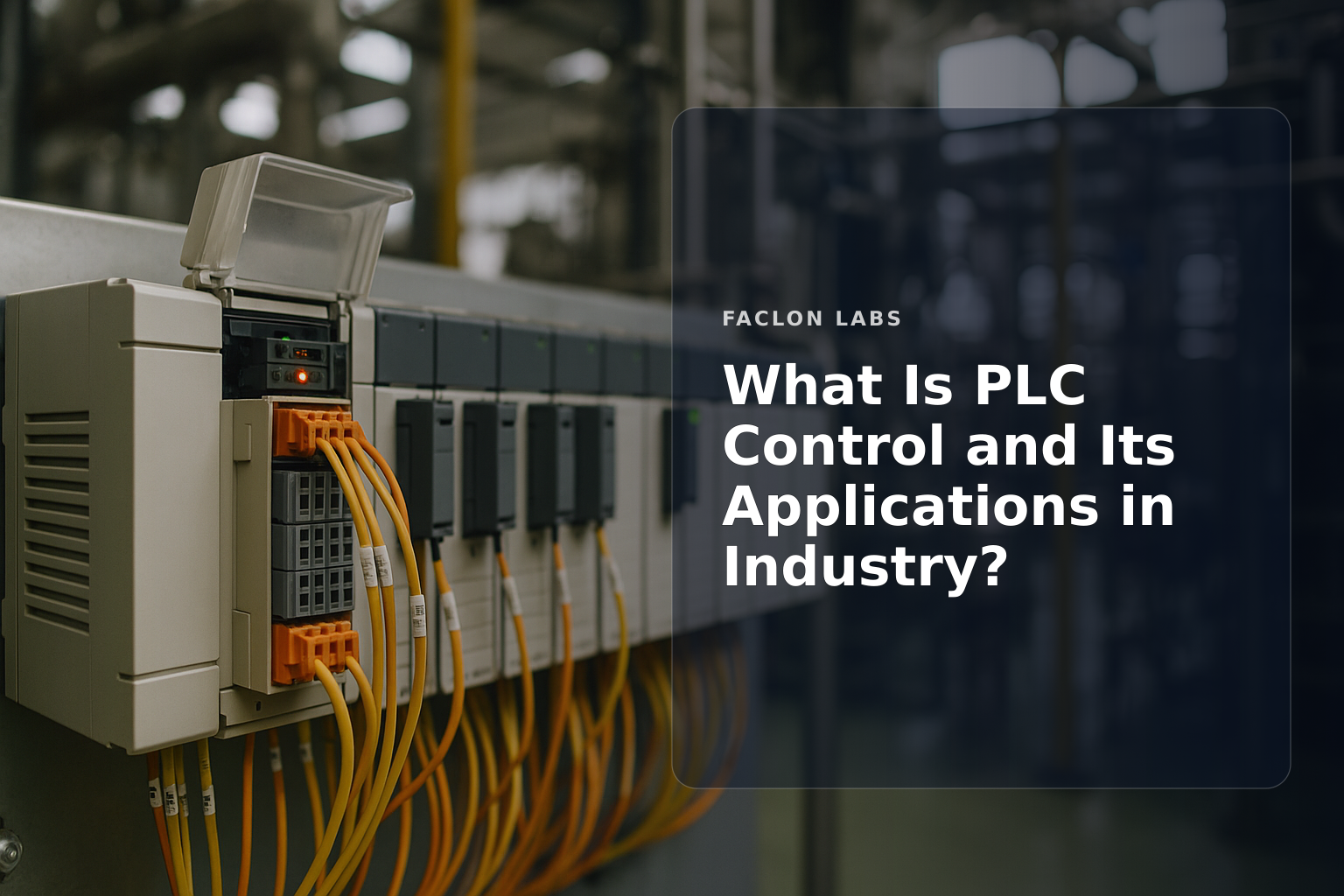
Programmable Logic Controllers (PLCs) form the backbone of industrial automation, yet many plant operations leaders new to automation may wonder, what is PLC control exactly? Understanding the fundamentals of PLCs is critical for grasping how modern factories and plants achieve efficient, safe, and scalable control over complex processes. This foundational knowledge also clarifies why PLCs remain indispensable despite advances in automation technologies.
This article breaks down what PLC control entails, how PLCs function, their key industrial applications, and how they compare to other control systems. It also looks ahead to how PLCs integrate with IIoT and AI to shape the future of industrial operations.
A Programmable Logic Controller (PLC) is a specialized industrial computer designed to perform control functions in harsh environments. Unlike general-purpose computers, PLCs are ruggedized to withstand vibration, temperature extremes, and electrical noise common in industrial settings. They continuously monitor inputs from sensors, execute user-defined logic programs, and control outputs to actuators or other devices.
Before PLCs, industrial control relied heavily on relay logic—physical relays wired to perform control sequences. This approach was inflexible and labor-intensive to modify. The introduction of PLCs in the late 1960s revolutionized automation by replacing hardwired relay logic with software-programmable logic, enabling faster changes and more complex control schemes.
A typical PLC system includes:
PLCs provide reliable, real-time control critical for maintaining production quality, safety, and uptime. Their modular design allows customization and scalability, supporting everything from small machines to entire plant-wide systems. Their programmability also enables integration with broader automation and data systems, making them foundational to Industry 4.0 initiatives [a comprehensive guide for programmable logic controllers].
PLCs continuously scan input modules to read signals from various sensors—such as temperature, pressure, flow, or position sensors. These inputs provide the real-time data necessary for decision-making.
The PLC’s CPU executes the user-programmed control logic cyclically, a process known as the scan cycle. This involves reading inputs, processing the logic, and updating outputs. Scan times typically range from milliseconds to a few hundred milliseconds, depending on the application.
Based on the logic results, the PLC sends commands to output modules that operate actuators like motors, valves, relays, and alarms, controlling the physical process or machine.
PLC programming languages standardized under IEC 61131-3 include:
| Language | Description | Typical Use Case |
|---|---|---|
| Ladder Logic | Graphical language resembling relay logic | Widely used for discrete control |
| Function Block Diagram | Graph-based blocks representing functions | Process control and complex logic |
| Structured Text | High-level textual programming similar to Pascal | Complex algorithms and data manipulation |
These languages allow engineers to create flexible, maintainable control programs suited to diverse industrial needs [what is a plc control system].
PLCs serve as the control core in many industrial sectors:
This versatility stems from PLCs’ ability to handle both discrete and continuous control tasks with high reliability [a controls engineer’s guide to plcs].
These benefits translate directly into improved ROI and competitive advantage for industrial operators.
| Control System | Strengths | Typical Use Case | Key Considerations |
|---|---|---|---|
| PLC | Rugged, real-time control, flexible | Discrete and process automation | Best for modular, scalable control |
| Distributed Control System (DCS) | Integrated process control, centralized | Large continuous processes | Complex, costly, suited for large plants |
| Microcontrollers/Embedded Systems | Low cost, specialized control | Simple machines or devices | Limited scalability and industrial robustness |
PLCs often serve as the preferred choice when flexibility, ease of programming, and industrial durability are priorities. They also play a central role in IIoT architectures by acting as data sources for higher-level analytics and AI systems [what is a programmable logic controller].
Modern PLCs increasingly support network protocols that enable secure data exchange with cloud platforms. This connectivity allows plant leaders to aggregate operational data for advanced analytics and remote monitoring.
AI algorithms can analyze PLC data streams to predict equipment failures before they occur and optimize process parameters dynamically, reducing downtime and energy consumption.
As PLCs connect to broader networks, protecting them from cyber threats becomes vital. Best practices include network segmentation, encryption, and regular firmware updates.
Investing in PLC systems with open communication standards and scalable architectures positions plants to adopt future automation innovations seamlessly [a comprehensive guide for programmable logic controllers].
Understanding what PLC control is and how it applies across industries equips plant leaders to make informed decisions about automation investments. For operations looking to improve control precision and operational efficiency, exploring PLC-based solutions is a critical step. Reach out to experts to evaluate how PLC control can fit into your plant’s automation roadmap and future-proof your operations.
Implementing Industrial Automation Solutions for Smart Factories Designing Robust Industrial AI Platform Architectures Benefits of Automated Maintenance Services for Industrial Plants
The main purpose of a PLC (Programmable Logic Controller) is to automate industrial electromechanical processes, such as controlling machinery on factory assembly lines, amusement rides, or light fixtures. It monitors inputs from sensors and switches, executes programmed logic, and controls output devices like motors, valves, and lights to perform specific tasks reliably and repeatedly.
Common applications of PLCs include manufacturing assembly lines, process control in chemical and food industries, water treatment plants, building automation systems (HVAC, lighting), material handling systems, and energy management. Essentially, any industrial environment requiring precise, automated control of machinery and processes can benefit from PLCs.
While a PLC is a type of computer, it differs significantly from a general-purpose computer. PLCs are ruggedized for harsh industrial environments, designed for real-time control, and typically programmed using specialized languages like Ladder Logic. General-purpose computers are designed for a broader range of tasks, run complex operating systems, and are not built for direct, real-time industrial control or extreme conditions.
The most common programming language for PLCs is Ladder Logic (LD), which visually resembles electrical relay circuits. Other standard languages include Function Block Diagram (FBD), Structured Text (ST), Instruction List (IL), and Sequential Function Chart (SFC), all defined by the IEC 61131-3 standard.