Join Our Lunch & Learn: How Agentic AI Will Transform Industrial Operations | Register Now →
.svg)
September 10, 2026
5 Mins
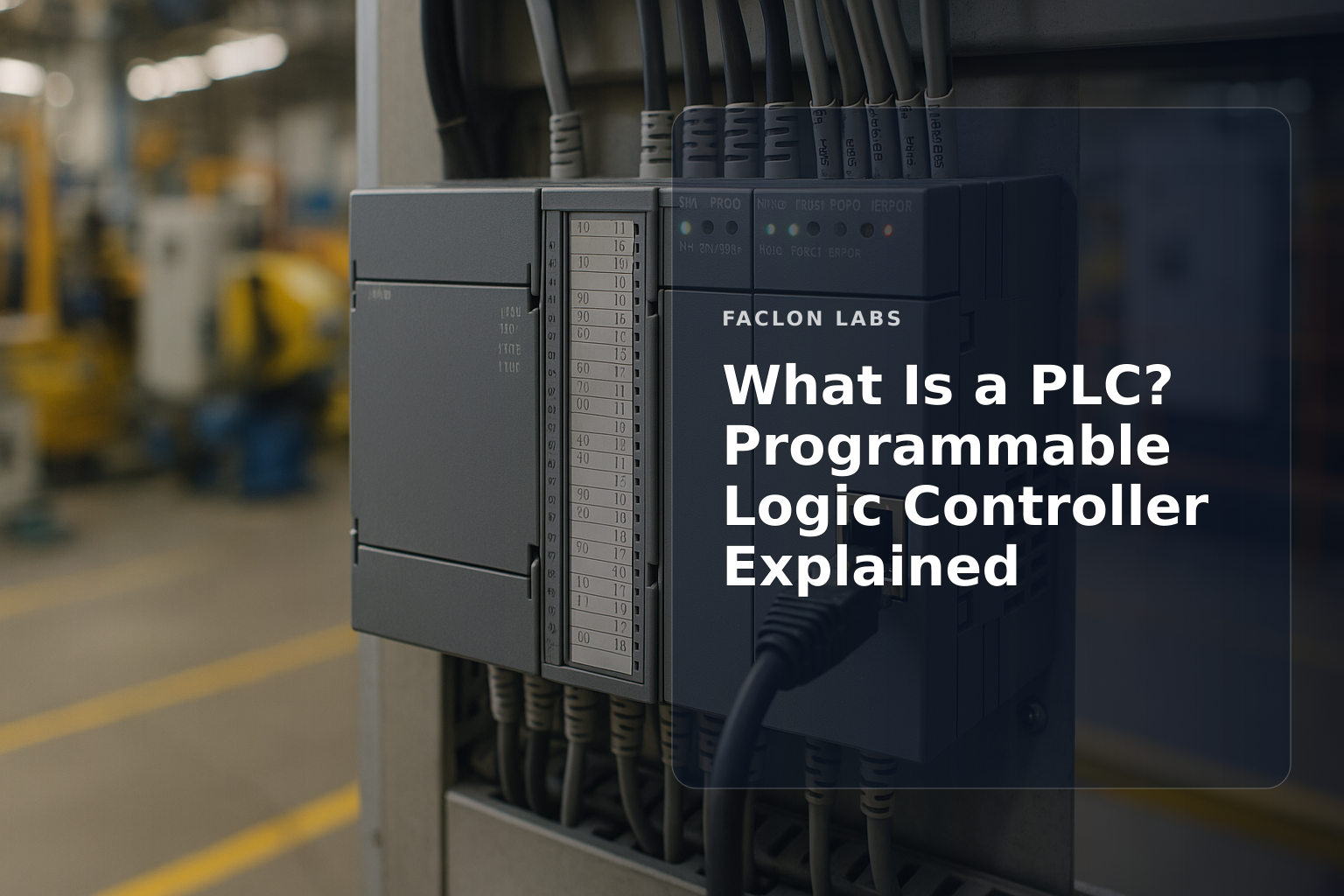
Programmable Logic Controllers (PLCs) are foundational to modern industrial automation, yet many new to manufacturing or plant operations may wonder: what exactly is a PLC? Understanding this device’s role is key to grasping how automated systems maintain efficiency, safety, and precision on the factory floor. Unlike general-purpose computers, PLCs are purpose-built for real-time control and durability in demanding environments.
This article explains the basics of PLCs, how they function, their essential components, and why they remain indispensable in industrial settings. We also clarify common confusions, such as the difference between PLCs and microcontrollers, and look at how PLCs are evolving with the rise of IIoT technologies.
A PLC is a specialized industrial computer engineered to automate electromechanical processes. It monitors inputs like sensors and switches, processes logic programmed by engineers, and controls outputs such as motors, valves, and alarms. Unlike PCs, PLCs are designed for continuous operation in harsh conditions including extreme temperatures, vibration, and electrical noise, ensuring reliable control in factories, utilities, and infrastructure [What Is a PLC Control System? A Guide to the Basics - Zuken US].
The term “programmable logic” refers to the user-defined control logic embedded in the PLC’s memory. This logic dictates how inputs are interpreted and what outputs are triggered, often represented in ladder logic diagrams or other industrial programming languages. This programmability allows the PLC to be customized for specific processes and easily updated when operations change.
PLCs are ruggedized to withstand industrial environments and operate in real time. They scan inputs, execute logic, and update outputs in milliseconds, enabling precise and immediate control. Their reliability minimizes downtime, a critical factor in production continuity.
PLCs receive input signals from a variety of field devices—temperature sensors, pressure switches, proximity detectors, push buttons, and more. These inputs provide the real-time data the PLC uses to make decisions.
The PLC’s CPU runs the user-programmed control logic. This logic can be simple (e.g., turning on a motor when a switch is pressed) or complex (e.g., coordinating multiple machines based on sensor feedback). Ladder logic is the most common programming method, resembling relay circuits for easier understanding by electricians and engineers.
Based on the logic and input states, the PLC sends commands to output devices—turning motors on or off, opening valves, activating alarms, or adjusting process parameters.
PLCs operate in a continuous scan cycle: read inputs → execute logic → update outputs → repeat. This cycle occurs dozens to hundreds of times per second, providing timely and consistent control.
| Component | Function |
|---|---|
| CPU | Executes control logic and manages operations |
| I/O Modules | Interface between PLC and physical devices |
| Power Supply | Provides stable power to the PLC system |
| Programming Device | Used to develop and upload control programs |
The CPU processes inputs, runs the control program, and manages outputs. It also handles communication with other devices and diagnostics.
Input modules receive signals from sensors; output modules send commands to actuators. Modular PLCs allow customization of I/O types and quantities.
A dedicated power supply converts and regulates voltage to the PLC components, ensuring consistent operation.
Control logic is created and modified using programming software on a PC or handheld device, then uploaded to the PLC.
| Feature | PLC | Microcontroller |
|---|---|---|
| Purpose | Industrial automation and control | Embedded systems, consumer electronics |
| Programming Complexity | Uses industrial programming languages (e.g., ladder logic) | Typically programmed in C/C++ or assembly |
| Ruggedness | Designed for harsh industrial environments | Less rugged, often requires protective housing |
| Scalability and I/O | Modular I/O for diverse sensors and actuators | Limited I/O, often fixed on chip |
PLCs are purpose-built for robust, real-time industrial control, whereas microcontrollers serve embedded applications with less demanding environmental requirements [What is a programmable logic controller (PLC)? | Control Design].
PLCs were developed in the late 1960s to replace complex relay control panels, simplifying wiring and enabling easier changes to control logic.
Today’s PLCs offer advanced networking, diagnostics, and support for multiple programming standards, enabling integration with broader automation systems.
PLCs now commonly interface with SCADA systems for supervisory control, MES for manufacturing execution, and Industrial Internet of Things (IIoT) platforms for data analytics and predictive maintenance [What is a programmable logic controller and how does it work? - CoNet].
As factories evolve into smart, connected environments, PLCs will continue to play a central role by bridging physical processes with digital intelligence [A comprehensive guide for programmable logic controllers | Newark Electronics].
If you’re starting with industrial automation, understanding PLCs is foundational. For deeper insights on integrating PLCs with IIoT platforms or optimizing plant operations through automation, explore our related resources Implementing Industrial Automation Solutions for Smart Factories, Designing Robust Industrial AI Platform Architectures, and Implementing an Industrial Operations Management Suite.
The primary function of a PLC is to automate industrial electromechanical processes. It continuously monitors inputs from sensors, executes a user-defined control program based on these inputs, and then sends commands to output devices like motors, valves, and lights to control machinery and processes in real-time.
The most common programming language for PLCs is Ladder Logic (LD), which visually resembles electrical relay circuits. Other standard languages include Structured Text (ST), Function Block Diagram (FBD), Instruction List (IL), and Sequential Function Chart (SFC), all defined by the IEC 61131-3 standard.
Yes, modern PLCs often have built-in Ethernet capabilities or can be equipped with communication modules that allow them to connect to local networks, the internet, and cloud platforms. This connectivity is crucial for IIoT applications, enabling remote monitoring, data collection, and integration with higher-level systems like SCADA, MES, and cloud-based analytics platforms.
PLCs are used across virtually all industrial sectors that require automation. This includes manufacturing (automotive, food & beverage, pharmaceuticals), process control (oil & gas, chemical, water treatment), energy, material handling, building automation, and many more due to their versatility and reliability.