Join Our Lunch & Learn: How Agentic AI Will Transform Industrial Operations | Register Now →
.svg)
September 21, 2026
5 Mins
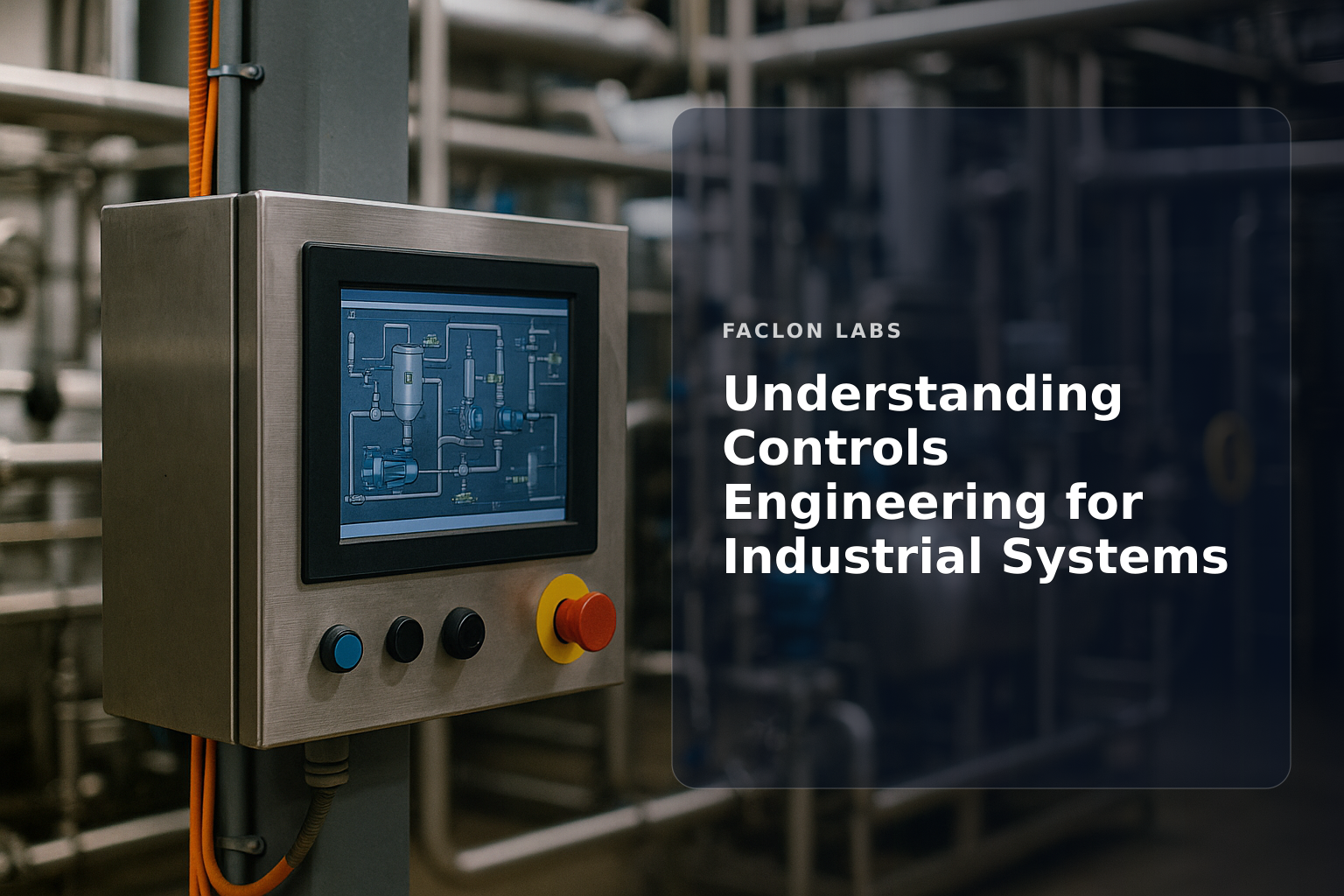
Controls engineering is a foundational element in modern industrial systems, enabling precise control over complex machinery and processes. As industries evolve toward digitalization and automation, understanding controls engineering is essential for plant operations leaders who seek to improve productivity, safety, and operational consistency. This overview explains what controls engineering entails, its components, and why it matters in today’s industrial landscape.
Controls engineering, also known as control systems engineering, is the practice of designing and managing systems that monitor and regulate industrial processes automatically. Its primary goal is to maintain desired process conditions—such as temperature, pressure, or flow—within specified limits to ensure safe and efficient operation.
Controls engineering sits at the intersection of several disciplines. It combines electrical engineering (for sensors and actuators), mechanical engineering (for physical system dynamics), and computer science (for programming and system logic). This multidisciplinary approach allows engineers to create integrated solutions that respond dynamically to changing industrial conditions.
The fundamental objectives of controls engineering are:
These goals ensure processes run reliably and meet production requirements consistently.
Historically, industrial processes were manually controlled by operators adjusting valves or switches. The introduction of automatic controllers, such as Proportional-Integral-Derivative (PID) controllers, marked the first major leap in automation. PID controllers continuously adjust outputs based on feedback to maintain process variables at target levels.
The 1970s and beyond saw the rise of Programmable Logic Controllers (PLCs), Distributed Control Systems (DCS), and Supervisory Control and Data Acquisition (SCADA) systems. PLCs provided flexible, programmable control for discrete and continuous processes. DCS offered centralized control and monitoring for complex plants, while SCADA systems enabled remote visualization and data acquisition.
Today, controls engineering integrates Industrial Internet of Things (IIoT) devices and artificial intelligence (AI) to enable predictive maintenance, real-time optimization, and autonomous operations. These technologies enhance data connectivity and decision-making capabilities, pushing control systems beyond traditional automation boundaries Designing Robust Industrial AI Platform Architectures.
Sensors measure physical parameters like temperature, pressure, flow, and vibration. These inputs provide the real-time data necessary for the control system to make informed decisions.
Controllers process sensor data and execute control algorithms to adjust actuators. Common controller types include:
Actuators convert controller signals into physical actions, such as opening a valve, starting a motor, or moving a robotic arm. They directly influence the process based on control logic.
HMIs provide operators with graphical displays to monitor and interact with the control system. SCADA extends this by offering supervisory control and data acquisition across multiple sites, enabling centralized oversight.
| Component | Function | Example Devices |
|---|---|---|
| Sensors | Measure process variables | Temperature sensors, flow meters |
| Controllers | Process data and control actuators | PLCs, DCS, industrial PCs |
| Actuators | Execute physical control actions | Valves, motors, robotic arms |
| HMIs / SCADA | Visualization and operator interface | Touchscreens, SCADA software |
Controls engineering plays a vital role in the operational success of industrial facilities by:
Controls engineers analyze process requirements and develop algorithms and system architectures to meet control objectives.
They write code and configure hardware to implement control strategies on PLCs, DCS, or industrial PCs.
Controls engineers validate system performance through rigorous testing, troubleshoot issues, and ensure reliable operation before full deployment.
Ongoing maintenance and periodic upgrades keep control systems aligned with evolving process demands and technology advancements.
Modern controls engineers incorporate AI and machine learning models to predict equipment failures and optimize control actions proactively What is Industrial Engineering and Its Role in Manufacturing?.
IIoT devices provide continuous, high-resolution data streams that enable more granular control and faster response times.
Advanced analytics and machine learning algorithms analyze historical and real-time data to anticipate process deviations and optimize control parameters dynamically.
With increased connectivity comes heightened cybersecurity risks. Controls engineers must implement robust security protocols to protect industrial control systems from cyber threats.
Controls engineering is evolving toward fully autonomous systems that self-correct and optimize without human intervention, forming the backbone of smart factories and Industry 4.0 initiatives Implementing Industrial Automation Solutions for Smart Factories.
Understanding controls engineering is fundamental for plant operations leaders aiming to optimize industrial processes. By grasping its principles and components, you can better evaluate automation strategies and technology investments that drive measurable operational improvements. For further insights on industrial automation and digital transformation, explore our resources on Implementing Industrial Automation Solutions for Smart Factories and Benefits of Automated Maintenance Services for Industrial Plants.
Control engineering is a foundational discipline focused on the theory and application of systems to regulate dynamic processes. Automation engineering is a broader field that applies control engineering principles, alongside other technologies, to design and implement automated systems, often encompassing robotics, manufacturing processes, and industrial machinery to minimize human intervention.
Essential skills for a controls engineer include a strong understanding of control theory, proficiency in programming (e.g., PLC, C++, Python), knowledge of industrial communication protocols (e.g., Modbus, OPC UA), experience with HMI/SCADA development, and a solid grasp of electrical and mechanical systems. Problem-solving, analytical thinking, and attention to detail are also crucial.
Controls engineering significantly impacts ROI by optimizing processes to reduce waste, improve energy efficiency, minimize downtime through predictive maintenance, enhance product quality, and increase throughput. By automating complex tasks, it also reduces labor costs and improves workplace safety, leading to substantial financial benefits and a competitive advantage.