Join Our Lunch & Learn: How Agentic AI Will Transform Industrial Operations | Register Now →
.svg)
September 18, 2026
6 Mins
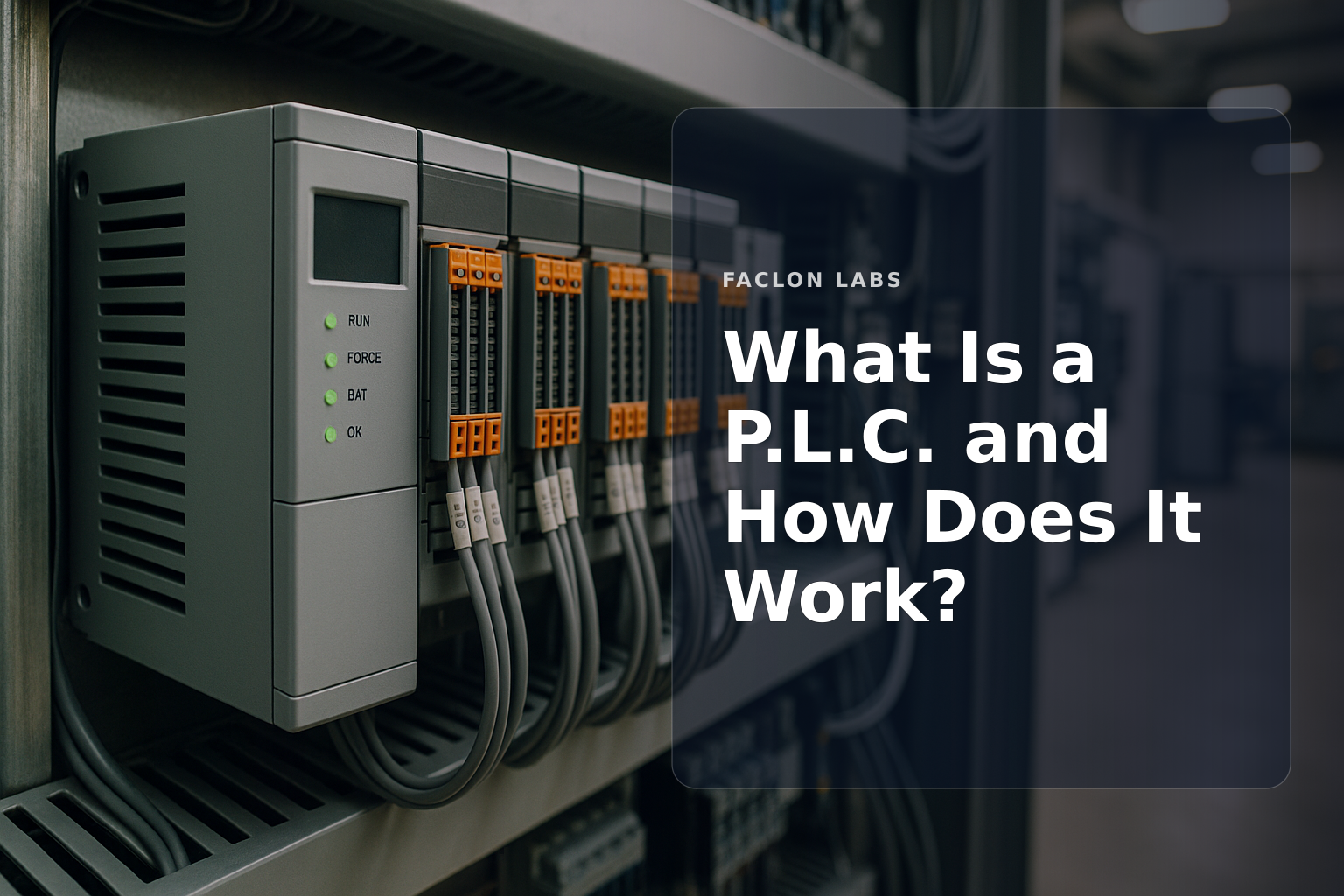
PLCs are foundational to modern industrial automation, enabling precise and reliable control of machinery and processes across manufacturing, utilities, and infrastructure. Understanding what a PLC is and how it works is essential for plant operations leaders who want to improve uptime, efficiency, and safety in their facilities. This guide breaks down the core concepts behind PLCs, their components, how they operate, and why they remain indispensable in industrial settings.
A programmable logic controller (PLC) is a specialized industrial computer designed specifically to control electromechanical processes. Unlike general-purpose computers, PLCs are built to withstand harsh conditions such as extreme temperatures, vibration, electrical noise, and dust. They continuously monitor inputs, apply logic programmed by engineers, and control outputs in real time to manage machines and processes.
Before PLCs, control systems relied heavily on relay-based logic circuits—physical switches wired to perform control functions. These were bulky, inflexible, and costly to modify. Introduced in the late 1960s, PLCs replaced relay logic by offering programmable control, reducing wiring complexity, and enabling faster changes to control logic without physical rewiring. This shift accelerated automation and improved system reliability.
PLCs are defined by their:
These features distinguish PLCs from standard computers and make them ideal for mission-critical control tasks [What is a Programmable Controller?].
A typical PLC system includes several essential components working together:
The CPU executes the control program, processes input signals, and determines output commands. It manages communication with programming devices and other systems.
Input modules interface with sensors, switches, and other field devices. They convert physical signals (digital or analog) into data the CPU can process.
Output modules control motors, valves, indicators, and other actuators by converting CPU commands into electrical signals that drive these devices.
The power supply provides stable voltage and current to the PLC’s components, ensuring uninterrupted operation even in fluctuating industrial power conditions.
This is the device or software used to write, upload, and debug the PLC’s control program. It connects to the CPU and allows engineers to modify logic as needed.
| Component | Function | Example Devices |
|---|---|---|
| CPU | Executes control logic and manages system | Allen-Bradley ControlLogix |
| Input Modules | Receive signals from sensors and switches | Digital input cards, analog input modules |
| Output Modules | Send commands to motors, valves, lights | Relay output, transistor output modules |
| Power Supply | Provides stable power | 24V DC power supply units |
| Programming Terminal | Interface for programming and debugging | Laptop with PLC programming software |
PLCs operate in a continuous scan cycle comprising three steps:
This cycle repeats rapidly, often hundreds or thousands of times per second, enabling real-time control.
Outputs can be:
Real-time processing ensures the PLC responds immediately to changing conditions, maintaining safe and efficient operation. Delays or missed signals can cause equipment damage or safety hazards, so PLCs are engineered for deterministic behavior [PLC Programming Best Practices].
Ladder Logic resembles electrical relay diagrams and is widely used due to its intuitive graphical format. It uses “rungs” representing logical conditions and outputs.
Other IEC 61131-3 standard programming languages offer different approaches:
PLCs use fundamental logic gates and functions to build control sequences:
Programming involves writing control logic, simulating or testing it in controlled conditions, and debugging errors. Good engineering practices and coding standards improve maintainability and safety [SHL-ELE-143 Guidelines for Coding PLCs].
PLCs are used across diverse industries and applications:
| Industry | Typical PLC Application |
|---|---|
| Automotive Manufacturing | Assembly line control, welding robots |
| Chemical Processing | Temperature and flow regulation |
| Food & Beverage | Batch mixing, packaging automation |
| Utilities | Water treatment, power plant monitoring |
| Building Management | HVAC, lighting, fire alarm systems |
PLCs continue to be a backbone technology for industrial automation, providing the reliability and control precision essential for modern plant operations Implementing Industrial Automation Solutions for Smart Factories What is SCADA and Its Role in Industrial Operations? Understanding Energy Consumption in Industrial Plants.
Understanding what a PLC is and how it works lays the foundation for leveraging industrial automation effectively. For plant leaders seeking to optimize operations, mastering PLC basics is a critical step toward smarter, more resilient manufacturing and process control systems.
The main function of a PLC is to automate industrial electromechanical processes. It continuously monitors inputs from sensors, executes a user-defined control program based on these inputs, and then sends corresponding output signals to control actuators like motors, valves, and lights, ensuring precise and reliable operation.
While both are computing devices, a PLC is specifically designed for industrial environments, featuring rugged construction, real-time operating systems, and specialized I/O modules for direct connection to industrial sensors and actuators. Standard computers are general-purpose, less robust, and typically not suited for direct control in harsh industrial settings.
The most common programming language for PLCs is Ladder Logic (LD), which visually resembles electrical relay circuits. Other standard languages include Structured Text (ST), Function Block Diagram (FBD), Instruction List (IL), and Sequential Function Chart (SFC), all defined by the IEC 61131-3 standard.
Yes, modern PLCs often have network communication capabilities (e.g., Ethernet/IP, Modbus TCP/IP) that allow them to connect to local networks and, with proper security measures, to the internet. This enables remote monitoring, data collection for IIoT platforms, and integration with SCADA or cloud-based systems.