Join Our Lunch & Learn: How Agentic AI Will Transform Industrial Operations | Register Now →
.svg)
September 15, 2026
5 Mins
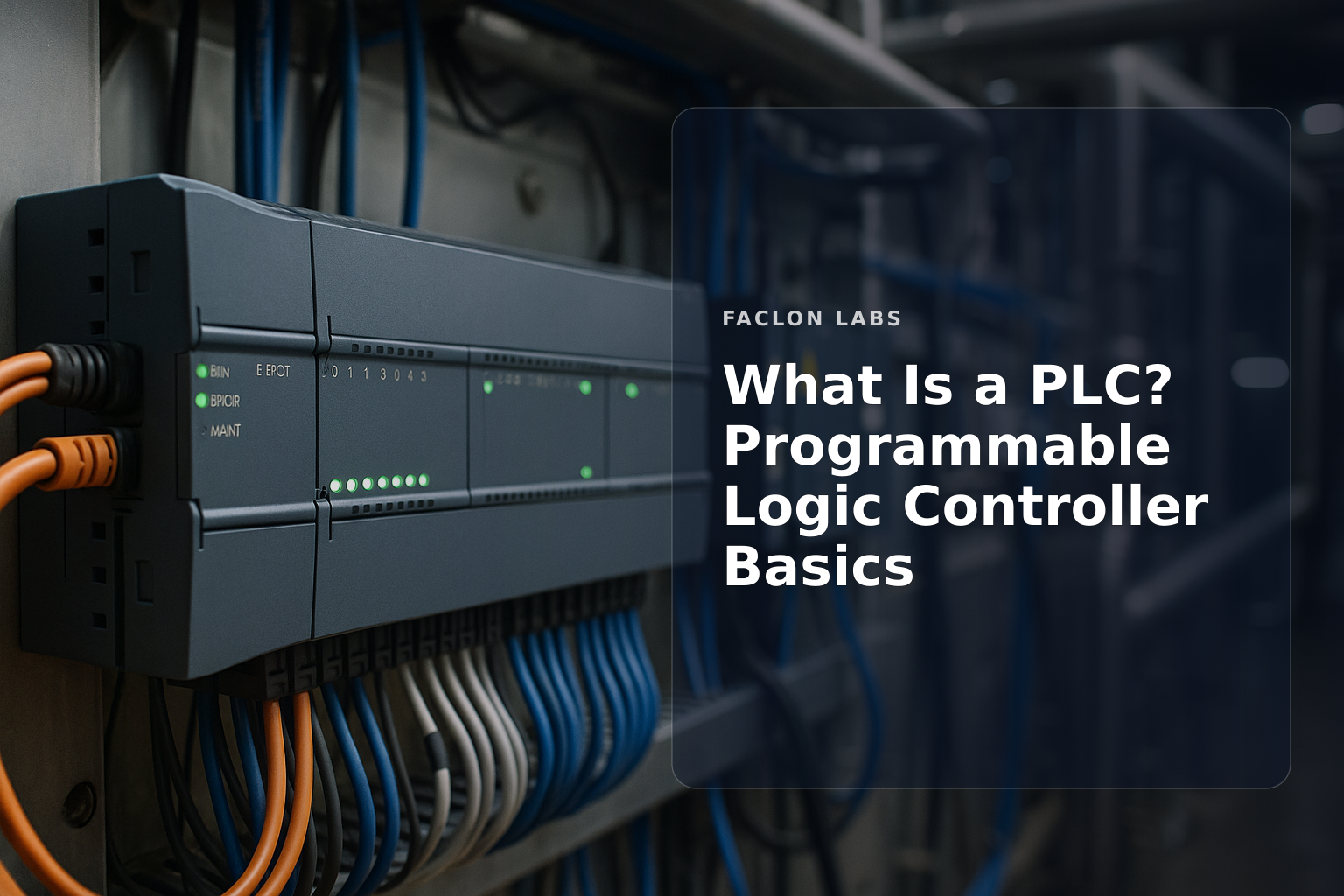
Programmable Logic Controllers (PLCs) are foundational to modern industrial automation. They enable factories and plants to operate complex machinery and processes with precision and minimal human intervention. Understanding what a PLC is and how it functions provides essential context for plant operations leaders seeking to optimize efficiency, safety, and quality.
PLCs have evolved from simple relay replacements to sophisticated control platforms that integrate with broader Industrial Internet of Things (IIoT) systems. This post breaks down the basics of PLCs, explaining their core functions, components, and applications across industries.
A PLC is a digital computer specifically engineered for industrial environments. Unlike general-purpose computers, it is designed to withstand extreme temperatures, electrical noise, vibration, and dust. Its primary function is to automate control tasks by continuously monitoring inputs and controlling outputs based on a user-defined program.
PLCs act as the central decision-makers in manufacturing and process control systems. They receive signals from sensors and switches, process these signals according to programmed logic, and then trigger actions such as starting motors, opening valves, or activating alarms. This role makes PLCs the “brain” that coordinates complex operations reliably and in real time.
Industrial settings demand equipment that can operate 24/7 without failure. PLCs are built with rugged hardware and real-time operating systems to ensure deterministic response times. Their reliability reduces downtime and maintenance costs, critical for maintaining consistent production.
PLCs operate on a repetitive cycle known as the scan cycle. This involves:
This cycle typically completes in milliseconds, enabling real-time control.
Inputs to a PLC come from various field devices such as:
Outputs are commands sent to:
PLCs are programmed using languages standardized under IEC 61131-3. The most common is ladder logic, which visually resembles electrical relay circuits and is intuitive for engineers familiar with traditional control systems. Other languages include Structured Text (ST), Function Block Diagram (FBD), and Sequential Function Charts (SFC), offering flexibility depending on complexity and application.
PLCs automate repetitive tasks with precision and speed far beyond manual operation. This automation reduces cycle times and increases throughput, directly impacting productivity and cost efficiency.
By controlling hazardous processes and machinery directly, PLCs minimize operator exposure to dangerous conditions. Automated interlocks and safety routines programmed into PLCs prevent unsafe operations, reducing accidents and errors.
PLCs maintain process consistency by enforcing exact control sequences and parameters. This leads to higher product quality and less waste. Their robust design and diagnostic features also improve equipment uptime by enabling predictive maintenance and quick fault detection.
| Component | Description | Example Functions |
|---|---|---|
| Processor (CPU) | Executes the control program and manages data flow | Runs logic, processes inputs/outputs |
| Memory | Stores the program, data, and system status | Retains control logic and historical data |
| Input Modules | Interface for receiving signals from digital or analog field devices | Converts sensor signals to CPU-readable data |
| Output Modules | Interfaces that send control signals to actuators and devices | Activates motors, valves, alarms |
| Power Supply | Provides stable voltage and current to the PLC components | Converts AC mains to required DC voltages |
| Communication Interfaces | Enables data exchange with other PLCs, HMIs, or IIoT systems | Ethernet, Modbus, Profibus protocols |
PLCs require reliable power sources and often include backup options to prevent data loss. Communication ports allow PLCs to connect with supervisory control and data acquisition (SCADA) systems, human-machine interfaces (HMIs), and IIoT platforms for centralized monitoring and control.
Modern PLCs increasingly support network connectivity and open protocols, enabling them to feed real-time operational data into IIoT platforms. This integration facilitates remote monitoring, predictive maintenance, and advanced analytics.
By collecting detailed process data from PLCs, organizations can apply machine learning and AI techniques to optimize performance, reduce energy consumption, and anticipate failures.
Traditional PLCs operated as standalone devices. Today, they are part of interconnected ecosystems where operational technology (OT) and information technology (IT) converge, driving smarter and more agile industrial operations Designing Robust Industrial AI Platform Architectures.
PLCs are versatile and widely adopted in various sectors:
| Industry | Typical PLC Application | Benefits |
|---|---|---|
| Automotive | Assembly line robotics and paint shops | Improved cycle times and quality control |
| Chemical Processing | Batch control and safety interlocks | Enhanced safety and process consistency |
| Food & Beverage | Mixing, filling, and packaging | Compliance with hygiene and quality standards |
| Utilities | Water treatment and power distribution | Reliable, continuous operation |
| Building Management | HVAC and lighting control | Energy savings and occupant comfort |
PLCs remain the backbone of industrial control systems, adaptable to new technologies and evolving operational demands Choosing the Best Gas Leak Detector for Industrial Plants.
Understanding what a PLC is and how it functions is essential for plant operations leaders aiming to leverage automation effectively. To explore how integrating PLC data with advanced analytics can enhance your operations, consider learning more about Generative AI Platforms: Capabilities, Applications, and Selection for Industrial AI.
The main purpose of a PLC is to automate industrial electromechanical processes. It continuously monitors inputs from sensors, executes a pre-programmed control logic, and then controls outputs to actuators, ensuring precise, repeatable, and reliable operation of machinery and systems without human intervention.
While both are computers, a PLC is specifically designed for industrial environments, featuring rugged construction, real-time operating systems, and specialized I/O modules for direct control of machinery. Standard computers are general-purpose, less robust, and typically not suited for direct, real-time industrial control due to their operating system latency and lack of industrial I/O.
The most common programming language for PLCs is Ladder Logic (LD), which visually resembles electrical relay logic diagrams. However, modern PLCs also support other languages defined by the IEC 61131-3 standard, including Function Block Diagram (FBD), Structured Text (ST), Instruction List (IL), and Sequential Function Chart (SFC).
Yes, many modern PLCs are equipped with Ethernet ports and communication protocols (like Modbus TCP/IP or OPC UA) that allow them to connect to local networks and, with proper security measures, to the internet. This connectivity is crucial for IIoT integration, enabling remote monitoring, data logging, and integration with higher-level systems like SCADA or MES.