Join Our Lunch & Learn: How Agentic AI Will Transform Industrial Operations | Register Now →
.svg)
September 18, 2026
5 Mins
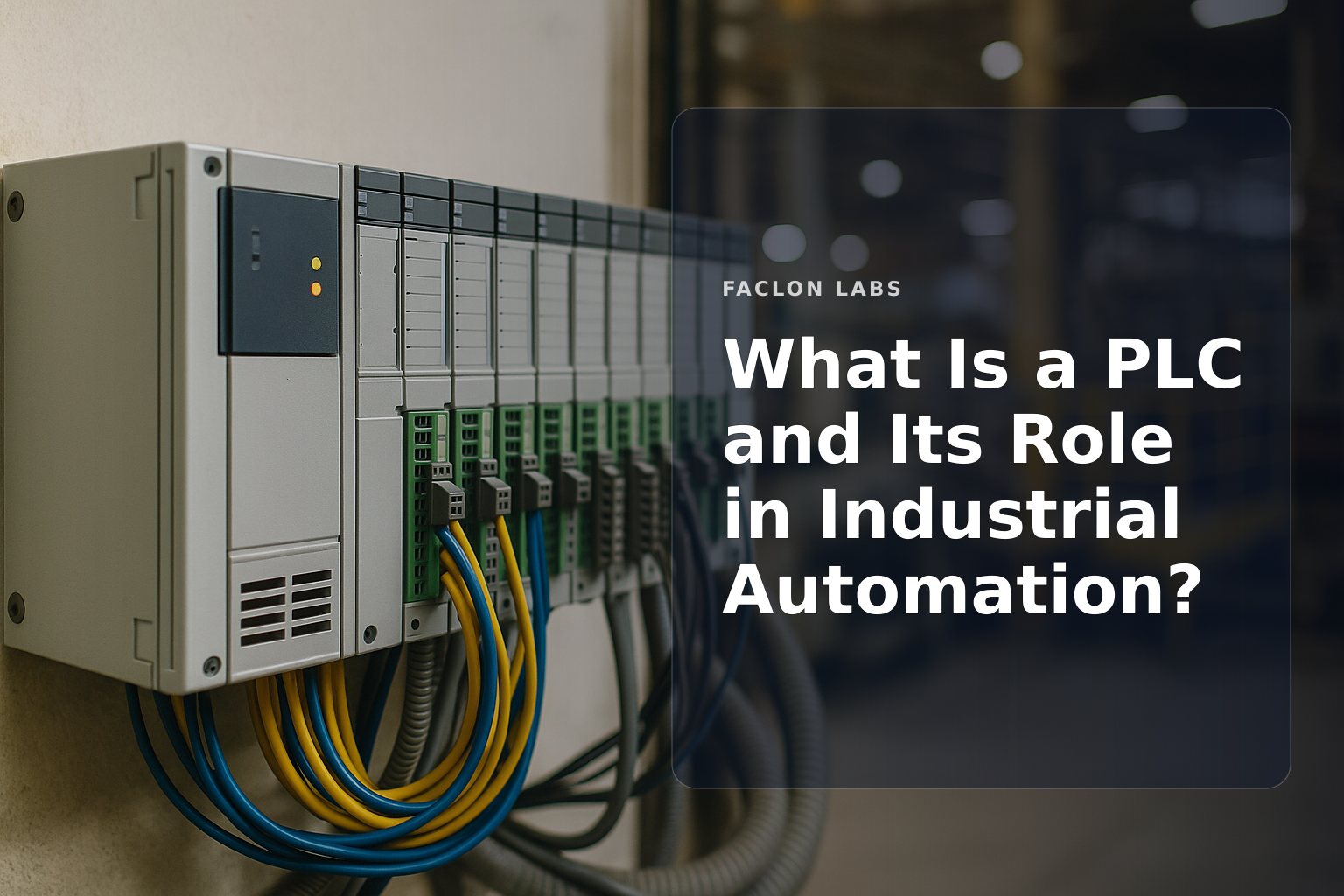
Industrial automation relies heavily on precise, reliable control systems to maintain efficient and safe operations. Among these systems, the Programmable Logic Controller (PLC) stands out as a fundamental technology that has evolved from simple relay-based controls to sophisticated digital computers. Understanding what a PLC is and how it functions provides essential insight into modern manufacturing and process automation.
PLCs serve as the backbone of automated control in factories, utilities, and other industrial settings. They coordinate complex machinery and processes by continuously monitoring sensors and executing programmed instructions, enabling plants to operate with minimal human intervention while maintaining high standards of safety and efficiency.
A PLC is a specialized industrial computer designed to control manufacturing processes or machinery. Unlike general-purpose computers, PLCs are built to operate reliably in harsh industrial environments with exposure to dust, moisture, temperature extremes, and electrical noise.
PLCs are ruggedized for durability and designed for real-time operation. They continuously scan inputs, execute control logic, and update outputs in milliseconds to seconds, ensuring timely responses to changing process conditions. Reliability and fail-safe behavior are critical, as PLC failures can halt production or create hazardous situations.
Originally, industrial automation used relay logic—physical relays wired to perform control sequences. PLCs emerged in the late 1960s to replace these bulky, inflexible relay panels with programmable software logic, greatly enhancing flexibility, scalability, and maintainability. This evolution laid the foundation for modern automated manufacturing.
The CPU is the brain of the PLC. It reads input signals, processes the control program, and sends commands to output devices. It manages timing, communication, and error diagnostics.
I/O modules interface the PLC with the physical world. Digital inputs/outputs handle discrete signals (e.g., switches, relays), while analog modules manage continuous signals (e.g., temperature, pressure). Special modules can include communication or motion control interfaces.
Program memory stores the user-written control logic. Data memory holds real-time process variables and system status information.
PLCs include power supplies to convert plant voltage to the required internal levels. Communication ports enable connectivity with Human-Machine Interfaces (HMIs), SCADA systems, and other industrial networks.
| Component | Function | Example Devices |
|---|---|---|
| CPU | Executes control logic and manages operations | Allen-Bradley, Siemens S7 CPUs |
| Digital I/O | Interfaces with on/off signals | Pushbuttons, solenoids |
| Analog I/O | Interfaces with variable signals | Temperature sensors, flow meters |
| Memory | Stores program and operational data | Flash, RAM |
| Power Supply | Provides stable power to PLC components | 24V DC power modules |
| Communication | Connects PLC to networks and supervisory systems | Ethernet, Modbus, Profibus modules |
PLCs operate in a continuous loop called the scan cycle:
This cycle repeats many times per second, allowing real-time control.
PLCs are programmed using standardized languages such as:
For example, a PLC controlling a conveyor belt might:
This simple control loop ensures safe and efficient material handling.
PLCs automate repetitive tasks with exact timing and consistency, reducing variability and increasing throughput.
Safety functions such as interlocks, emergency stops, and fail-safe shutdowns are programmed into PLCs to protect personnel and equipment.
Automated control minimizes manual interventions, lowering the risk of mistakes and reducing labor costs.
PLCs commonly interface with supervisory systems to provide operators with real-time process data and control capabilities, enabling centralized monitoring and decision-making What is SCADA and Its Role in Industrial Operations?.
| Control System | Typical Use Case | Strengths | Limitations |
|---|---|---|---|
| PLC | Discrete control, machinery | Rugged, real-time, easy programming | Limited for complex process control |
| Distributed Control System (DCS) | Continuous process industries | High-level process control, redundancy | Higher cost, complex configuration |
| Industrial PC (IPC) | Data-intensive or complex automation | High processing power, flexible OS | Less rugged, higher maintenance |
PLCs are optimized for discrete and sequential control tasks, while DCSs excel in continuous processes. Industrial PCs offer advanced computing but may lack PLC-grade reliability. Increasingly, PLCs integrate with IIoT and edge computing platforms to enhance data-driven operations Essential Tools for Data Analytics in Smart Manufacturing.
Understanding PLCs is foundational for plant operations leaders aiming to optimize industrial automation. For deeper insights on integrating PLCs with modern IIoT platforms and enhancing operational intelligence, explore our related resources and technical guides.
The main purpose of a PLC (Programmable Logic Controller) is to automate industrial electromechanical processes by continuously monitoring input devices and making decisions based on its programmed logic to control output devices. This ensures efficient, reliable, and safe operation of machinery and systems in manufacturing and other industrial settings.
PLCs are used across a vast range of industrial applications, including factory automation (assembly lines, packaging, material handling), process control (chemical plants, oil & gas, water treatment), building automation, energy management, and even in amusement park rides. Essentially, any system requiring precise, repeatable control of machinery can benefit from a PLC.
PLC programming, particularly using Ladder Logic, is often considered relatively intuitive for those familiar with electrical schematics and relay logic, as it visually represents control circuits. While mastering advanced functions and different programming languages requires practice and understanding of control theory, basic PLC programming is accessible to learn for technicians and engineers.
PLCs connect to other systems like SCADA (Supervisory Control and Data Acquisition) or HMI (Human Machine Interface) via various industrial communication protocols such as Ethernet/IP, Modbus TCP/IP, Profinet, or OPC UA. These connections allow for centralized monitoring, data logging, alarm management, and remote control of the PLC-controlled processes, providing a comprehensive view of plant operations.